7 Proven Benefits of MEWP Operator Training in UAE for Teams
Why Trained MEWP Operators Matter to Your Business
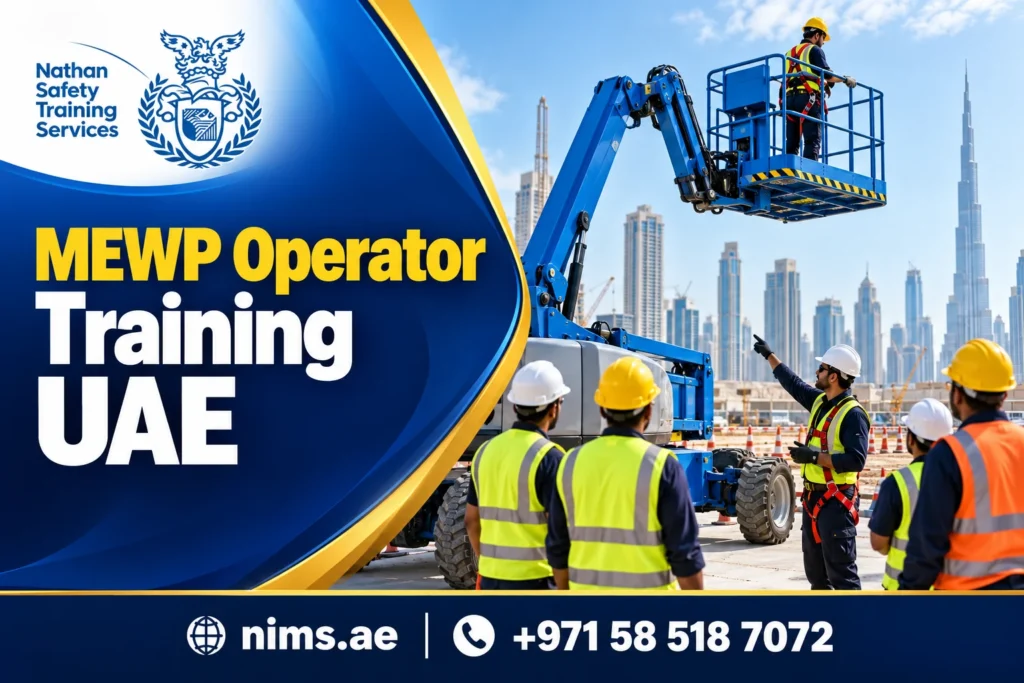
MEWP Operator Training UAE helps companies turn their workers into safe, confident scissor-lift and boom-lift operators. This guide explains the 7 proven benefits your business gets when you train your team and how NIMS delivers that training for companies across the UAE.
If your crew works on a mobile elevating work platform every day, one wrong move at height can stop a project. It can also injure a worker and damage your name with clients.
Quick answer: trained MEWP operators reduce incidents, help you meet authority and client safety rules, protect costly equipment, and keep your projects on schedule.
This guide is written for HR managers, HSE managers, project managers, and procurement teams who need trained, certified operators on site.
What Is MEWP Operator Training?
MEWP operator training teaches workers how to inspect, set up, drive, and position an elevated platform safely. It also teaches them how to bring everyone down safely if something goes wrong.
On UAE sites, you will hear these machines called manlifts, cherry pickers, or aerial work platforms (AWPs). The main types are:
- Scissor lifts: straight vertical access for indoor maintenance, fit-out, and high-bay work
- Articulating boom lifts: “up and over” reach around obstacles
- Telescopic boom lifts: long, straight outreach for facades and large structures
Most companies need both scissor lift training for indoor jobs and boom lift training for outdoor and high-reach work.
A good course covers:
- A full pre-use inspection of controls, tyres, hydraulics, guardrails, and emergency systems
- Platform capacity, safe working load, and reading the load chart
- Wind limits and ground conditions such as slopes, soft soil, and potholes
- Exclusion zones, barricading, and working with a spotter or banksman
- Overhead hazards, including power lines and structures
- Ground controls and emergency lowering
For full course details, see the NIMS MEWP Operator Training page.
Why UAE Companies Are Making MEWP Training a Priority
MEWPs are now standard equipment on UAE projects. You see them in malls, high-rise towers, warehouses, airports, ports, and industrial plants.
Demand for MEWP training in Dubai is growing in areas like Business Bay, Dubai Marina, Jebel Ali, and Dubai South. Demand for MEWP training in Abu Dhabi is also strong in Mussafah, KIZAD, and Ruwais.
Here is why companies are acting now:
- Authority rules: industry sources note that Dubai Municipality guideline TG GU67 expects MEWP operators to be trained to the ISO 18878 standard. Abu Dhabi sites follow OSHAD requirements.
- Client demands: main contractors and facility owners often ask for training certificates before workers get site access.
- Permit-to-work systems: many sites will not issue a work-at-height permit to an untrained operator.
- Audits and insurance: written training records make HSE audits and insurance reviews much easier.
MEWP training also fits well with your wider working at height training plan, since both cover fall risks, harness use, and rescue.
Tip: always confirm the exact certificate your client or authority asks for before you book.
7 Powerful Benefits of a KHDA Certified HSE Trainer for Your Team
Each benefit below links training directly to results your business can measure: fewer incidents, smoother audits, less downtime, and stronger client trust.
1. Fewer Accidents and Near Misses at Height
Most MEWP incidents start with small mistakes. Common causes include:
- Tip-overs on soft ground or slopes
- Workers trapped or crushed against overhead structures
- Contact with live power lines
- Falls from the platform
- Collisions with people or vehicles at ground level
Trained operators check the ground, set up exclusion zones, and watch for overhead hazards before they go up. That means fewer injuries, fewer lost-time incidents, and fewer stop-work orders.
2. Easier Compliance and Smoother Client Audits
When auditors or clients ask for proof, you need clear records. A recognized MEWP certification UAE gives you certificates and training records for every operator.
This helps you:
- Pass HSE audits and client inspections
- Meet pre-qualification needs in tenders
- Show due diligence if an incident is investigated
3. Faster Site Access and Fewer Project Delays
Many main contractors stop untrained operators at the gate. A certified crew can start work quickly, without waiting for last-minute training. Your project stays on schedule, and you avoid penalties for delays.
4. Lower Equipment Damage and Repair Costs
MEWPs are expensive to buy or rent. Poor handling leads to damaged booms, broken guardrails, and hydraulic faults.
Trained operators:
- Never load the platform beyond its rated capacity
- Use smooth, controlled movements
- Report defects early instead of working with them
The result is less downtime and fewer damage charges from rental companies.
5. One Safe Standard Across All Your Sites
If your crews work in Dubai, Sharjah, and Abu Dhabi, each team may follow different habits. Group-based corporate MEWP training gives every operator the same checklist, the same rules, and the same emergency steps. Supervisors can then manage all sites the same way.
6. More Productive and Confident Operators
Confident operators work faster and make fewer errors. Through structured manlift operator training, they learn to pick the right machine for each job. They also learn to position it correctly the first time. That means less rework and more tasks completed per shift.
7. A Stronger Safety Culture and Better Reputation
When you invest in your people, it shows. Workers feel valued and take safety more seriously. Clients see a contractor they can trust, which can help you win repeat work and score better in tenders.
Which Industries and Roles Need MEWP Training?
Any company that uses scissor lifts or boom lifts, even once a week, should train its operators.
Industries that rely on MEWPs every day:
- Construction, fit-out, and construction safety projects
- Facility management and building maintenance
- Warehousing and logistics
- Oil and gas and industrial plants
- Manufacturing
- Airports and aviation infrastructure
- Events and exhibitions
- Malls, retail centers, and high-rise buildings
Roles to include in your training plan:
- MEWP and manlift operators
- Electricians and MEP technicians
- Maintenance and FM technicians
- Warehouse staff who work at height
- Supervisors, spotters, and ground crew who manage MEWP work
How NIMS Delivers MEWP Training for Your Company
NIMS makes it simple to get your whole team trained and certified. Here is how MEWP Operator Training UAE works for companies:
- Share your needs: tell NIMS how many workers need training, which machines they use, and what your client or site requires.
- Training plan: NIMS checks your team’s experience and suggests new-operator or refresher training.
- Schedule: batches are planned around your shifts and project dates.
- Theory and practice: operators learn inspections, controls, safe positioning, and emergency lowering through real work scenarios.
- Assessment: each operator is checked on knowledge and practical skills.
- Certificates and records: you receive training records ready for your HSE files and client audits.
- Ongoing support: NIMS can also help with refreshers, other HSE courses, and HSE manpower supply if you need safety officers on site.
Why Companies Choose NIMS for MEWP Training
As a trusted MEWP training provider Dubai companies rely on, NIMS focuses on practical skills that work on real UAE sites.
- Practical, trainer-led learning: real operating scenarios and hands-on control, not just slides
- Experienced trainers who come from the relevant industries
- Site-ready habits: permit-to-work awareness, toolbox talks, barricading, and banksman coordination
- Recognized quality: NIMS holds ISO 9001, ISO 14001, and ISO 45001 certifications and works with awarding bodies such as IOSH, NEBOSH, and IEMA across its HSE courses
- Proven clients: companies like Al Habtoor, Saipem, Daikin, TK Elevator, and Khidmah have worked with NIMS
- UAE-wide coverage: Dubai, Abu Dhabi, Sharjah, Ajman, Ras Al Khaimah, Fujairah, and Umm Al Quwain
- One partner for training and safety staff: NIMS supplies HSE manpower as well as training
Clients such as the Gargash Group have said their employees found the NIMS training practical and could use it on site right away.
Frequently Asked Questions
What is MEWP Operator Training UAE?
It is a practical course that teaches workers to inspect, operate, and position scissor lifts and boom lifts safely on UAE sites. It also covers emergency lowering and rescue basics.
Is MEWP training mandatory in the UAE?
Industry sources note that Dubai Municipality guidance expects trained MEWP operators, and most main contractors require proof of training before site access. Always check what your authority and client ask for.
How long does the training take?
Most MEWP operator courses can be completed in about one day. The exact time depends on your team’s experience and the machines covered.
What is the difference between new-operator and refresher training?
New-operator training is for workers with little or no MEWP experience. MEWP refresher training is for experienced operators who need to update their skills and renew their records.
Can NIMS train a large group from one company?
Yes. NIMS trains company teams in planned batches. To ask about on-site MEWP training at your location, contact the NIMS team with your group size and site details.
Which machines are covered?
The training covers scissor lifts, articulating boom lifts, and telescopic boom lifts.
My client asks for IPAF. What should I do?
IPAF is an international MEWP training scheme. If your client asks for a specific card or certificate, mention it when you contact NIMS so the team can advise you on the right course.
Book MEWP Operator Training for Your Team Today
Every untrained operator is a risk to your people, your equipment, and your project timeline. Train your team with NIMS and give your clients certified operators they can trust.
When you contact NIMS, share:
- The number of workers who need training
- The machines they use (scissor lift, articulating boom, or telescopic boom)
- Your site location and preferred dates
- Any certificate your client or authority requires