

Home / Flagman Safety
Flagman Safety
Flagman and Traffic Marshal Training UAE — Positioning, Signals and RTA-Aligned Certification
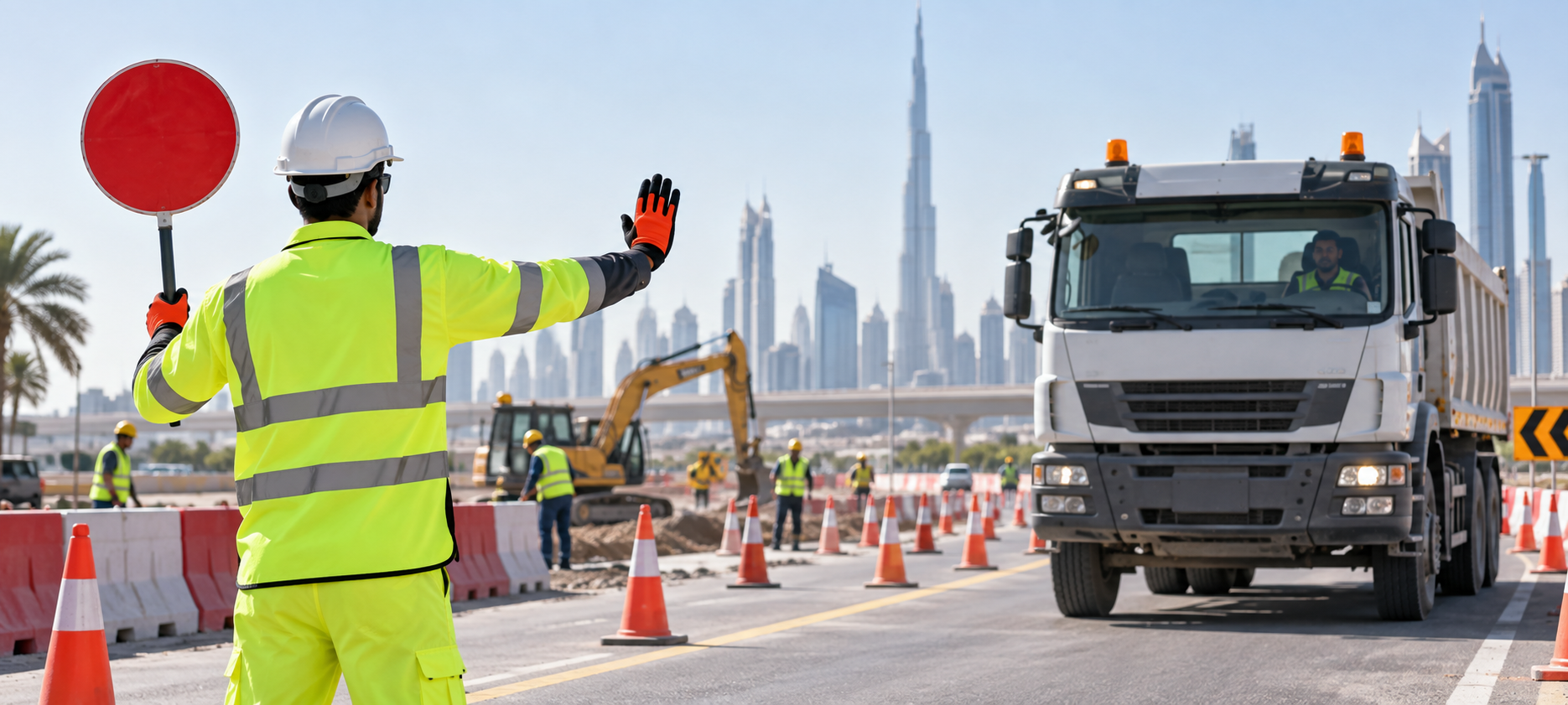
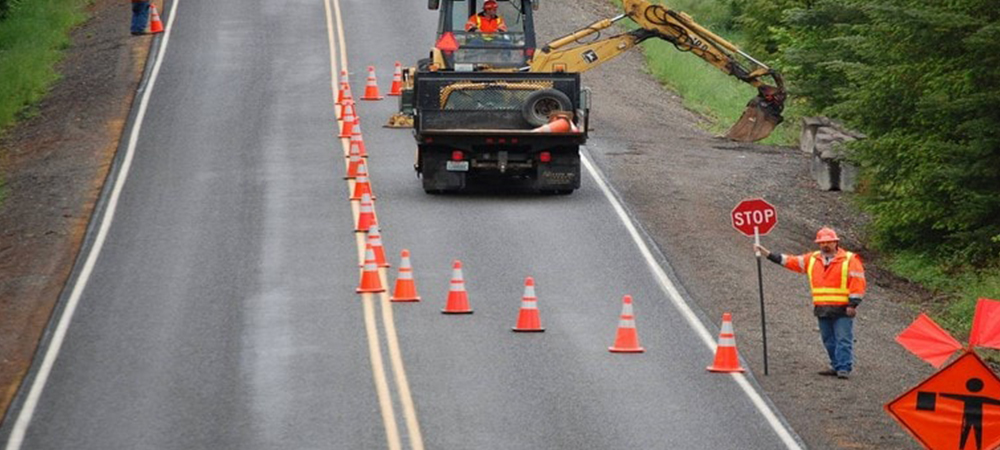
A flagman standing in a driver’s blind spot is not directing traffic — he’s standing in the path of it. The role looks simple from outside a moving vehicle: stand there, wave, stop the cars. Done properly it’s a discipline of positioning, visibility and unambiguous signalling that a driver can react to safely at speed. Done badly, the flagman is the hazard he was posted to prevent.
Nathan Safety Training (NIMS) certifies flagmen and traffic marshals across UAE road, utility and construction projects, built around RTA-recognised signalling standards and the positioning judgement that keeps the person holding the sign out of the vehicle’s actual path.
Why Positioning Is the Real Skill, Not the Hand Signal
Road and site traffic control in Dubai sits under the Roads and Transport Authority (RTA) for public roads, and under Dubai Municipality or the relevant developer’s HSE framework for internal site traffic. Both expect a documented traffic management plan for any works affecting vehicle movement — not an improvised arrangement decided on site the morning work starts. The flagman is the human execution of that plan, and the plan is only as good as whether the flagman is actually visible, correctly positioned, and using signals every driver on that road will recognise the same way.
This distinguishes a properly trained flagman from someone handed a stop/go sign with no briefing: the training is as much about where to stand and how to be seen as it is about the signal itself.
RTA permit conditions for public road works commonly specify a minimum number of certified traffic controllers relative to closure length, though the exact figure varies by project and road classification — which is why we recommend checking the specific condition on your permit rather than assuming a blanket ratio applies everywhere.
The Job With No Margin for a Bad Guess
A flagman’s mistakes don’t happen in slow motion. A driver approaching at speed reacts to what they see in a fraction of a second, which means a badly positioned or ambiguous signal doesn’t get a second chance to be corrected — it either works or it doesn’t, in real time, with a vehicle already in motion.
The cost of getting it wrong extends well past the individual incident. A road works project involved in a traffic incident faces permit review, potential suspension of the works order, and a harder path to approval on the next project — on top of whatever happened to the people involved.
Who This Course Is For
Anyone whose job puts them between a road and moving traffic, on public roads or inside a site perimeter.
- Road and infrastructure construction crews
- Utility contractors carrying out excavation or maintenance on or near carriageways
- Logistics and yard operations managing vehicle and pedestrian conflict points
- Event companies managing temporary road closures and diversions
- Facilities and security teams directing traffic at site entrances and loading bays
Road Conditions Change Across the Seven Emirates
Road works volume and driving conditions differ enough by emirate that positioning judgement needs local calibration. We deliver onsite across all seven:
- Dubai — RTA-regulated works on high-speed arterial roads like Sheikh Zayed Road demand the sharpest positioning discipline in the country, given both traffic volume and vehicle speed
- Abu Dhabi — Corniche-area works and Western Region highway projects both fall under this course, but the desert highway environment calls for very different visibility judgement than a dense urban road
- Sharjah — the Sharjah–Dubai commuter corridor carries some of the heaviest cross-emirate traffic volume anywhere in the UAE, particularly during peak hours
- Ajman — a growing road infrastructure programme is bringing more temporary works, and with it, more first-time flagman deployments that benefit from proper positioning training
- Ras Al Khaimah — mountain road works near Jebel Jais introduce gradient and sightline challenges a flat urban road never presents
- Fujairah — the E99 mountain pass and routes connecting to the Gulf of Oman coast carry blind-curve risk that changes how a flagman needs to be positioned
- Umm Al Quwain — quieter roads overall, but any works affecting a public road still require the same RTA-aligned control as a Dubai highway project
Road Conditions Change Across the Seven Emirates
Road works volume and driving conditions differ enough by emirate that positioning judgement needs local calibration. We deliver onsite across all seven:
- Dubai — RTA-regulated works on high-speed arterial roads like Sheikh Zayed Road demand the sharpest positioning discipline in the country, given both traffic volume and vehicle speed
- Abu Dhabi — Corniche-area works and Western Region highway projects both fall under this course, but the desert highway environment calls for very different visibility judgement than a dense urban road
- Sharjah — the Sharjah–Dubai commuter corridor carries some of the heaviest cross-emirate traffic volume anywhere in the UAE, particularly during peak hours
- Ajman — a growing road infrastructure programme is bringing more temporary works, and with it, more first-time flagman deployments that benefit from proper positioning training
- Ras Al Khaimah — mountain road works near Jebel Jais introduce gradient and sightline challenges a flat urban road never presents
- Fujairah — the E99 mountain pass and routes connecting to the Gulf of Oman coast carry blind-curve risk that changes how a flagman needs to be positioned
- Umm Al Quwain — quieter roads overall, but any works affecting a public road still require the same RTA-aligned control as a Dubai highway project
What the Course Covers
Module | Focus |
Standard hand signals | Stop, proceed, slow, direction change — unambiguous, RTA-recognised |
Positioning and visibility | Blind spot awareness, safe standing distance, sightline to approaching traffic |
PPE and night visibility | High-visibility clothing standards, illuminated signage for low-light work |
Traffic management plans | Reading and following an approved plan, not improvising on site |
Communication with site supervision | Radio protocol, escalation if traffic conditions change unexpectedly |
What Post-Incident Reviews Keep Finding
The incidents we get called in to review afterwards almost never involve an unclear signal. They involve positioning.
Positioning is the one judgement call I’d never leave a new flagman to make alone on day one — pair them with an experienced colleague until it’s instinctive, not just understood.
- Flagmen positioned in a driver’s blind spot, especially around large vehicles and reversing plant
- No traffic management plan reviewed before deployment — positioning decided informally on the day
- High-visibility clothing that meets daytime standards but isn’t rated for night or low-light conditions
- No communication link back to site supervision if traffic volume or conditions change mid-shift
- Flagmen swapped between roles without dedicated signalling refresher, signals becoming inconsistent between shifts
What Our Flagman Programme Covers That Others Skip
We built this course around positioning judgement first and signalling second, because positioning is where we see experienced flagmen get complacent, not signal recall.
Sites already working with Nathan ISO Consulting on a wider construction safety management system can fold flagman certification directly into that documentation, since both sit inside the same group rather than requiring separate audits.
- Signalling standards aligned to RTA expectations for public road works
- Positioning and blind-spot training conducted with actual vehicles and plant, not diagrams alone
- Night and low-visibility work covered as a distinct module, not an afterthought
- Onsite delivery so training happens against your actual road layout or site entrance
- Refresher packages scheduled to keep signalling consistent across rotating crews
Courses Offered
- First Aid Course - CPR and AED
- Confined Space
- Fire Safety Awareness
- Scaffolding Inspection
- Scaffolding Erection & Dismantling
- Flagman Safety
- Chemical Safety and Handling Training
- Hazard and Risk Assessment
- Rigging and Slinging Training
- Traffic Safety
- Hand and Power Tools Operator
- Electrical Safety
- Lock Out and Tag Out (LOTO)
- Accident Incident Investigation
- Lifeguard Training
- Advanced Risk Assessment & Compliance Service
- Behavior-Based Safety Workplace Safety Consulting
- Construction Site Safety Induction Training
- Emergency Response Team Training
- Excavator Operator Training
- Forklift Operator Training
- H2S Awareness & Breathing Apparatus Training
- Hot Work Safety Training
- Incident Reporting & Root Cause Analysis Service
- MEWP Operator Training
- Mobile Crane Operator Training
- Permit to Work System Training
- Rope Access Training
- Working at Height & Fall Protection Safety Training
- Oil & Gas Safety Training
- Fire Warden Training
- Manual Handling Training
- Banksman Safety Training
- Gas Tester Training
- Defensive Driving Training
- HAZMAT Awareness Training
- Machine Safety and Machine Guarding Training
- Spill Response and Spill Control Training
- Welding Safety Training
Need expert advice? Speak to our team today
FAQ
Is flagman certification required for road works in the UAE?
For works affecting public roads, RTA-aligned traffic management arrangements including trained personnel directing traffic are standard practice and typically a condition of the road works permit itself, not optional site discretion.
What's the difference between a flagman and a traffic marshal?
In practice the terms are often used interchangeably in the UAE. Where a distinction is drawn, a flagman typically controls a single point of traffic flow, while a traffic marshal may have broader responsibility across a site entrance or multiple traffic conflict points, sometimes with radio coordination duties.
Do you train on RTA-specific signalling standards?
Yes, our hand signals and positioning guidance are built to align with what RTA and Dubai Municipality expect to see on public road works, so signals are consistent with what drivers are used to seeing across the emirate.
How long does flagman certification last?
We recommend refresher training annually, or sooner if a flagman moves between very different site types — public road works and internal yard traffic management involve different judgement calls despite using similar signals.
Does the course cover night shift work?
Yes, as a distinct module. Visibility requirements, illuminated signage and positioning judgement all change substantially after dark, and a flagman trained only for daytime conditions is under-prepared for a night shift.
What PPE is required for this role?
High-visibility clothing meeting the relevant class for the work environment, and for night work, additional reflective or illuminated elements. We cover what’s appropriate for your specific site type as part of the course.
Can this be combined with general traffic safety or defensive driving training?
Yes, particularly for logistics and yard operations where staff may rotate between driving duties and traffic control duties. See our separate Traffic Safety course for the driver-focused side of this.
Is this course suitable for event traffic management?
Yes, with specific attention to temporary road closures, diversions and the higher volume of unfamiliar drivers events tend to bring compared to a routine construction site.
Do you provide the traffic management plan, or only the flagman training?
Our core course trains the individual flagman against an existing or provided traffic management plan. We can support development of the traffic management plan itself as a separate scope if you don’t already have one in place.
How many flagmen does a typical site need?
It depends on the number of active traffic conflict points, sightline distances and vehicle speed on the approach — a single-point site entrance is very different from a multi-lane road closure. We help size this during course scoping.
Do mountain road works in RAK or Fujairah need different flagman training than a flat Dubai road?
Yes — gradient, blind curves and reduced sightlines around Jebel Jais or the E99 mountain pass change positioning judgement meaningfully compared with a flat, straight urban road, and we cover this as a distinct scenario for crews working those routes.
How long does flagman certification take?
Our core course runs one day, combining classroom signalling standards with hands-on positioning practice against moving vehicles, so certification is ready before the next shift if booked with reasonable notice.
Is this course suitable for security guards asked to direct traffic occasionally?
Yes, and we’d recommend it specifically — security staff are often asked to manage vehicle access without ever receiving dedicated positioning or signalling training, which is exactly the gap this course closes.
Is 'flagman' the same as 'traffic marshal' or 'banksman'?
Flagman and traffic marshal are generally used interchangeably in the UAE for someone controlling vehicle movement with signals. Banksman usually refers specifically to directing a reversing vehicle or a crane lift at close range rather than general road traffic — related skills, but we treat them as distinct scenarios within the course.
- First Aid Course - CPR and AED
- Confined Space
- Fire Safety Awareness
- Scaffolding Inspection
- Scaffolding Erection & Dismantling
- Flagman Safety
- Chemical Safety and Handling Training
- Hazard and Risk Assessment
- Rigging and Slinging Training
- Traffic Safety
- Hand and Power Tools Operator
- Electrical Safety
- Lock Out and Tag Out (LOTO)
- Accident Incident Investigation
- Lifeguard Training
- Advanced Risk Assessment & Compliance Service
- Behavior-Based Safety Workplace Safety Consulting
- Construction Site Safety Induction Training
- Emergency Response Team Training
- Excavator Operator Training
- Forklift Operator Training
- H2S Awareness & Breathing Apparatus Training
- Hot Work Safety Training
- Incident Reporting & Root Cause Analysis Service
- MEWP Operator Training
- Mobile Crane Operator Training
- Permit to Work System Training
- Rope Access Training
- Working at Height & Fall Protection Safety Training
Flagman and Traffic Marshal Training UAE — Positioning, Signals and RTA-Aligned Certification
A flagman standing in a driver’s blind spot is not directing traffic — he’s standing in the path of it. The role looks simple from outside a moving vehicle: stand there, wave, stop the cars. Done properly it’s a discipline of positioning, visibility and unambiguous signalling that a driver can react to safely at speed. Done badly, the flagman is the hazard he was posted to prevent.
Nathan Safety Training (NIMS) certifies flagmen and traffic marshals across UAE road, utility and construction projects, built around RTA-recognised signalling standards and the positioning judgement that keeps the person holding the sign out of the vehicle’s actual path.
Why Positioning Is the Real Skill, Not the Hand Signal
Road and site traffic control in Dubai sits under the Roads and Transport Authority (RTA) for public roads, and under Dubai Municipality or the relevant developer’s HSE framework for internal site traffic. Both expect a documented traffic management plan for any works affecting vehicle movement — not an improvised arrangement decided on site the morning work starts. The flagman is the human execution of that plan, and the plan is only as good as whether the flagman is actually visible, correctly positioned, and using signals every driver on that road will recognise the same way.
This distinguishes a properly trained flagman from someone handed a stop/go sign with no briefing: the training is as much about where to stand and how to be seen as it is about the signal itself.
RTA permit conditions for public road works commonly specify a minimum number of certified traffic controllers relative to closure length, though the exact figure varies by project and road classification — which is why we recommend checking the specific condition on your permit rather than assuming a blanket ratio applies everywhere.
The Job With No Margin for a Bad Guess
A flagman’s mistakes don’t happen in slow motion. A driver approaching at speed reacts to what they see in a fraction of a second, which means a badly positioned or ambiguous signal doesn’t get a second chance to be corrected — it either works or it doesn’t, in real time, with a vehicle already in motion.
The cost of getting it wrong extends well past the individual incident. A road works project involved in a traffic incident faces permit review, potential suspension of the works order, and a harder path to approval on the next project — on top of whatever happened to the people involved.
Who This Course Is For
Anyone whose job puts them between a road and moving traffic, on public roads or inside a site perimeter.
- Road and infrastructure construction crews
- Utility contractors carrying out excavation or maintenance on or near carriageways
- Logistics and yard operations managing vehicle and pedestrian conflict points
- Event companies managing temporary road closures and diversions
- Facilities and security teams directing traffic at site entrances and loading bays
Road Conditions Change Across the Seven Emirates
Road works volume and driving conditions differ enough by emirate that positioning judgement needs local calibration. We deliver onsite across all seven:
- Dubai — RTA-regulated works on high-speed arterial roads like Sheikh Zayed Road demand the sharpest positioning discipline in the country, given both traffic volume and vehicle speed
- Abu Dhabi — Corniche-area works and Western Region highway projects both fall under this course, but the desert highway environment calls for very different visibility judgement than a dense urban road
- Sharjah — the Sharjah–Dubai commuter corridor carries some of the heaviest cross-emirate traffic volume anywhere in the UAE, particularly during peak hours
- Ajman — a growing road infrastructure programme is bringing more temporary works, and with it, more first-time flagman deployments that benefit from proper positioning training
- Ras Al Khaimah — mountain road works near Jebel Jais introduce gradient and sightline challenges a flat urban road never presents
- Fujairah — the E99 mountain pass and routes connecting to the Gulf of Oman coast carry blind-curve risk that changes how a flagman needs to be positioned
- Umm Al Quwain — quieter roads overall, but any works affecting a public road still require the same RTA-aligned control as a Dubai highway project
Road Conditions Change Across the Seven Emirates
Road works volume and driving conditions differ enough by emirate that positioning judgement needs local calibration. We deliver onsite across all seven:
- Dubai — RTA-regulated works on high-speed arterial roads like Sheikh Zayed Road demand the sharpest positioning discipline in the country, given both traffic volume and vehicle speed
- Abu Dhabi — Corniche-area works and Western Region highway projects both fall under this course, but the desert highway environment calls for very different visibility judgement than a dense urban road
- Sharjah — the Sharjah–Dubai commuter corridor carries some of the heaviest cross-emirate traffic volume anywhere in the UAE, particularly during peak hours
- Ajman — a growing road infrastructure programme is bringing more temporary works, and with it, more first-time flagman deployments that benefit from proper positioning training
- Ras Al Khaimah — mountain road works near Jebel Jais introduce gradient and sightline challenges a flat urban road never presents
- Fujairah — the E99 mountain pass and routes connecting to the Gulf of Oman coast carry blind-curve risk that changes how a flagman needs to be positioned
- Umm Al Quwain — quieter roads overall, but any works affecting a public road still require the same RTA-aligned control as a Dubai highway project
What the Course Covers
Module | Focus |
Standard hand signals | Stop, proceed, slow, direction change — unambiguous, RTA-recognised |
Positioning and visibility | Blind spot awareness, safe standing distance, sightline to approaching traffic |
PPE and night visibility | High-visibility clothing standards, illuminated signage for low-light work |
Traffic management plans | Reading and following an approved plan, not improvising on site |
Communication with site supervision | Radio protocol, escalation if traffic conditions change unexpectedly |
What Post-Incident Reviews Keep Finding
The incidents we get called in to review afterwards almost never involve an unclear signal. They involve positioning.
Positioning is the one judgement call I’d never leave a new flagman to make alone on day one — pair them with an experienced colleague until it’s instinctive, not just understood.
- Flagmen positioned in a driver’s blind spot, especially around large vehicles and reversing plant
- No traffic management plan reviewed before deployment — positioning decided informally on the day
- High-visibility clothing that meets daytime standards but isn’t rated for night or low-light conditions
- No communication link back to site supervision if traffic volume or conditions change mid-shift
- Flagmen swapped between roles without dedicated signalling refresher, signals becoming inconsistent between shifts
What Our Flagman Programme Covers That Others Skip
We built this course around positioning judgement first and signalling second, because positioning is where we see experienced flagmen get complacent, not signal recall.
Sites already working with Nathan ISO Consulting on a wider construction safety management system can fold flagman certification directly into that documentation, since both sit inside the same group rather than requiring separate audits.
- Signalling standards aligned to RTA expectations for public road works
- Positioning and blind-spot training conducted with actual vehicles and plant, not diagrams alone
- Night and low-visibility work covered as a distinct module, not an afterthought
- Onsite delivery so training happens against your actual road layout or site entrance
- Refresher packages scheduled to keep signalling consistent across rotating crews
FAQ
Is flagman certification required for road works in the UAE?
For works affecting public roads, RTA-aligned traffic management arrangements including trained personnel directing traffic are standard practice and typically a condition of the road works permit itself, not optional site discretion.
What's the difference between a flagman and a traffic marshal?
In practice the terms are often used interchangeably in the UAE. Where a distinction is drawn, a flagman typically controls a single point of traffic flow, while a traffic marshal may have broader responsibility across a site entrance or multiple traffic conflict points, sometimes with radio coordination duties.
Do you train on RTA-specific signalling standards?
Yes, our hand signals and positioning guidance are built to align with what RTA and Dubai Municipality expect to see on public road works, so signals are consistent with what drivers are used to seeing across the emirate.
How long does flagman certification last?
We recommend refresher training annually, or sooner if a flagman moves between very different site types — public road works and internal yard traffic management involve different judgement calls despite using similar signals.
Does the course cover night shift work?
Yes, as a distinct module. Visibility requirements, illuminated signage and positioning judgement all change substantially after dark, and a flagman trained only for daytime conditions is under-prepared for a night shift.
What PPE is required for this role?
High-visibility clothing meeting the relevant class for the work environment, and for night work, additional reflective or illuminated elements. We cover what’s appropriate for your specific site type as part of the course.
Can this be combined with general traffic safety or defensive driving training?
Yes, particularly for logistics and yard operations where staff may rotate between driving duties and traffic control duties. See our separate Traffic Safety course for the driver-focused side of this.
Is this course suitable for event traffic management?
Yes, with specific attention to temporary road closures, diversions and the higher volume of unfamiliar drivers events tend to bring compared to a routine construction site.
Do you provide the traffic management plan, or only the flagman training?
Our core course trains the individual flagman against an existing or provided traffic management plan. We can support development of the traffic management plan itself as a separate scope if you don’t already have one in place.
How many flagmen does a typical site need?
It depends on the number of active traffic conflict points, sightline distances and vehicle speed on the approach — a single-point site entrance is very different from a multi-lane road closure. We help size this during course scoping.
Do mountain road works in RAK or Fujairah need different flagman training than a flat Dubai road?
Yes — gradient, blind curves and reduced sightlines around Jebel Jais or the E99 mountain pass change positioning judgement meaningfully compared with a flat, straight urban road, and we cover this as a distinct scenario for crews working those routes.
How long does flagman certification take?
Our core course runs one day, combining classroom signalling standards with hands-on positioning practice against moving vehicles, so certification is ready before the next shift if booked with reasonable notice.
Is this course suitable for security guards asked to direct traffic occasionally?
Yes, and we’d recommend it specifically — security staff are often asked to manage vehicle access without ever receiving dedicated positioning or signalling training, which is exactly the gap this course closes.
Is 'flagman' the same as 'traffic marshal' or 'banksman'?
Flagman and traffic marshal are generally used interchangeably in the UAE for someone controlling vehicle movement with signals. Banksman usually refers specifically to directing a reversing vehicle or a crane lift at close range rather than general road traffic — related skills, but we treat them as distinct scenarios within the course.
Certify Your Flagmen
Whether you need flagman certification for a single project or an ongoing traffic marshal team, tell us your site type — public road, internal yard, or event — and shift pattern, and we’ll scope the right certification and refresher schedule.
Nathan Safety Training (NIMS) — Flagman and traffic marshal certification across Dubai, Abu Dhabi, Sharjah, Ajman, Ras Al Khaimah, Fujairah and Umm Al Quwain.