

Home / Forklift Operator Training
Forklift Operator Training
Forklift Operator Certification UAE | Workplace Competency Beyond the RTA Licence
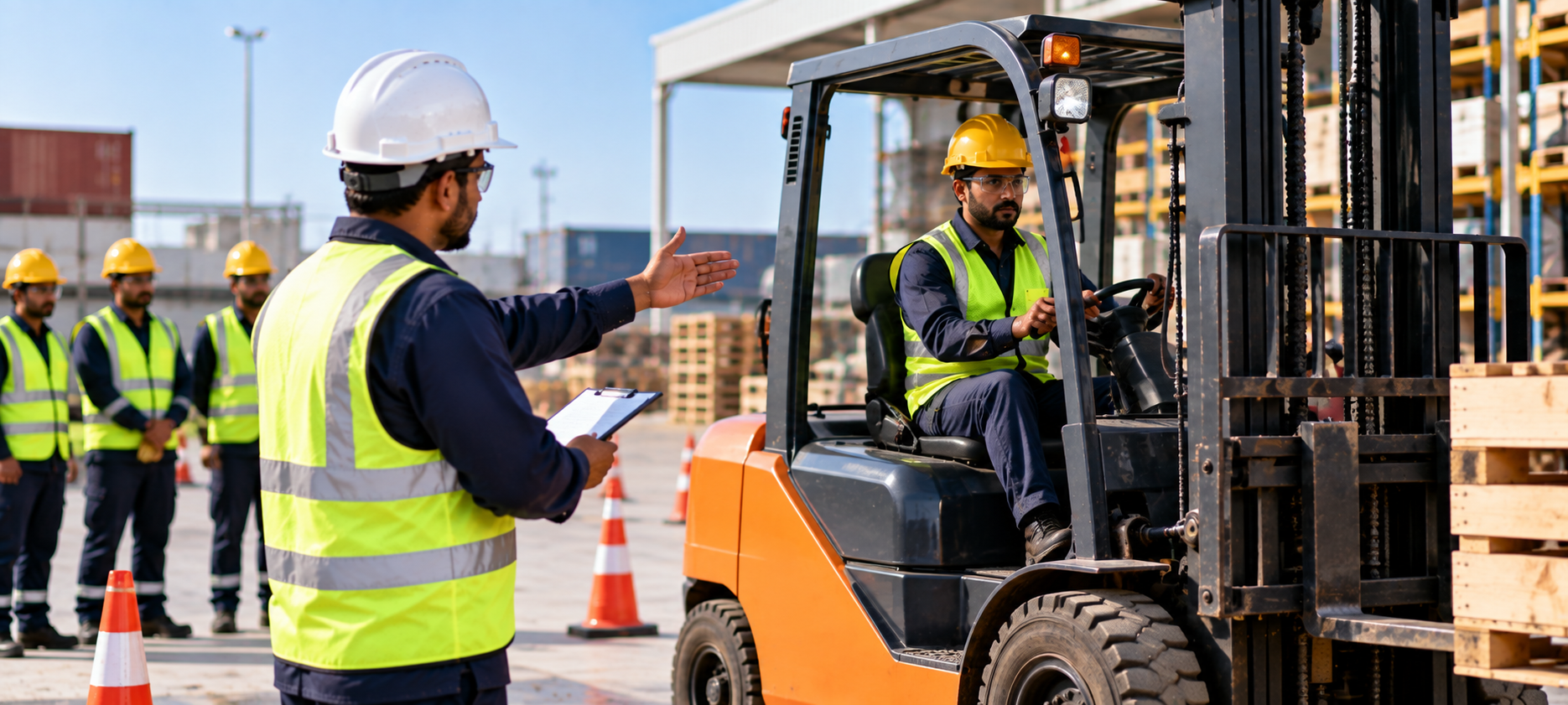
Warehouse forklift incidents rarely involve a dramatic failure. They involve a stack that was slightly too high for the load centre, a pedestrian in a blind spot at the exact moment the operator was checking a mirror, or a racking collision that was entirely avoidable if the operator had actually understood the specific layout of that warehouse rather than generic forklift handling. None of that is what an RTA driving test examines.
Nathan Safety Training (NIMS) provides the workplace competency certification that UAE warehouses, logistics facilities and construction sites are actually audited against — load centre calculation, racking and pedestrian safety, and the counterbalance-versus-reach-truck judgement calls that separate a competent operator from a merely licensed one.
The Same Two-Certificate Structure as Every Heavy Equipment Role
Forklift operation in the UAE follows the same split as other heavy mechanical equipment: the RTA Category 7 licence is the legal requirement to drive the forklift at all, obtained through an authorised driving institute after a road test, minimum age twenty. Separately, workplace safety regulation — enforced through Dubai Municipality and ADOSH-SF — expects a workplace competency certificate proving the operator understands load centre calculation, racking interaction, and pedestrian safety specific to a warehouse or yard environment.
Warehouse and logistics operators sometimes assume the RTA licence alone is sufficient because it’s the one everyone talks about — it isn’t, and it was never designed to test what happens when a fully loaded forklift meets a pedestrian crossing point inside an actual working warehouse.
We provide the workplace competency certificate. Operators who don’t yet hold the RTA Category 7 licence should obtain it in parallel through an authorised driving institute — we’re happy to point clients toward that separate process.
What Untrained Forklift Operation Actually Costs
Forklift incidents concentrate around a predictable set of causes: overloading beyond the rated load centre, racking collision from misjudged clearance, and pedestrian struck-by incidents at blind intersections — all three are competency gaps, not equipment failures, and all three are preventable through training the RTA test doesn’t cover.
A racking collision alone can cascade well beyond the immediate damage — a compromised racking structure sometimes requires a full engineering inspection before the warehouse can resume normal operation, turning a single misjudged manoeuvre into days of reduced capacity.
Who Needs This Certification
Forklift competency requirements apply anywhere powered industrial trucks move material.
- Warehouse and distribution centre operators across logistics and retail supply chains
- Manufacturing facilities moving raw material and finished goods internally
- Construction sites using forklifts for material handling and site logistics
- Hospitality and F&B operations with back-of-house warehousing and cold storage
- Free zone tenants across JAFZA, DIP and similar logistics-heavy zones
Where We Deliver This Training
Ground conditions and utility density both vary significantly by emirate. We deliver onsite across all seven:
- Dubai — dense underground utility networks across established areas make utility strike prevention the dominant focus, alongside deep basement excavation for high-rise foundations
- Abu Dhabi — large-scale government infrastructure and KEZAD industrial excavation, often larger-volume earthworks than typical Dubai commercial sites
- Sharjah — Industrial Areas expansion and facility construction excavation, generally smaller-scale than Dubai or Abu Dhabi megaprojects
- Ajman — growing residential and infrastructure excavation work alongside the emirate’s construction boom
- Ras Al Khaimah — quarrying-adjacent excavation around Al Hamra brings genuinely different ground conditions — rock and aggregate rather than typical soil profiles
- Fujairah — FOIZ-related infrastructure and pipeline excavation, where utility and existing infrastructure awareness carries particularly high consequence
- Umm Al Quwain — smaller-scale excavation work, but the same competency and utility-awareness requirements apply
Forklift Types Covered
Type | Typical Use | Key Competency Focus |
Counterbalance | General warehouse and yard material handling | Load centre calculation, stability triangle |
Reach Truck | High-bay racking in narrower aisles | Mast reach judgement, aisle clearance |
Rough Terrain / Telehandler | Construction sites and outdoor material handling | Ground stability, extended reach load charts |
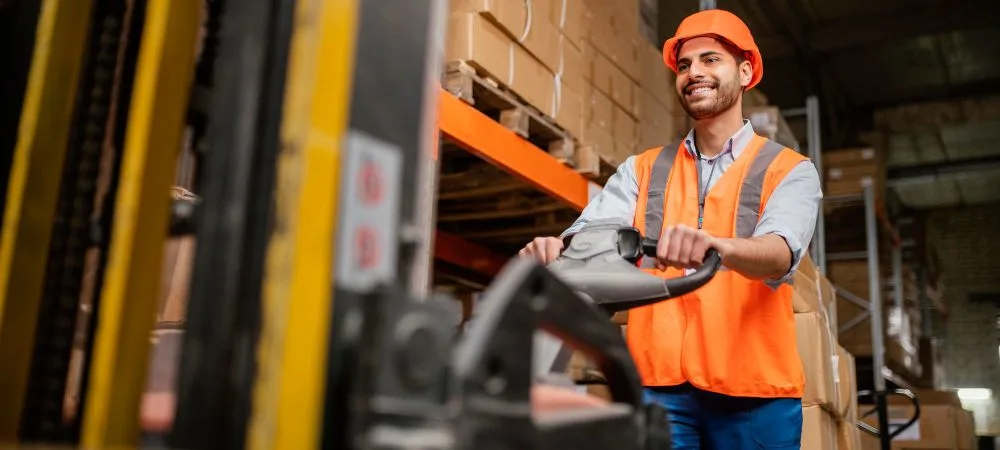
Pedestrian-Operated / Pallet Truck | Lower-capacity, walk-behind material movement | Pedestrian interaction awareness, manoeuvring in tight spaces |
Where Forklift Incidents Actually Originate
he forklift itself is rarely the problem. The judgement call made in the two seconds before a manoeuvre almost always is.
If I had to check one thing first on a warehouse walk-through, it’s whether pedestrian walkways and forklift routes are physically separated, or just painted lines everyone has learned to ignore under time pressure.
- Loads carried above the rated capacity for that specific load centre distance, not just the forklift’s maximum rating
- Pedestrian and forklift routes sharing the same space with no physical segregation, only painted lines
- Operators switching between counterbalance and reach truck models without type-specific reassessment
- Racking damage reported informally and never escalated to a proper structural check
- Reversing without a spotter in high-pedestrian-traffic areas of the warehouse
What Our Certification Actually Covers
We built this course around the specific judgement calls that cause real incidents — load centre miscalculation, racking clearance, pedestrian blind spots — rather than generic controls-and-levers instruction.
hsemanpower.ae, part of the same group, can supply additional certified forklift operators for warehouses needing capacity as well as certification for their existing team.
- Type-specific assessment across counterbalance, reach truck, rough terrain and pedestrian-operated equipment, not one generic forklift course
- Load centre and stability triangle calculation taught as practical judgement, not just a formula on a slide
- Pedestrian safety and racking interaction assessed against your actual warehouse layout where possible
- Clear guidance on how this certificate relates to — and doesn’t replace — the separate RTA Category 7 licensing process
- Certification documentation ready for immediate production during a Dubai Municipality or ADOSH-SF inspection
Courses Offered
- First Aid Course - CPR and AED
- Confined Space
- Fire Safety Awareness
- Scaffolding Inspection
- Scaffolding Erection & Dismantling
- Flagman Safety
- Chemical Safety and Handling Training
- Hazard and Risk Assessment
- Rigging and Slinging Training
- Traffic Safety
- Hand and Power Tools Operator
- Electrical Safety
- Lock Out and Tag Out (LOTO)
- Accident Incident Investigation
- Lifeguard Training
- Advanced Risk Assessment & Compliance Service
- Behavior-Based Safety Workplace Safety Consulting
- Construction Site Safety Induction Training
- Emergency Response Team Training
- Excavator Operator Training
- Forklift Operator Training
- H2S Awareness & Breathing Apparatus Training
- Hot Work Safety Training
- Incident Reporting & Root Cause Analysis Service
- MEWP Operator Training
- Mobile Crane Operator Training
- Permit to Work System Training
- Rope Access Training
- Working at Height & Fall Protection Safety Training
- Oil & Gas Safety Training
- Fire Warden Training
- Manual Handling Training
- Banksman Safety Training
- Gas Tester Training
- Defensive Driving Training
- HAZMAT Awareness Training
- Machine Safety and Machine Guarding Training
- Spill Response and Spill Control Training
- Welding Safety Training
Need expert advice? Speak to our team today
FAQ
Do I need an RTA licence and your training, or just one of them?
Both. The RTA Category 7 licence is the legal requirement to operate a forklift, obtained through an authorised driving institute. Our workplace competency certificate covers the site-specific safety knowledge — load centre calculation, racking and pedestrian safety — that the RTA test doesn’t examine. UAE warehouses generally expect operators to hold both.
Can you issue the RTA Category 7 forklift licence directly?
No — that’s issued specifically by RTA-authorised driving institutes after their road test. We issue the separate workplace competency certificate; we can point clients toward an authorised institute for the RTA process.
Do you train on reach trucks as well as standard counterbalance forklifts?
Yes — counterbalance, reach truck, rough terrain and pedestrian-operated equipment each involve different judgement calls, and we assess type-specific competency rather than treating all forklifts as interchangeable.
What is load centre, and why does it matter so much?
Load centre is the distance from the front of the forks to the load’s centre of gravity, and a forklift’s rated capacity is only valid at the manufacturer’s specified load centre — an oversized or oddly-shaped load with a longer effective load centre can exceed safe capacity even though its total weight is within the forklift’s maximum rating.
How long does forklift operator certification take?
Our core course runs one to two days depending on prior experience and how many equipment types need covering, combining theory with practical operating assessment.
Do you assess operators on our actual warehouse layout?
Where practical, yes — assessing against real racking configuration, aisle widths and pedestrian routes gives a far more accurate competency picture than a generic training yard, and we build this in wherever the site allows it.
Is this certification accepted for Dubai Municipality and ADOSH-SF audits?
Yes, our course content and documentation are built to match what both frameworks expect an employer to demonstrate for forklift operator competency.
How long is the certificate valid?
We recommend renewal every two to three years, or sooner following any incident involving forklift operation, and immediately when an operator moves to a materially different equipment type.
Can this be combined with our Excavator Operator training?
Yes, particularly for construction sites and yards running mixed heavy equipment fleets — we can schedule both on the same site visit for operators or teams needing multiple certifications.
Do experienced forklift operators from other countries still need UAE-specific certification?
Yes — prior experience is valuable, but UAE-specific competency assessment against local regulatory expectations and your actual site conditions is still required.
Can you certify a whole warehouse team at once, or only individuals?
We regularly certify full teams in a single booking, which is more efficient than individual sessions for warehouses with multiple operators needing certification or renewal at the same time.
Do you deliver this training across all seven emirates?
Yes, with the highest concentration of demand in Dubai’s JAFZA and DIP logistics zones, alongside significant volume in Abu Dhabi’s KEZAD and Fujairah’s port-adjacent warehousing.
- First Aid Course - CPR and AED
- Confined Space
- Fire Safety Awareness
- Scaffolding Inspection
- Scaffolding Erection & Dismantling
- Flagman Safety
- Chemical Safety and Handling Training
- Hazard and Risk Assessment
- Rigging and Slinging Training
- Traffic Safety
- Hand and Power Tools Operator
- Electrical Safety
- Lock Out and Tag Out (LOTO)
- Accident Incident Investigation
- Lifeguard Training
- Advanced Risk Assessment & Compliance Service
- Behavior-Based Safety Workplace Safety Consulting
- Construction Site Safety Induction Training
- Emergency Response Team Training
- Excavator Operator Training
- Forklift Operator Training
- H2S Awareness & Breathing Apparatus Training
- Hot Work Safety Training
- Incident Reporting & Root Cause Analysis Service
- MEWP Operator Training
- Mobile Crane Operator Training
- Permit to Work System Training
- Rope Access Training
- Working at Height & Fall Protection Safety Training
Forklift Operator Certification UAE | Workplace Competency Beyond the RTA Licence
Warehouse forklift incidents rarely involve a dramatic failure. They involve a stack that was slightly too high for the load centre, a pedestrian in a blind spot at the exact moment the operator was checking a mirror, or a racking collision that was entirely avoidable if the operator had actually understood the specific layout of that warehouse rather than generic forklift handling. None of that is what an RTA driving test examines.
Nathan Safety Training (NIMS) provides the workplace competency certification that UAE warehouses, logistics facilities and construction sites are actually audited against — load centre calculation, racking and pedestrian safety, and the counterbalance-versus-reach-truck judgement calls that separate a competent operator from a merely licensed one.
The Same Two-Certificate Structure as Every Heavy Equipment Role
Forklift operation in the UAE follows the same split as other heavy mechanical equipment: the RTA Category 7 licence is the legal requirement to drive the forklift at all, obtained through an authorised driving institute after a road test, minimum age twenty. Separately, workplace safety regulation — enforced through Dubai Municipality and ADOSH-SF — expects a workplace competency certificate proving the operator understands load centre calculation, racking interaction, and pedestrian safety specific to a warehouse or yard environment.
Warehouse and logistics operators sometimes assume the RTA licence alone is sufficient because it’s the one everyone talks about — it isn’t, and it was never designed to test what happens when a fully loaded forklift meets a pedestrian crossing point inside an actual working warehouse.
We provide the workplace competency certificate. Operators who don’t yet hold the RTA Category 7 licence should obtain it in parallel through an authorised driving institute — we’re happy to point clients toward that separate process.
What Untrained Forklift Operation Actually Costs
Forklift incidents concentrate around a predictable set of causes: overloading beyond the rated load centre, racking collision from misjudged clearance, and pedestrian struck-by incidents at blind intersections — all three are competency gaps, not equipment failures, and all three are preventable through training the RTA test doesn’t cover.
A racking collision alone can cascade well beyond the immediate damage — a compromised racking structure sometimes requires a full engineering inspection before the warehouse can resume normal operation, turning a single misjudged manoeuvre into days of reduced capacity.
Who Needs This Certification
Forklift competency requirements apply anywhere powered industrial trucks move material.
- Warehouse and distribution centre operators across logistics and retail supply chains
- Manufacturing facilities moving raw material and finished goods internally
- Construction sites using forklifts for material handling and site logistics
- Hospitality and F&B operations with back-of-house warehousing and cold storage
- Free zone tenants across JAFZA, DIP and similar logistics-heavy zones
Where We Deliver This Training
Warehouse and logistics density varies significantly by emirate. We deliver onsite across all seven:
- Dubai — JAFZA and DIP hold the country’s highest concentration of large-scale warehousing and logistics operations, driving the bulk of our forklift certification volume
- Abu Dhabi — KEZAD and Mussafah industrial warehousing, often larger-format facilities with correspondingly higher-capacity forklift fleets
- Sharjah — Sharjah Airport Free Zone and the Industrial Areas hold a dense concentration of SME warehousing and light manufacturing storage
- Ajman — growing warehousing capacity as logistics operators expand beyond Dubai and Sharjah for lower-cost facility options
- Ras Al Khaimah — RAK FTZ warehousing alongside RAK Ceramics and quarrying-adjacent material handling operations
- Fujairah — Port of Fujairah-adjacent warehousing and bonded storage, with cargo handling volume among the highest on the UAE’s east coast
- Umm Al Quwain — smaller-scale warehousing through UAQ Free Trade Zone, still requiring the same competency certification
Forklift Types Covered
Type | Typical Use | Key Competency Focus |
Counterbalance | General warehouse and yard material handling | Load centre calculation, stability triangle |
Reach Truck | High-bay racking in narrower aisles | Mast reach judgement, aisle clearance |
Rough Terrain / Telehandler | Construction sites and outdoor material handling | Ground stability, extended reach load charts |
Pedestrian-Operated / Pallet Truck | Lower-capacity, walk-behind material movement | Pedestrian interaction awareness, manoeuvring in tight spaces |
Where Forklift Incidents Actually Originate
The forklift itself is rarely the problem. The judgement call made in the two seconds before a manoeuvre almost always is.
If I had to check one thing first on a warehouse walk-through, it’s whether pedestrian walkways and forklift routes are physically separated, or just painted lines everyone has learned to ignore under time pressure.
- Loads carried above the rated capacity for that specific load centre distance, not just the forklift’s maximum rating
- Pedestrian and forklift routes sharing the same space with no physical segregation, only painted lines
- Operators switching between counterbalance and reach truck models without type-specific reassessment
- Racking damage reported informally and never escalated to a proper structural check
- Reversing without a spotter in high-pedestrian-traffic areas of the warehouse
What Our Certification Actually Covers
We built this course around the specific judgement calls that cause real incidents — load centre miscalculation, racking clearance, pedestrian blind spots — rather than generic controls-and-levers instruction.
hsemanpower.ae, part of the same group, can supply additional certified forklift operators for warehouses needing capacity as well as certification for their existing team.
- Type-specific assessment across counterbalance, reach truck, rough terrain and pedestrian-operated equipment, not one generic forklift course
- Load centre and stability triangle calculation taught as practical judgement, not just a formula on a slide
- Pedestrian safety and racking interaction assessed against your actual warehouse layout where possible
- Clear guidance on how this certificate relates to — and doesn’t replace — the separate RTA Category 7 licensing process
- Certification documentation ready for immediate production during a Dubai Municipality or ADOSH-SF inspection
FAQ
Do I need an RTA licence and your training, or just one of them?
Both. The RTA Category 7 licence is the legal requirement to operate a forklift, obtained through an authorised driving institute. Our workplace competency certificate covers the site-specific safety knowledge — load centre calculation, racking and pedestrian safety — that the RTA test doesn’t examine. UAE warehouses generally expect operators to hold both.
Can you issue the RTA Category 7 forklift licence directly?
No — that’s issued specifically by RTA-authorised driving institutes after their road test. We issue the separate workplace competency certificate; we can point clients toward an authorised institute for the RTA process.
Do you train on reach trucks as well as standard counterbalance forklifts?
Yes — counterbalance, reach truck, rough terrain and pedestrian-operated equipment each involve different judgement calls, and we assess type-specific competency rather than treating all forklifts as interchangeable.
What is load centre, and why does it matter so much?
Load centre is the distance from the front of the forks to the load’s centre of gravity, and a forklift’s rated capacity is only valid at the manufacturer’s specified load centre — an oversized or oddly-shaped load with a longer effective load centre can exceed safe capacity even though its total weight is within the forklift’s maximum rating.
How long does forklift operator certification take?
Our core course runs one to two days depending on prior experience and how many equipment types need covering, combining theory with practical operating assessment.
Do you assess operators on our actual warehouse layout?
Where practical, yes — assessing against real racking configuration, aisle widths and pedestrian routes gives a far more accurate competency picture than a generic training yard, and we build this in wherever the site allows it.
Is this certification accepted for Dubai Municipality and ADOSH-SF audits?
Yes, our course content and documentation are built to match what both frameworks expect an employer to demonstrate for forklift operator competency.
How long is the certificate valid?
We recommend renewal every two to three years, or sooner following any incident involving forklift operation, and immediately when an operator moves to a materially different equipment type.
Can this be combined with our Excavator Operator training?
Yes, particularly for construction sites and yards running mixed heavy equipment fleets — we can schedule both on the same site visit for operators or teams needing multiple certifications.
Do experienced forklift operators from other countries still need UAE-specific certification?
Yes — prior experience is valuable, but UAE-specific competency assessment against local regulatory expectations and your actual site conditions is still required.
Can you certify a whole warehouse team at once, or only individuals?
We regularly certify full teams in a single booking, which is more efficient than individual sessions for warehouses with multiple operators needing certification or renewal at the same time.
Do you deliver this training across all seven emirates?
Yes, with the highest concentration of demand in Dubai’s JAFZA and DIP logistics zones, alongside significant volume in Abu Dhabi’s KEZAD and Fujairah’s port-adjacent warehousing.
Get Your Forklift Operators Certified
Whether it’s a single operator or a full warehouse team, and whichever forklift types you run, tell us your equipment mix and facility layout, and we’ll scope certification accordingly.
Nathan Safety Training (NIMS) — Forklift operator workplace competency training across Dubai, Abu Dhabi, Sharjah, Ajman, Ras Al Khaimah, Fujairah and Umm Al Quwain.