
Incident Reporting and Root Cause Analysis: Expert Training in Dubai
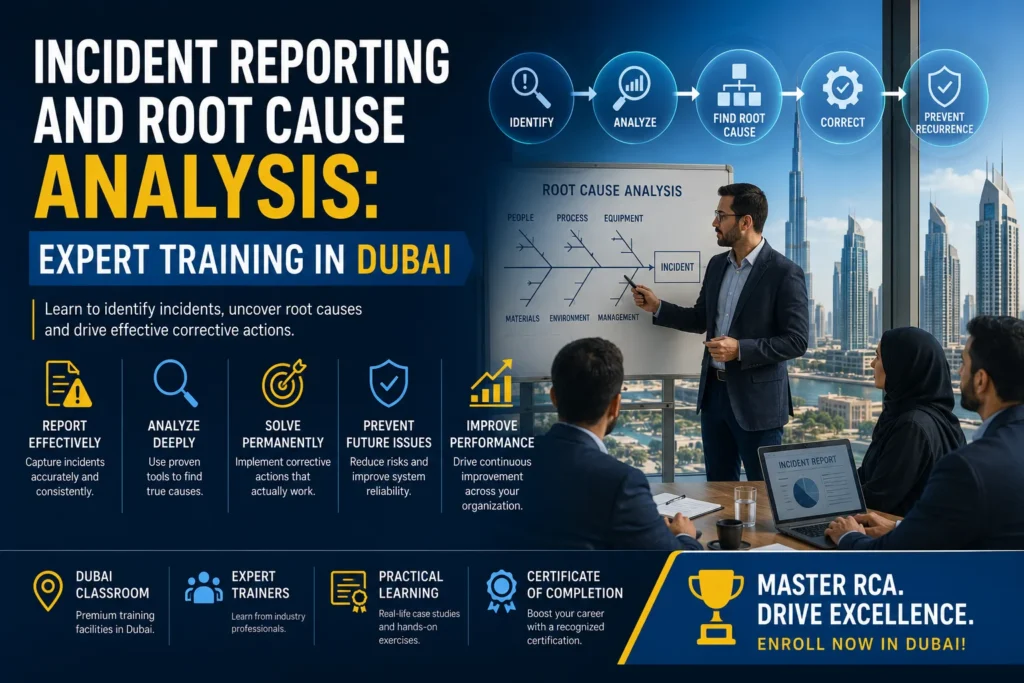
Every workplace incident, big or small, tells a story. But without the right skills, most companies only read the first page, the injury, the damage, and the downtime and never find out what really caused it. That’s where incident reporting and root cause analysis service training in Dubai makes the difference. It equips safety teams with a structured way to report incidents accurately and dig down to the real cause, not just the surface-level symptom, so the same failure doesn’t happen twice.
In this guide, we’ll break down what incident reporting and root cause analysis (RCA) actually involve, why UAE businesses can’t afford to skip this training, and how the right program turns lessons learned into lasting workplace safety improvements.
What Is Incident Reporting?
Incident reporting is the structured process of documenting any unplanned event that causes, or could have caused, harm, damage, or loss at a worksite. It’s the first and most important step in any safety management system, because a well-documented incident is the raw material every investigation depends on.
Incidents typically fall into a few categories:
- Injury or illness events: Anything resulting in physical harm
- Near-misses: Events that could have caused harm but didn’t
- Property or equipment damage: Machinery failures, structural damage, vehicle collisions
- Environmental incidents: Spills, leaks, emissions
- High-potential events: Situations with low actual harm but high risk if repeated
Accurate, timely reporting isn’t just paperwork. It’s the foundation that allows a proper root cause analysis to happen at all.
What Is Root Cause Analysis (RCA)?
Root cause analysis is a systematic method used to identify the underlying reasons behind an incident, not just the obvious trigger. Most workplace investigations stop at “human error” and move on. A trained investigator using proper Root Cause Analysis (RCA) methodology training knows that human error is rarely the root cause; it’s usually a symptom of a weaker system, a process gap, or a missing control further upstream.
RCA asks the harder questions:
- Why did the worker skip the safety check?
- Why wasn’t the equipment maintained on schedule?
- Why did the training not cover this scenario?
- Why did the existing control fail to catch this risk?
Answering these layered questions is what separates a real investigation from a blame exercise.
Why Incident Reporting and RCA Matter for UAE Businesses
Dubai’s fast-moving construction, energy, and industrial sectors operate under strict health and safety expectations, and for good reason. A single unresolved root cause can lead to repeat incidents, regulatory penalties, or far worse.
Here’s what strong incident reporting and RCA processes deliver:
- Prevents repeat incidents by fixing the actual cause, not just the symptom
- Strengthens regulatory compliance with UAE OSH and international standards (ISO 45001, OSHAD, etc.)
- Reduces operational downtime caused by recurring equipment or process failures
- Builds a genuine safety culture, where employees report issues instead of hiding them
- Protects company reputation by demonstrating due diligence to clients, insurers, and regulators
For any organization serious about workplace safety incident management, this isn’t optional groundwork; it’s core risk management.
Common Root Cause Analysis Methods Explained
Professional training typically covers several proven RCA techniques, each suited to different types of incidents:
- 5 Whys: Repeatedly asking “why” (usually five times) to move past the obvious answer and reach the underlying cause
- Fishbone Diagram (Ishikawa): Visually mapping potential causes across categories like people, process, equipment, and environment
- Barrier Analysis: Identifying which safety barriers should have prevented the incident and why they failed
- Causal Mapping: Building a visual chain of events to show how one failure led to another
A well-designed incident reporting and root cause analysis service training program in Dubai teaches teams when and how to apply each method, rather than relying on just one approach for every situation.
Step-by-Step Incident Investigation Process
A structured investigation generally follows this sequence:
- Immediate response: Secure the site, ensure safety, provide first aid if needed
- Evidence collection: Photos, physical evidence, equipment logs, environmental conditions
- Witness interviews: Gathering accounts while memories are fresh and unbiased
- Timeline reconstruction: Mapping the sequence of events leading to the incident
- Documentation review: Checking maintenance records, training logs, and procedures
- Root cause identification: Applying RCA tools to pinpoint the true underlying cause
- Control evaluation: Assessing why existing safeguards didn’t prevent the event
Following this sequence consistently is what proper incident investigation and reporting procedures training is designed to instill across a team.
From RCA to CAPA: Turning Findings Into Action
Identifying the root cause is only half the job. The real value comes from converting findings into a Corrective and Preventive Action (CAPA) training in a UAE framework that actually gets implemented and tracked.
A strong CAPA process includes the following:
- Corrective actions: Fixing the immediate cause of the current incident
- Preventive actions: Addressing systemic issues to stop similar incidents elsewhere
- Ownership and deadlines: Assigning clear responsibility with realistic timelines
- Verification: Confirming the action was implemented and is actually working
- Follow-up review: Revisiting after a set period to check the fix held
Without this final step, even the best root cause analysis becomes a report that sits in a folder rather than a change that protects your workforce.
Industries in Dubai That Need This Training Most
While every sector benefits from strong incident management, some industries in the UAE carry higher risk exposure and regulatory scrutiny:
- Oil, gas, and petrochemicals
- Construction and infrastructure
- Manufacturing and industrial processing
- Power and energy
- Marine and logistics
- Facilities and property management
For these sectors, structured incident reporting and RCA aren’t just best practices; they’re often a contractual or regulatory requirement for operating in the UAE.
Common Mistakes Companies Make During Investigations
Even experienced teams fall into avoidable traps without proper training:
- Stopping at “human error” instead of digging into system-level causes
- Blame-focused investigations that discourage honest reporting
- Poor documentation that makes findings impossible to verify later
- No follow-up on corrective actions, so the same incident repeats
- Inconsistent methods, where every investigator does it differently
These gaps are exactly what structured, expert-led training is designed to close.
Why Professional Incident Reporting and RCA Training Matters
Reading about RCA methods is one thing; applying them under real workplace pressure is another. A properly delivered incident reporting and root cause analysis service training program in Dubai gives your team hands-on practice with real case studies, practical tools they can use immediately, and a shared methodology across the organization, so every investigation follows the same reliable standard, regardless of who’s leading it.
This consistency is what transforms incident management from a reactive checkbox exercise into a genuine driver of workplace safety and operational reliability.
FAQ
What is the difference between incident reporting and root cause analysis?
Incident reporting documents what happened, while root cause analysis investigates why it happened at a systemic level, going beyond the immediate trigger.
Who should attend incident reporting and RCA training?
HSE managers, safety officers, supervisors, and operations teams responsible for investigating and preventing workplace incidents.
How long does RCA training typically take?
Most professional programs run from one to a few days, combining theory with hands-on case study practice, depending on the depth of the course.
Is this training relevant across all UAE industries?
Yes. While high-risk sectors like construction and oil & gas benefit most, the core methodology applies to any organization managing workplace safety.
Ready to Strengthen Your Incident Management System?
Repeat incidents cost more than downtime; they put your people and your reputation at risk. If your team is ready to move from guesswork to a proven, structured approach, our Incident Reporting and Root Cause Analysis Service training in Dubai gives you the tools, methodology, and hands-on practice to investigate incidents properly and prevent them from happening again.