

5 Proven Ways Flagman Training Protects Your Business
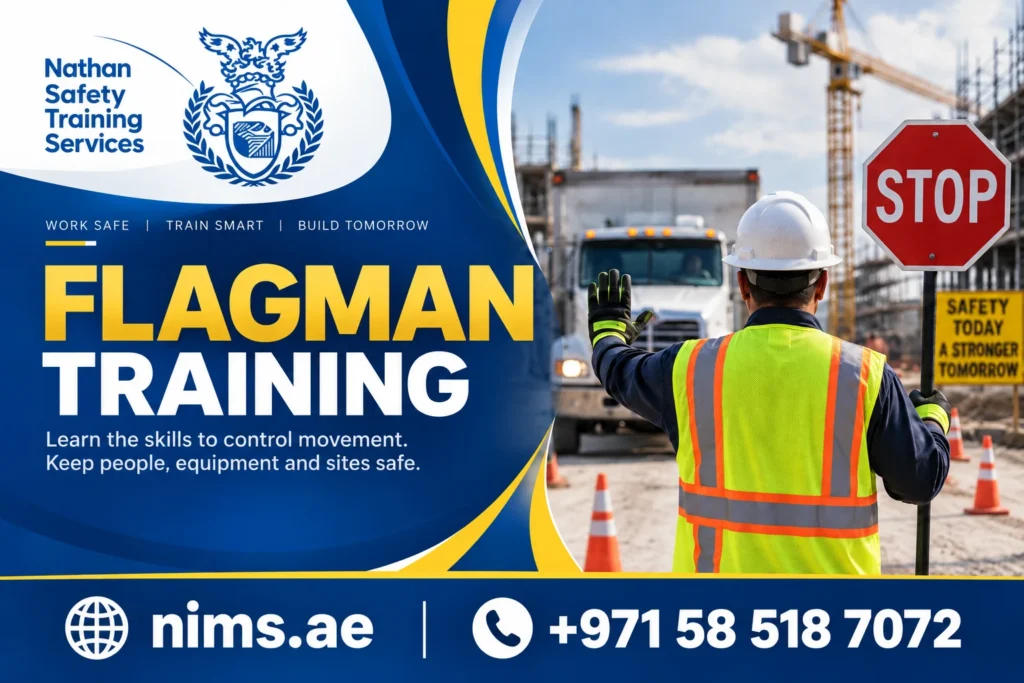
If your company sends workers anywhere near live traffic, roadworks, construction sites, utility projects, or busy loading bays, flagman training isn’t a paperwork formality. It’s one of the most cost-effective risk controls a business can put in place. A single untrained flagman on a bad day can trigger an accident, a permit suspension, and a liability claim that costs far more than the training itself.
This guide breaks down exactly how proper flagman training protects your business, not just your workers, and what to look for when you’re arranging it for your team.
What Is Flagman Training, and Why Should Businesses Care?
Flagman training teaches workers how to safely direct vehicle traffic around road works, construction zones, and site entrances using standardized hand signals, correct positioning, and visibility practices. In the UAE, this typically aligns with RTA-recognized signalling standards for public roads and site-specific HSE requirements for internal traffic.
For an individual worker, it’s a certification. For a business, it’s something bigger: a control measure that sits between your company and a traffic incident, a permit violation, or a reputational hit.
Companies that treat flagman training as a genuine safety investment, not a box-ticking exercise, consistently see fewer incidents, smoother audits, and stronger client trust. Here’s exactly how.
5 Proven Ways Flagman Training Protects Your Business
1. Reduces Workplace Accidents and Liability Exposure
A flagman’s job leaves no room for guesswork. A driver approaching at speed reacts in a fraction of a second; there’s no do-over if the signal is unclear or the flagman is standing in a blind spot.
Untrained or poorly briefed personnel are far more likely to:
- Stand in a driver’s blind spot, especially near reversing vehicles and heavy plants
- Give ambiguous or inconsistent hand signals
- Misjudge safe standing distance on high-speed roads
Every one of these is a liability exposure for your business, not just a safety issue for the individual. Proper training closes that gap before it becomes an incident report.
2. Ensures RTA and Regulatory Compliance for Site and Road Permits
In the UAE, road works affecting public roads typically require a documented traffic management plan and RTA-aligned signalling as a condition of the permit itself, not something left to site discretion.
Trained flagmen are the human execution of that compliance requirement. Without them, your business risks:
- Permit delays or rejections during application
- Non-compliance flags during site inspections
- Difficulty renewing approvals for future projects
Certified staff makes compliance straightforward instead of something you’re scrambling to prove after the fact.
3. Protects Company Reputation and Future Project Approvals
A traffic incident on your site doesn’t stay contained to that one project. It can trigger:
- Permit review or suspension of the current work order
- A harder approval path on your next project with the same authority
- Damaged trust with clients, developers, and regulators who now see your company as higher risk
For contractors and logistics companies bidding on future work, a clean safety record is a competitive advantage. Flagman training is a direct, low-cost way to protect that record.
4. Reduces Insurance and Incident-Related Costs
Every traffic-related incident carries costs beyond the obvious ones: medical costs, equipment damage, legal exposure, and potential increases in insurance premiums. Investigation time and project downtime add further hidden costs that rarely make it into the initial estimate.
Trained flagmen reduce the frequency and severity of these incidents, which means:
- Fewer claims against your company’s insurance
- Lower long-term premium risk
- Reduced downtime from incident investigations and rework
Compared to the cost of a single serious incident, corporate flagman training is a small, predictable line item.
5. Improves Workforce Productivity and Site Efficiency
Untrained or inconsistently trained flagmen create friction on-site, confusion between shifts, delays while supervisors intervene, and rework when traffic management plans aren’t followed correctly.
A properly trained team means:
- Faster, smoother traffic flow around your site or works area
- Fewer delays caused by miscommunication between flagmen and drivers
- Consistent signalling across rotating crews and shifts
Safety training, done right, doesn’t slow projects down; it keeps them running without avoidable interruptions.
Signs Your Company Needs Flagman Training
If any of the following sound familiar, it’s worth reviewing your current setup:
- Staff are directing traffic without ever receiving dedicated positioning or signalling training
- Your team rotates between roles, and signalling has become inconsistent between shifts
- You don’t have a documented traffic management plan reviewed before each deployment
- Night shift work happens without a distinct visibility and PPE plan
- You’re bidding on projects that require certified traffic control personnel as a permit condition
- A recent incident or near-miss involved positioning or blind-spot issues
What to Look for in a Corporate Flagman Training Provider
Not all training providers cover the same ground. When you’re arranging flagman training for your workforce, look for:
- On-site delivery: Training conducted against your actual road layout or site entrance, not a generic classroom setup
- RTA-aligned signalling standards: So your certified staff are consistent with what drivers across the emirate expect to see
- Positioning and blind-spot training with real vehicles and plants, not diagrams alone
- A dedicated night and low-visibility module, since daytime-only training leaves crews under-prepared for night shifts
- Refresher scheduling: To keep signalling consistent as crews rotate
- Flexibility to scale: Whether you need to certify a handful of staff or an entire rotating workforce across multiple sites
Why UAE Companies Choose NIMS for Corporate Flagman Training
Nathan Safety Training (NIMS) certifies flagmen and traffic marshals for construction, utility, logistics, and facilities management companies across all seven emirates. Training is delivered onsite, built around RTA-recognized signalling standards, and structured around the positioning judgement that actually prevents incidents, not just signal recall.
For companies managing rotating crews or multiple site types, NIMS also offers refresher packages, so your workforce stays consistently certified without you having to track it manually.
You can see the full course structure, modules, and FAQs on our Flagman and Traffic Marshal Training page.
Frequently Asked Questions
Can flagman training be delivered on-site for our team?
Yes. Training is conducted at your actual site or road layout so your team certifies against the real environment they’ll be working in, not a generic classroom setup.
How many employees can we get certified at once?
Group sizes are scoped based on your workforce size, number of active traffic conflict points, and shift pattern. NIMS can certify a small team or an entire rotating crew.
Do you offer refresher training for existing certified staff?
Yes. Refresher packages are scheduled to keep signalling consistent across crews, especially where staff rotates between roles or site types.
Is this suitable for staff who only direct traffic occasionally, like security teams?
Yes, this is one of the most common gaps we see. Staff asked to manage vehicle access without dedicated training are exactly who this course is built for.
Ready to certify your workforce?
Flagman training is one of the lowest-cost, highest-impact safety investments a company operating around traffic can make. It protects your workers, your permits, your reputation, and your bottom line, all at once.