


Home / Construction Site Safety Induction Training
Construction Site Safety Induction Training
Day One on Site: Construction Safety Induction Training Across the UAE
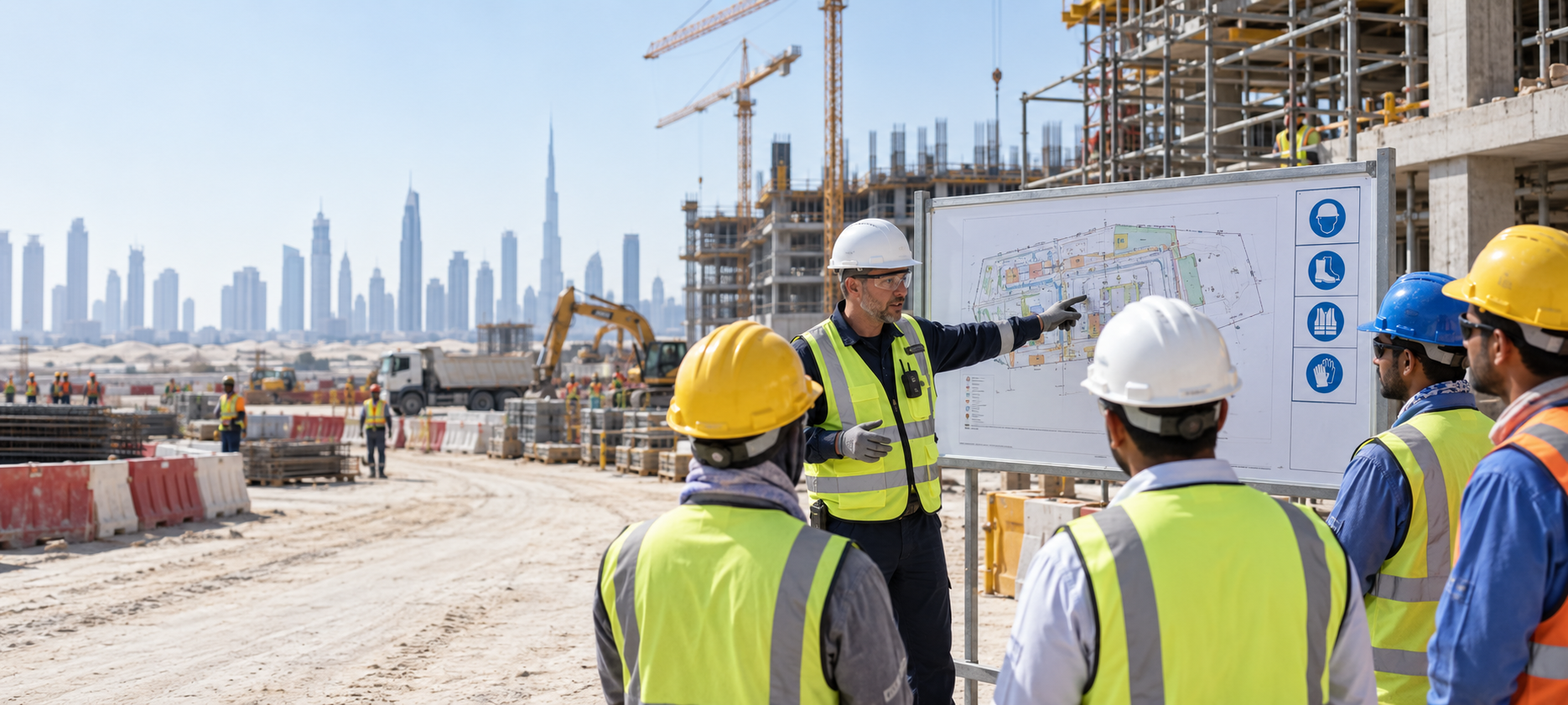
Every specialist certificate on this site — confined space, scaffolding, working at height — assumes one thing already happened: that the person holding it actually understood the site itself before starting work. Which muster point, which PPE zone, which areas are restricted, who to call. Skip that foundation and the specialist training sits on top of a gap nobody notices until an emergency actually happens.
Nathan Safety Training (NIMS) delivers site safety induction across UAE construction and industrial projects — the mandatory first-day briefing every worker, visitor and new subcontractor needs before setting foot past the gate, documented in a way that holds up when a Dubai Municipality inspector asks to see it.
The One Training Requirement Every Site Shares
MOHRE and emirate-level regulations require every construction worker to complete a safety induction before starting work, regardless of trade, seniority or how many other certificates they already hold. Dubai Municipality’s HSEMS framework names a training and induction programme for all site workers as one of the mandatory elements of a compliant HSE Plan, and inspectors treat an undocumented briefing as equivalent to no briefing at all having taken place — there is no informal-but-thorough credit given during a review.
The practical complication is language. UAE construction workforces routinely include several first languages on the same site, and an induction delivered only in English or Arabic to a crew that doesn’t share either fluently isn’t meeting the substance of the requirement even if a form gets signed.
This course sits deliberately upstream of our trade-specific training — Scaffolding, Confined Space, Fall Protection and the rest. Induction establishes the site-wide baseline; those courses build specific competency on top of it.
Why the First Day Matters More Than Any Other
New workers are disproportionately represented in early-tenure incidents — not because they’re less capable, but because they haven’t yet built the situational awareness that experienced crews take for granted: where the reversing vehicles actually move, which stairwell is currently blocked, what the site alarm actually sounds like. A thorough, understood induction compresses that awareness gap instead of leaving a new worker to absorb it the slow way.
The commercial exposure runs alongside the human one. An incident involving a worker who can’t produce a documented, dated induction record is one of the fastest ways a Dubai Municipality inspection escalates from a routine visit to a serious finding — the missing paperwork becomes the headline issue as much as the incident itself.
Who Needs This Training
Induction requirements apply more broadly than most sites initially plan for.
- New construction workers and tradespeople before their first shift on any site
- Subcontractor crews joining an active project partway through, who need site-specific induction even if already trained elsewhere
- Site visitors, delivery drivers and inspectors requiring a shorter but still documented orientation
- Transferred staff moving between a company’s own projects, since site-specific hazards differ project to project
- Management and office staff who visit site occasionally but aren’t full-time site personnel
Where We Deliver This Training
Induction content has to reflect local site conditions and workforce languages, which shift by emirate. We deliver onsite across all seven:
- Dubai — large, multi-nationality construction workforces across the city’s high-rise and infrastructure projects, where induction is routinely delivered in four or more languages on the same site
- Abu Dhabi — government megaprojects and KEZAD industrial construction, where induction volume runs high given the scale of concurrent projects
- Sharjah — Industrial Areas manufacturing facility construction and expansion projects, generally smaller crews than Dubai’s tower sites
- Ajman — the emirate’s mid-rise residential construction boom is driving induction demand faster than many contractors’ existing HSE capacity
- Ras Al Khaimah — quarrying and industrial construction around Al Hamra, alongside growing hospitality development requiring induction for a different workforce profile
- Fujairah — FOIZ-adjacent construction and terminal expansion projects, where induction includes site-specific hazards well beyond a standard building site
- Umm Al Quwain — smaller construction volume, but the same mandatory pre-work induction requirement applies regardless of project scale
Induction Types
Type | Duration | Audience |
General Site Induction | Half day | All new workers and tradespeople before first shift |
Trade-Specific Induction Add-On | 1–2 hours | Crews entering high-risk zones (excavation, height, confined space) |
Visitor & Delivery Induction | 15–30 minutes | Short-term site visitors, drivers, inspectors |
Refresher / Re-Induction | 1 hour | Returning staff or workers transferring between projects |
Where Induction Programmes Fall Short of the Requirement
The gap is almost never a missing induction — it’s an induction that technically happened but didn’t actually transfer understanding.
If a worker can sign the attendance sheet but can’t point to the nearest muster point twenty minutes later, the induction met the paperwork requirement and missed the actual point of having one.
- Induction delivered in a single language on a site where a meaningful share of the workforce isn’t fluent in it
- Attendance signed off without any verification that content was actually understood, not just heard
- Subcontractor crews assumed to be covered by their own company’s induction, with no site-specific briefing added
- Induction content that hasn’t been updated after a significant site layout or hazard change
- Visitor inductions skipped entirely for ‘just a quick site visit’ that turns into an hour on an active work area
How We Run Induction Differently
We built this course around comprehension, not attendance, because a signed form with no real understanding behind it protects nobody when something actually goes wrong.
For clients also building out full HSE documentation, Nathan ISO Consulting — part of the same group — can align this induction programme with a wider HSE Plan submission, and hsemanpower.ae can supply additional site orientation staff for large mobilisation days.
- Delivered in English, Arabic, Hindi and Urdu to match real UAE site workforce composition, not a single-language script
- Comprehension checked through short verbal or practical confirmation, not just a signature on an attendance sheet
- Site-specific content built from an actual walk of your project, not a generic construction induction template
- Digital attendance and certification records formatted for immediate production during a Dubai Municipality inspection
- Scaled delivery for large mobilisation days, so induction doesn’t become the bottleneck holding up a big crew start
Courses Offered
- First Aid Course - CPR and AED
- Confined Space
- Fire Safety Awareness
- Scaffolding Inspection
- Scaffolding Erection & Dismantling
- Flagman Safety
- Chemical Safety and Handling Training
- Hazard and Risk Assessment
- Rigging and Slinging Training
- Traffic Safety
- Hand and Power Tools Operator
- Electrical Safety
- Lock Out and Tag Out (LOTO)
- Accident Incident Investigation
- Lifeguard Training
- Advanced Risk Assessment & Compliance Service
- Behavior-Based Safety Workplace Safety Consulting
- Construction Site Safety Induction Training
- Emergency Response Team Training
- Excavator Operator Training
- Forklift Operator Training
- H2S Awareness & Breathing Apparatus Training
- Hot Work Safety Training
- Incident Reporting & Root Cause Analysis Service
- MEWP Operator Training
- Mobile Crane Operator Training
- Permit to Work System Training
- Rope Access Training
- Working at Height & Fall Protection Safety Training
- Oil & Gas Safety Training
- Fire Warden Training
- Manual Handling Training
- Banksman Safety Training
- Gas Tester Training
- Defensive Driving Training
- HAZMAT Awareness Training
- Machine Safety and Machine Guarding Training
- Spill Response and Spill Control Training
- Welding Safety Training
Need expert advice? Speak to our team today
FAQ
Is site safety induction legally required in the UAE?
Yes, in substance — MOHRE and emirate-level regulations require every worker to complete a safety induction before starting work, and Dubai Municipality’s HSEMS framework names it as a mandatory element of a compliant HSE Plan. An undocumented briefing is treated as if it didn’t happen during an inspection.
How is this different from your trade-specific courses like Scaffolding or Confined Space?
Induction is the general, site-wide baseline every worker needs regardless of trade — site layout, emergency procedures, PPE zones, hazard awareness. Trade-specific courses build specialised competency on top of that baseline for particular high-risk activities. Workers typically need induction first, then relevant trade-specific certification.
Do subcontractor crews need our induction if they've already been inducted on another project?
Yes — induction is site-specific, not portable between projects. A crew inducted correctly on a previous site still needs to understand this particular site’s layout, hazards and emergency procedures before starting work here.
How long does General Site Induction take?
Our core General Site Induction runs half a day, covering site layout, emergency procedures, PPE requirements and hazard awareness in enough depth that workers retain it, not just hear it.
Do you deliver induction in languages other than English and Arabic?
Yes — we deliver in English, Arabic, Hindi and Urdu as standard, reflecting the actual language composition of most UAE construction workforces, since an induction nobody fully understands doesn’t meet the substance of the requirement even with a signature attached.
What's included in a visitor or delivery driver induction?
A shorter, focused briefing — typically fifteen to thirty minutes — covering PPE requirements, restricted areas and emergency procedures relevant to a short site visit, still documented, since even a brief unescorted visit carries genuine risk on an active site.
Can you handle induction for a large mobilisation day with hundreds of workers?
Yes, we scale delivery specifically for large mobilisation events, so induction doesn’t become the bottleneck that delays a major crew start.
Do you verify that workers actually understood the induction, not just attended it?
Yes — we build in short verbal or practical comprehension checks rather than relying solely on an attendance signature, which is the gap we most commonly find when reviewing other providers’ induction records.
How often does induction need to be refreshed?
Immediately if there’s a significant site layout or hazard change, and generally for any worker transferring between projects, since site-specific hazards differ even within the same company’s portfolio.
Can this be bundled with our other required training, like First Aid or Fire Safety?
Yes, many clients schedule induction alongside foundational courses like First Aid, CPR & AED or Fire Safety Awareness on the same mobilisation day to reduce total onboarding downtime.
Do you provide documentation ready for a Dubai Municipality inspection?
Yes — attendance and completion records are formatted so they can be produced immediately during an inspection, since an inspector asking for induction evidence and not receiving it promptly is treated the same as if the induction never happened.
Is this course relevant outside construction, or only for building sites?
The same principle applies to any industrial or high-risk site bringing on new workers, though our construction-focused induction is the most requested version given the scale of UAE construction activity and its specific regulatory attention.
- First Aid Course - CPR and AED
- Confined Space
- Fire Safety Awareness
- Scaffolding Inspection
- Scaffolding Erection & Dismantling
- Flagman Safety
- Chemical Safety and Handling Training
- Hazard and Risk Assessment
- Rigging and Slinging Training
- Traffic Safety
- Hand and Power Tools Operator
- Electrical Safety
- Lock Out and Tag Out (LOTO)
- Accident Incident Investigation
- Lifeguard Training
- Advanced Risk Assessment & Compliance Service
- Behavior-Based Safety Workplace Safety Consulting
- Construction Site Safety Induction Training
- Emergency Response Team Training
- Excavator Operator Training
- Forklift Operator Training
- H2S Awareness & Breathing Apparatus Training
- Hot Work Safety Training
- Incident Reporting & Root Cause Analysis Service
- MEWP Operator Training
- Mobile Crane Operator Training
- Permit to Work System Training
- Rope Access Training
- Working at Height & Fall Protection Safety Training


Day One on Site: Construction Safety Induction Training Across the UAE
Every specialist certificate on this site — confined space, scaffolding, working at height — assumes one thing already happened: that the person holding it actually understood the site itself before starting work. Which muster point, which PPE zone, which areas are restricted, who to call. Skip that foundation and the specialist training sits on top of a gap nobody notices until an emergency actually happens.
Nathan Safety Training (NIMS) delivers site safety induction across UAE construction and industrial projects — the mandatory first-day briefing every worker, visitor and new subcontractor needs before setting foot past the gate, documented in a way that holds up when a Dubai Municipality inspector asks to see it.
The One Training Requirement Every Site Shares
MOHRE and emirate-level regulations require every construction worker to complete a safety induction before starting work, regardless of trade, seniority or how many other certificates they already hold. Dubai Municipality’s HSEMS framework names a training and induction programme for all site workers as one of the mandatory elements of a compliant HSE Plan, and inspectors treat an undocumented briefing as equivalent to no briefing at all having taken place — there is no informal-but-thorough credit given during a review.
The practical complication is language. UAE construction workforces routinely include several first languages on the same site, and an induction delivered only in English or Arabic to a crew that doesn’t share either fluently isn’t meeting the substance of the requirement even if a form gets signed.
This course sits deliberately upstream of our trade-specific training — Scaffolding, Confined Space, Fall Protection and the rest. Induction establishes the site-wide baseline; those courses build specific competency on top of it.
Why the First Day Matters More Than Any Other
New workers are disproportionately represented in early-tenure incidents — not because they’re less capable, but because they haven’t yet built the situational awareness that experienced crews take for granted: where the reversing vehicles actually move, which stairwell is currently blocked, what the site alarm actually sounds like. A thorough, understood induction compresses that awareness gap instead of leaving a new worker to absorb it the slow way.
The commercial exposure runs alongside the human one. An incident involving a worker who can’t produce a documented, dated induction record is one of the fastest ways a Dubai Municipality inspection escalates from a routine visit to a serious finding — the missing paperwork becomes the headline issue as much as the incident itself.
Who Needs This Training
Induction requirements apply more broadly than most sites initially plan for.
- New construction workers and tradespeople before their first shift on any site
- Subcontractor crews joining an active project partway through, who need site-specific induction even if already trained elsewhere
- Site visitors, delivery drivers and inspectors requiring a shorter but still documented orientation
- Transferred staff moving between a company’s own projects, since site-specific hazards differ project to project
- Management and office staff who visit site occasionally but aren’t full-time site personnel
Where We Deliver This Training
Induction content has to reflect local site conditions and workforce languages, which shift by emirate. We deliver onsite across all seven:
- Dubai — large, multi-nationality construction workforces across the city’s high-rise and infrastructure projects, where induction is routinely delivered in four or more languages on the same site
- Abu Dhabi — government megaprojects and KEZAD industrial construction, where induction volume runs high given the scale of concurrent projects
- Sharjah — Industrial Areas manufacturing facility construction and expansion projects, generally smaller crews than Dubai’s tower sites
- Ajman — the emirate’s mid-rise residential construction boom is driving induction demand faster than many contractors’ existing HSE capacity
- Ras Al Khaimah — quarrying and industrial construction around Al Hamra, alongside growing hospitality development requiring induction for a different workforce profile
- Fujairah — FOIZ-adjacent construction and terminal expansion projects, where induction includes site-specific hazards well beyond a standard building site
- Umm Al Quwain — smaller construction volume, but the same mandatory pre-work induction requirement applies regardless of project scale
Induction Types
Type | Duration | Audience |
General Site Induction | Half day | All new workers and tradespeople before first shift |
Trade-Specific Induction Add-On | 1–2 hours | Crews entering high-risk zones (excavation, height, confined space) |
Visitor & Delivery Induction | 15–30 minutes | Short-term site visitors, drivers, inspectors |
Refresher / Re-Induction | 1 hour | Returning staff or workers transferring between projects |
Where Induction Programmes Fall Short of the Requirement
The gap is almost never a missing induction — it’s an induction that technically happened but didn’t actually transfer understanding.
If a worker can sign the attendance sheet but can’t point to the nearest muster point twenty minutes later, the induction met the paperwork requirement and missed the actual point of having one.
- Induction delivered in a single language on a site where a meaningful share of the workforce isn’t fluent in it
- Attendance signed off without any verification that content was actually understood, not just heard
- Subcontractor crews assumed to be covered by their own company’s induction, with no site-specific briefing added
- Induction content that hasn’t been updated after a significant site layout or hazard change
- Visitor inductions skipped entirely for ‘just a quick site visit’ that turns into an hour on an active work area
How We Run Induction Differently
We built this course around comprehension, not attendance, because a signed form with no real understanding behind it protects nobody when something actually goes wrong.
For clients also building out full HSE documentation, Nathan ISO Consulting — part of the same group — can align this induction programme with a wider HSE Plan submission, and hsemanpower.ae can supply additional site orientation staff for large mobilisation days.
- Delivered in English, Arabic, Hindi and Urdu to match real UAE site workforce composition, not a single-language script
- Comprehension checked through short verbal or practical confirmation, not just a signature on an attendance sheet
- Site-specific content built from an actual walk of your project, not a generic construction induction template
- Digital attendance and certification records formatted for immediate production during a Dubai Municipality inspection
- Scaled delivery for large mobilisation days, so induction doesn’t become the bottleneck holding up a big crew start
FAQ
Is site safety induction legally required in the UAE?
Yes, in substance — MOHRE and emirate-level regulations require every worker to complete a safety induction before starting work, and Dubai Municipality’s HSEMS framework names it as a mandatory element of a compliant HSE Plan. An undocumented briefing is treated as if it didn’t happen during an inspection.
How is this different from your trade-specific courses like Scaffolding or Confined Space?
Induction is the general, site-wide baseline every worker needs regardless of trade — site layout, emergency procedures, PPE zones, hazard awareness. Trade-specific courses build specialised competency on top of that baseline for particular high-risk activities. Workers typically need induction first, then relevant trade-specific certification.
Do subcontractor crews need our induction if they've already been inducted on another project?
Yes — induction is site-specific, not portable between projects. A crew inducted correctly on a previous site still needs to understand this particular site’s layout, hazards and emergency procedures before starting work here.
How long does General Site Induction take?
Our core General Site Induction runs half a day, covering site layout, emergency procedures, PPE requirements and hazard awareness in enough depth that workers retain it, not just hear it.
Do you deliver induction in languages other than English and Arabic?
Yes — we deliver in English, Arabic, Hindi and Urdu as standard, reflecting the actual language composition of most UAE construction workforces, since an induction nobody fully understands doesn’t meet the substance of the requirement even with a signature attached.
What's included in a visitor or delivery driver induction?
A shorter, focused briefing — typically fifteen to thirty minutes — covering PPE requirements, restricted areas and emergency procedures relevant to a short site visit, still documented, since even a brief unescorted visit carries genuine risk on an active site.
Can you handle induction for a large mobilisation day with hundreds of workers?
Yes, we scale delivery specifically for large mobilisation events, so induction doesn’t become the bottleneck that delays a major crew start.
Do you verify that workers actually understood the induction, not just attended it?
Yes — we build in short verbal or practical comprehension checks rather than relying solely on an attendance signature, which is the gap we most commonly find when reviewing other providers’ induction records.
How often does induction need to be refreshed?
Immediately if there’s a significant site layout or hazard change, and generally for any worker transferring between projects, since site-specific hazards differ even within the same company’s portfolio.
Can this be bundled with our other required training, like First Aid or Fire Safety?
Yes, many clients schedule induction alongside foundational courses like First Aid, CPR & AED or Fire Safety Awareness on the same mobilisation day to reduce total onboarding downtime.
Do you provide documentation ready for a Dubai Municipality inspection?
Yes — attendance and completion records are formatted so they can be produced immediately during an inspection, since an inspector asking for induction evidence and not receiving it promptly is treated the same as if the induction never happened.
Is this course relevant outside construction, or only for building sites?
The same principle applies to any industrial or high-risk site bringing on new workers, though our construction-focused induction is the most requested version given the scale of UAE construction activity and its specific regulatory attention.
Book Site Induction for Your Next Mobilisation
Whether you need a single crew inducted or a large mobilisation day covered, tell us your project scope, workforce languages and timeline, and we’ll scope delivery that doesn’t hold up your start date.
Nathan Safety Training (NIMS) — Construction site safety induction training across Dubai, Abu Dhabi, Sharjah, Ajman, Ras Al Khaimah, Fujairah and Umm Al Quwain.