

Home / Rigging And Slinging Training
Rigging And Slinging Training
Rigging and Slinging Training UAE (Sling Angles, Load Charts, Banksman Signals)
Widen the angle between two sling legs from 30 to 90 degrees and the load on each leg doesn’t stay the same — it roughly doubles. That single piece of arithmetic, ignored or simply not known, is behind a disproportionate number of dropped-load incidents on UAE construction and fabrication sites. A sling rated well within its safe working load can still fail catastrophically if the angle it’s rigged at was never actually calculated.
Nathan Safety Training (NIMS) trains riggers, slingers and banksmen across the UAE on load chart interpretation, sling selection and the hand-signal coordination with crane operators that keeps a lift predictable from the moment it leaves the ground to the moment it lands.
The Standard This Course Is Built Against
Lifting operations across UAE construction and industrial sites require documented lifting plans, with crane and lifting equipment subject to inspection and certification requirements enforced through Dubai Municipality and ADOSH-SF frameworks. Internationally, the technical standard most UAE lifting equipment inspection and competency frameworks reference is the UK’s Lifting Operations and Lifting Equipment Regulations (LOLER) approach — periodic thorough examination, documented safe working loads, and a competent person signing off equipment before it’s used, not after.
None of that technical framework replaces the judgement call made in the seconds before a lift begins: is this sling the right type for this load, at this angle, and is the person giving hand signals actually in the crane operator’s line of sight.
Lifting equipment certification bodies operating in the UAE generally require thorough examination records to be retained and produced on request, and an expired or missing certificate is one of the fastest ways a lift gets stopped mid-mobilisation on a well-run site. Keeping that paperwork current is as much a scheduling discipline as a safety one.
No Warning Before the Load Moves Wrong
A rigging failure doesn’t build up gradually the way a chemical exposure or a fatigue-related driving incident might. The load is secure until, in a fraction of a second, it isn’t — and by the time anyone notices the angle was wrong or the sling was damaged, the physics have already taken over.
Beyond the immediate safety stakes, a dropped or swinging load halts the entire lift plan for the day, often the whole site, and triggers scrutiny of every other lift the same crew has performed recently — a considerably more expensive outcome than the training that would have prevented it.
Who This Course Is For
Rigging and slinging skill is needed anywhere a load leaves the ground under a crane, hoist or lifting appliance.
- Construction — precast elements, structural steel, plant and material lifts
- Oil & gas fabrication yards — vessel and module lifts, heavy equipment installation
- Ports and marine operations — cargo handling, container operations
- Manufacturing — heavy machinery installation and relocation
- Event staging and production — truss rigging, stage structure lifts for exhibitions and concerts
Port to Port: Where We Deliver This Course
Lift types differ sharply by emirate depending on whether the dominant activity is port cargo, fabrication, or event staging. We deliver onsite across all seven:
- Dubai — JAFZA’s port and logistics lifts sit alongside DWTC’s exhibition and event rigging, giving Dubai crews the widest variety of lift types we train against
- Abu Dhabi — Mussafah’s fabrication yards handle some of the heaviest module and vessel lifts in the country, which is where our Advanced-level sling angle and load chart training is most in demand
- Sharjah — Hamriyah Port’s cargo handling operations need consistent banksman signalling across a high volume of daily lifts
- Ajman — Ajman Port’s cargo operations are smaller in scale than Dubai or Sharjah but carry identical sling angle and load chart risk
- Ras Al Khaimah — RAK Maritime City’s marine lifts and the quarrying sector’s heavy equipment moves both fall under this course, with genuinely different load profiles
- Fujairah — Port of Fujairah’s cargo and bunker operations move some of the highest lift volumes on the UAE’s east coast
- Umm Al Quwain — smaller port operations, but the same sling angle mathematics applies whether the load is a shipping container or a piece of quarry equipment
Sling Angle and Load Effect
Angle Between Sling Legs | Load Factor on Each Leg |
0–30° | Approx. same as vertical load |
30–60° | Moderate increase — verify against load chart |
60–90° | Significant increase — approaching double the vertical load |
Above 90° | Avoid — outside safe rigging practice for most configurations |
Equipment Failure Is Rare. Miscalculation Isn't.
Equipment failure is rare. Miscalculation and shortcuts are common.
If a rigger can’t explain why a particular sling was chosen for a particular load, that’s the conversation I’d want to have before the lift, not after.
- Sling angle estimated by eye rather than calculated, quietly loading one leg well beyond its rating
- Damaged or kinked slings still in service because the visible wear ‘still looks fine’
- No colour-coded inspection system, so nobody can tell at a glance which slings are due for retirement
- Rigger and crane operator using different or informal hand signals instead of a shared, standard set
- Tag lines skipped on a windy day, leaving the load to swing uncontrolled during the lift
Hands-On, Not Theory-Only
We built this course around real load calculations rather than worked examples on paper, because sling angle judgement only sticks when it’s practised against an actual lift.
hsemanpower.ae can supply additional certified riggers and banksmen for a defined lifting programme, often the more practical option than training a whole new in-house team for a single major lift campaign.
- Hands-on sling selection and angle calculation using real loads, not worked examples on paper only
- Banksman and signaller training conducted alongside actual crane operations where possible
- Lifting equipment inspection and tagging systems taught to the standard your site auditor will check
- Instructors with fabrication yard and heavy lift experience across oil & gas and construction
- Course content adaptable to event rigging where the load types and time pressure are genuinely different
Courses Offered
- First Aid Course - CPR and AED
- Confined Space
- Fire Safety Awareness
- Scaffolding Inspection
- Scaffolding Erection & Dismantling
- Flagman Safety
- Chemical Safety and Handling Training
- Hazard and Risk Assessment
- Rigging and Slinging Training
- Traffic Safety
- Hand and Power Tools Operator
- Electrical Safety
- Lock Out and Tag Out (LOTO)
- Accident Incident Investigation
- Lifeguard Training
- Advanced Risk Assessment & Compliance Service
- Behavior-Based Safety Workplace Safety Consulting
- Construction Site Safety Induction Training
- Emergency Response Team Training
- Excavator Operator Training
- Forklift Operator Training
- H2S Awareness & Breathing Apparatus Training
- Hot Work Safety Training
- Incident Reporting & Root Cause Analysis Service
- MEWP Operator Training
- Mobile Crane Operator Training
- Permit to Work System Training
- Rope Access Training
- Working at Height & Fall Protection Safety Training
- Oil & Gas Safety Training
- Fire Warden Training
- Manual Handling Training
- Banksman Safety Training
- Gas Tester Training
- Defensive Driving Training
- HAZMAT Awareness Training
- Machine Safety and Machine Guarding Training
- Spill Response and Spill Control Training
- Welding Safety Training
Need expert advice? Speak to our team today
FAQ
What's the difference between a rigger, a slinger and a banksman?
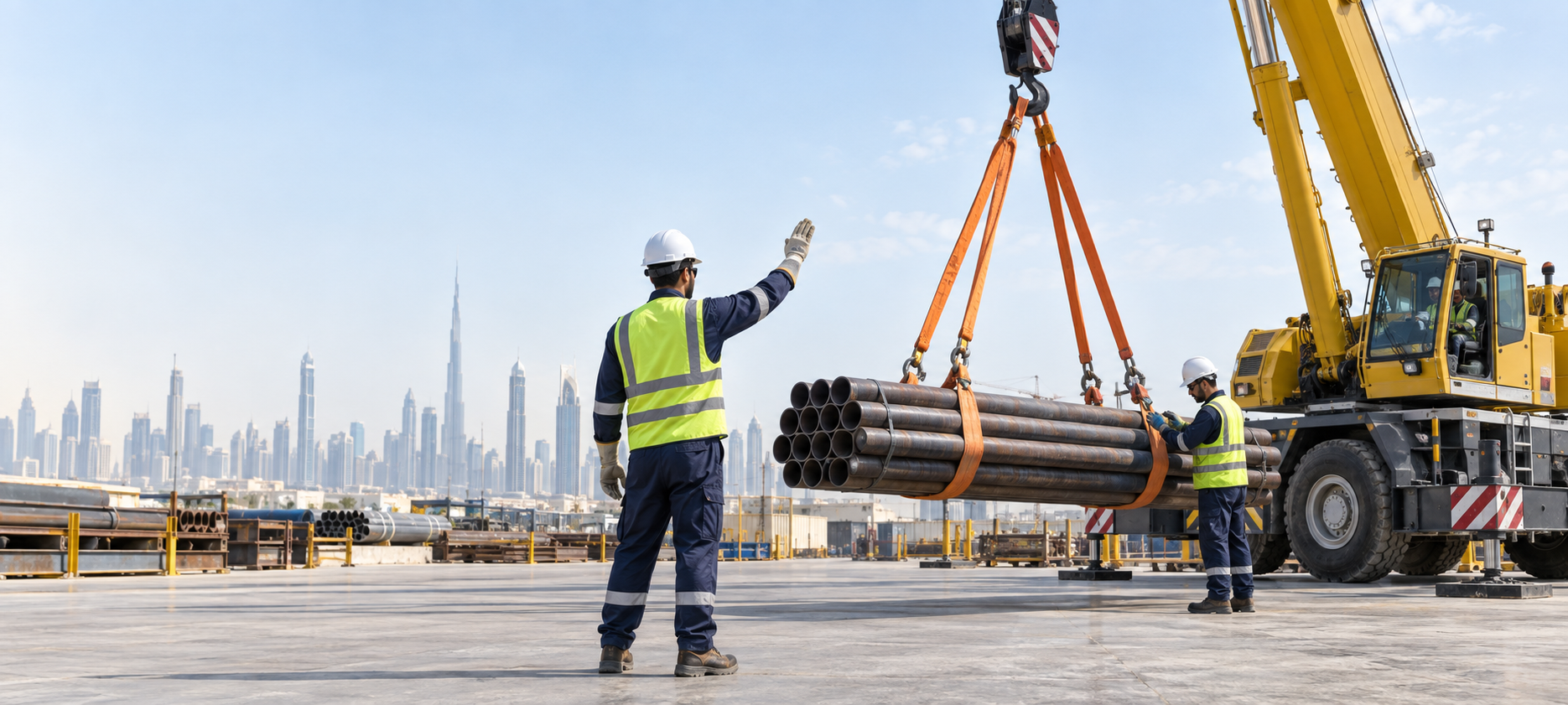
A rigger prepares and attaches the lifting gear to the load. A slinger selects and connects the correct slings for that specific load and configuration — often the same person as the rigger on smaller sites. A banksman (or signaller) directs the crane operator using hand signals or radio, positioned where they can see both the load and the operator.
Why does sling angle matter so much?
Widening the angle between sling legs increases the load carried by each individual leg, even though the total weight being lifted hasn’t changed — at wide angles this increase can be severe enough to exceed a sling’s rated capacity even when the total load is well within the crane’s limit.
How often should lifting equipment be inspected?
Slings and lifting gear need a pre-use visual check before every lift, plus periodic thorough examination by a competent person on a defined schedule — typically every six or twelve months depending on usage and equipment type, consistent with the inspection discipline UAE lifting equipment frameworks expect.
Do you train on all sling types?
Yes — wire rope, chain, synthetic webbing and round slings each have different inspection criteria, damage tolerances and suitability for different loads and environments, and the course covers what differs between them.
Is this course relevant to event and exhibition staging?
Yes, and it’s a genuinely different application — truss rigging for stages and structures involves different load types, tighter timelines and often overhead rigging points rather than ground-based crane lifts, which we address as a distinct module for event production teams.
What hand signals do you train banksmen on?
The standard set of crane hand signals recognised across UAE construction and industrial sites, so a banksman trained by us can work predictably with any crane operator familiar with the same standard, not a company-specific variant.
Do you cover load chart interpretation?
Yes — reading a crane’s load chart correctly for boom angle, radius and configuration is core to the course, since the safe working load at full radius can be dramatically lower than the crane’s maximum rated capacity.
Is certification required before someone can act as a banksman on a UAE site?
Main contractors and site HSE frameworks typically require documented, current banksman certification before authorising someone to direct crane operations — an untrained signaller is one of the more commonly cited findings in lifting-related incident investigations.
How long does rigging and slinging certification remain valid?
We recommend refresher training every two to three years, and immediately following any lifting incident or near-miss, given how much judgement is involved in angle and load assessment compared to more procedural safety tasks.
Do you deliver this training onsite?
Yes, and it’s the format we recommend — rigging judgement is best built against your actual load types, lifting equipment and crane configurations, across Dubai, Abu Dhabi, Sharjah, Ajman, Ras Al Khaimah, Fujairah and Umm Al Quwain.
Do the UAE's ports — Jebel Ali, Fujairah, Hamriyah, RAK Maritime City — need different rigging training?
The core rigging and slinging discipline is the same, but cargo type and lift frequency differ enough between ports that we adjust the working examples — container operations, bunker cargo and marine lifts each carry a slightly different risk emphasis.
How long does rigger and banksman certification take?
Basic rigging and slinging certification runs two days; banksman and signaller training can be delivered standalone in one day or combined with the rigging course for crews covering both roles.
Is a rigger the same as a banksman or signaller?
Not quite — a rigger prepares and attaches the lifting gear to the load; a banksman or signaller directs the crane operator once the lift is underway. The same person often holds both qualifications, but they’re assessed as distinct skill sets within this course.
- First Aid Course - CPR and AED
- Confined Space
- Fire Safety Awareness
- Scaffolding Inspection
- Scaffolding Erection & Dismantling
- Flagman Safety
- Chemical Safety and Handling Training
- Hazard and Risk Assessment
- Rigging and Slinging Training
- Traffic Safety
- Hand and Power Tools Operator
- Electrical Safety
- Lock Out and Tag Out (LOTO)
- Accident Incident Investigation
- Lifeguard Training
- Advanced Risk Assessment & Compliance Service
- Behavior-Based Safety Workplace Safety Consulting
- Construction Site Safety Induction Training
- Emergency Response Team Training
- Excavator Operator Training
- Forklift Operator Training
- H2S Awareness & Breathing Apparatus Training
- Hot Work Safety Training
- Incident Reporting & Root Cause Analysis Service
- MEWP Operator Training
- Mobile Crane Operator Training
- Permit to Work System Training
- Rope Access Training
- Working at Height & Fall Protection Safety Training
Rigging and Slinging Training UAE (Sling Angles, Load Charts, Banksman Signals)
Widen the angle between two sling legs from 30 to 90 degrees and the load on each leg doesn’t stay the same — it roughly doubles. That single piece of arithmetic, ignored or simply not known, is behind a disproportionate number of dropped-load incidents on UAE construction and fabrication sites. A sling rated well within its safe working load can still fail catastrophically if the angle it’s rigged at was never actually calculated.
Nathan Safety Training (NIMS) trains riggers, slingers and banksmen across the UAE on load chart interpretation, sling selection and the hand-signal coordination with crane operators that keeps a lift predictable from the moment it leaves the ground to the moment it lands.
The Standard This Course Is Built Against
Lifting operations across UAE construction and industrial sites require documented lifting plans, with crane and lifting equipment subject to inspection and certification requirements enforced through Dubai Municipality and ADOSH-SF frameworks. Internationally, the technical standard most UAE lifting equipment inspection and competency frameworks reference is the UK’s Lifting Operations and Lifting Equipment Regulations (LOLER) approach — periodic thorough examination, documented safe working loads, and a competent person signing off equipment before it’s used, not after.
None of that technical framework replaces the judgement call made in the seconds before a lift begins: is this sling the right type for this load, at this angle, and is the person giving hand signals actually in the crane operator’s line of sight.
Lifting equipment certification bodies operating in the UAE generally require thorough examination records to be retained and produced on request, and an expired or missing certificate is one of the fastest ways a lift gets stopped mid-mobilisation on a well-run site. Keeping that paperwork current is as much a scheduling discipline as a safety one.
No Warning Before the Load Moves Wrong
A rigging failure doesn’t build up gradually the way a chemical exposure or a fatigue-related driving incident might. The load is secure until, in a fraction of a second, it isn’t — and by the time anyone notices the angle was wrong or the sling was damaged, the physics have already taken over.
Beyond the immediate safety stakes, a dropped or swinging load halts the entire lift plan for the day, often the whole site, and triggers scrutiny of every other lift the same crew has performed recently — a considerably more expensive outcome than the training that would have prevented it.
Who This Course Is For
Rigging and slinging skill is needed anywhere a load leaves the ground under a crane, hoist or lifting appliance.
- Construction — precast elements, structural steel, plant and material lifts
- Oil & gas fabrication yards — vessel and module lifts, heavy equipment installation
- Ports and marine operations — cargo handling, container operations
- Manufacturing — heavy machinery installation and relocation
- Event staging and production — truss rigging, stage structure lifts for exhibitions and concerts
Port to Port: Where We Deliver This Course
Lift types differ sharply by emirate depending on whether the dominant activity is port cargo, fabrication, or event staging. We deliver onsite across all seven:
- Dubai — JAFZA’s port and logistics lifts sit alongside DWTC’s exhibition and event rigging, giving Dubai crews the widest variety of lift types we train against
- Abu Dhabi — Mussafah’s fabrication yards handle some of the heaviest module and vessel lifts in the country, which is where our Advanced-level sling angle and load chart training is most in demand
- Sharjah — Hamriyah Port’s cargo handling operations need consistent banksman signalling across a high volume of daily lifts
- Ajman — Ajman Port’s cargo operations are smaller in scale than Dubai or Sharjah but carry identical sling angle and load chart risk
- Ras Al Khaimah — RAK Maritime City’s marine lifts and the quarrying sector’s heavy equipment moves both fall under this course, with genuinely different load profiles
- Fujairah — Port of Fujairah’s cargo and bunker operations move some of the highest lift volumes on the UAE’s east coast
- Umm Al Quwain — smaller port operations, but the same sling angle mathematics applies whether the load is a shipping container or a piece of quarry equipment
Sling Angle and Load Effect
Angle Between Sling Legs | Load Factor on Each Leg |
0–30° | Approx. same as vertical load |
30–60° | Moderate increase — verify against load chart |
60–90° | Significant increase — approaching double the vertical load |
Above 90° | Avoid — outside safe rigging practice for most configurations |
Equipment Failure Is Rare. Miscalculation Isn't.
Equipment failure is rare. Miscalculation and shortcuts are common.
If a rigger can’t explain why a particular sling was chosen for a particular load, that’s the conversation I’d want to have before the lift, not after.
- Sling angle estimated by eye rather than calculated, quietly loading one leg well beyond its rating
- Damaged or kinked slings still in service because the visible wear ‘still looks fine’
- No colour-coded inspection system, so nobody can tell at a glance which slings are due for retirement
- Rigger and crane operator using different or informal hand signals instead of a shared, standard set
- Tag lines skipped on a windy day, leaving the load to swing uncontrolled during the lift
Hands-On, Not Theory-Only
We built this course around real load calculations rather than worked examples on paper, because sling angle judgement only sticks when it’s practised against an actual lift.
hsemanpower.ae can supply additional certified riggers and banksmen for a defined lifting programme, often the more practical option than training a whole new in-house team for a single major lift campaign.
- Hands-on sling selection and angle calculation using real loads, not worked examples on paper only
- Banksman and signaller training conducted alongside actual crane operations where possible
- Lifting equipment inspection and tagging systems taught to the standard your site auditor will check
- Instructors with fabrication yard and heavy lift experience across oil & gas and construction
- Course content adaptable to event rigging where the load types and time pressure are genuinely different
FAQ
What's the difference between a rigger, a slinger and a banksman?
A rigger prepares and attaches the lifting gear to the load. A slinger selects and connects the correct slings for that specific load and configuration — often the same person as the rigger on smaller sites. A banksman (or signaller) directs the crane operator using hand signals or radio, positioned where they can see both the load and the operator.
Why does sling angle matter so much?
Widening the angle between sling legs increases the load carried by each individual leg, even though the total weight being lifted hasn’t changed — at wide angles this increase can be severe enough to exceed a sling’s rated capacity even when the total load is well within the crane’s limit.
How often should lifting equipment be inspected?
Slings and lifting gear need a pre-use visual check before every lift, plus periodic thorough examination by a competent person on a defined schedule — typically every six or twelve months depending on usage and equipment type, consistent with the inspection discipline UAE lifting equipment frameworks expect.
Do you train on all sling types?
Yes — wire rope, chain, synthetic webbing and round slings each have different inspection criteria, damage tolerances and suitability for different loads and environments, and the course covers what differs between them.
Is this course relevant to event and exhibition staging?
Yes, and it’s a genuinely different application — truss rigging for stages and structures involves different load types, tighter timelines and often overhead rigging points rather than ground-based crane lifts, which we address as a distinct module for event production teams.
What hand signals do you train banksmen on?
The standard set of crane hand signals recognised across UAE construction and industrial sites, so a banksman trained by us can work predictably with any crane operator familiar with the same standard, not a company-specific variant.
Do you cover load chart interpretation?
Yes — reading a crane’s load chart correctly for boom angle, radius and configuration is core to the course, since the safe working load at full radius can be dramatically lower than the crane’s maximum rated capacity.
Is certification required before someone can act as a banksman on a UAE site?
Main contractors and site HSE frameworks typically require documented, current banksman certification before authorising someone to direct crane operations — an untrained signaller is one of the more commonly cited findings in lifting-related incident investigations.
How long does rigging and slinging certification remain valid?
We recommend refresher training every two to three years, and immediately following any lifting incident or near-miss, given how much judgement is involved in angle and load assessment compared to more procedural safety tasks.
Do you deliver this training onsite?
Yes, and it’s the format we recommend — rigging judgement is best built against your actual load types, lifting equipment and crane configurations, across Dubai, Abu Dhabi, Sharjah, Ajman, Ras Al Khaimah, Fujairah and Umm Al Quwain.
Do the UAE's ports — Jebel Ali, Fujairah, Hamriyah, RAK Maritime City — need different rigging training?
The core rigging and slinging discipline is the same, but cargo type and lift frequency differ enough between ports that we adjust the working examples — container operations, bunker cargo and marine lifts each carry a slightly different risk emphasis.
How long does rigger and banksman certification take?
Basic rigging and slinging certification runs two days; banksman and signaller training can be delivered standalone in one day or combined with the rigging course for crews covering both roles.
Do you cover mobile crane operations, or only rigging and slinging?
This course covers rigging, slinging and banksman signalling — the load-handling side of a lift. Mobile crane operator certification itself is a separate, specialised qualification we can advise on but don’t currently deliver directly.
Is a rigger the same as a banksman or signaller?
Not quite — a rigger prepares and attaches the lifting gear to the load; a banksman or signaller directs the crane operator once the lift is underway. The same person often holds both qualifications, but they’re assessed as distinct skill sets within this course.
Certify Your Riggers and Banksmen
Whether you need rigger, slinger or banksman certification — or all three — tell us your typical load types and lifting equipment, and we’ll scope training that matches the lifts your crew actually performs.
Nathan Safety Training (NIMS) — Rigging, slinging and banksman training across Dubai, Abu Dhabi, Sharjah, Ajman, Ras Al Khaimah, Fujairah and Umm Al Quwain.