

Home / Working At Height & Fall Protection Safety Training
Working At Height & Fall Protection Safety Training
Fall Protection and Working at Height Training Across the UAE
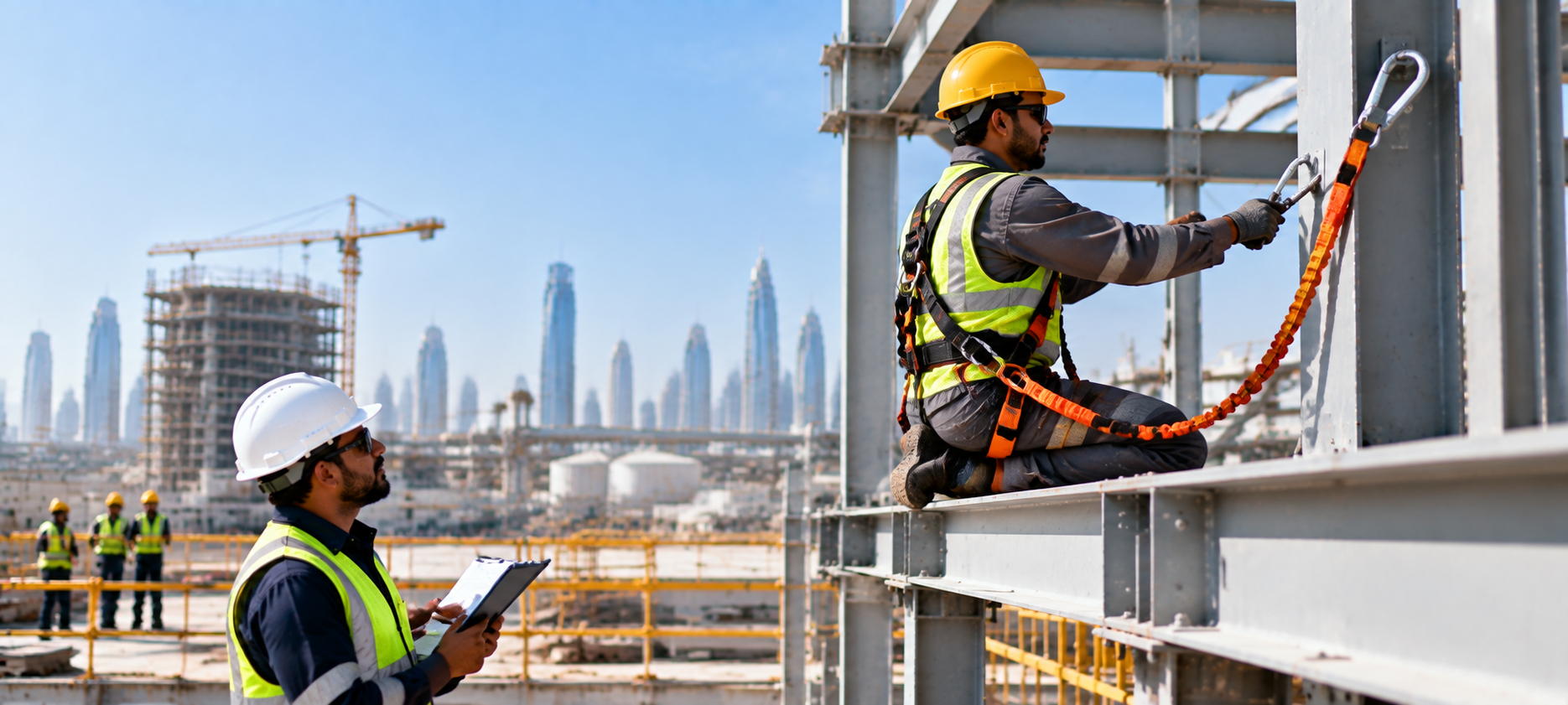
A harness that isn’t clipped to anything is a costume, not equipment — and one of the most common findings on any working-at-height audit is exactly that: correct PPE, worn correctly, connected to nothing. Fall protection only works as a system, and the weakest link decides the outcome, whether that weak link is the anchor point, the lanyard length, or the plan for what happens in the minutes after a fall is actually arrested.
Nathan Safety Training (NIMS) trains the foundational working-at-height and fall protection competency that sits beneath our method-specific courses — Scaffolding, Rope Access, MEWP — covering harness use, anchor point selection, fall arrest versus restraint, and the rescue planning that has to exist before anyone works suspended above the ground.
Why This Sits Beneath Our Other Height-Related Courses
Working at height is explicitly covered under Dubai Municipality’s Code of Construction Safety Practice and ADOSH-SF’s Codes of Practice as a distinct, specifically regulated activity, and falls remain one of the most consistently cited causes of serious construction injury across UAE sites regardless of how much other safety training has improved. This course teaches the underlying principles — hierarchy of fall protection, harness and lanyard use, anchor point assessment, rescue planning — that our Scaffolding, Rope Access and MEWP courses each apply to their specific method.
The hierarchy matters as a decision sequence, not just a list: eliminate the need to work at height first where possible, then use collective protection like guardrails, then fall restraint that prevents reaching a fall hazard at all, and fall arrest — stopping a fall already in progress — only as the last line of defence, not the default plan.
A rescue plan is not optional once fall arrest is in use. A worker left suspended in a harness after a fall is arrested faces a genuine medical risk from suspension trauma within minutes, which means ‘how do we get them down, and how fast’ has to be answered before the work starts, not improvised afterward.
What an Unprotected Fall Actually Costs
Falls from height are disproportionately represented in the most serious injury outcomes reviewed across UAE construction sites, and the severity doesn’t scale gently with height — falls from surprisingly modest heights can still cause life-changing injury, which is part of why ‘it’s not that high’ is one of the most dangerous informal judgement calls made on a site.
Beyond the immediate human cost, a fall incident typically triggers an immediate halt to all height-related work across the site pending investigation, and insurers increasingly scrutinise fall protection training records specifically when assessing claims involving height-related injury.
Who Needs This Training
This is a foundational course relevant to almost anyone whose work involves height, before they move to a method-specific course.
- Construction trades working from scaffolding, ladders or fixed platforms
- MEP contractors installing services in elevated plant rooms or ceiling voids
- Facade and building maintenance staff working near unprotected edges
- Warehouse staff accessing high-level racking or mezzanine areas
- Anyone being assessed as a rescue-capable team member for a site working at height
Where We Deliver This Training
Working-at-height demand tracks each emirate’s construction and maintenance activity. We deliver onsite across all seven:
- Dubai — continuous high-rise and infrastructure construction generates the country’s highest working-at-height training volume across trades
- Abu Dhabi — government megaprojects and industrial facility maintenance both carry significant working-at-height exposure
- Sharjah — Industrial Areas facility maintenance and construction, generally lower-rise work than Dubai’s tower sites
- Ajman — the mid-rise residential construction boom is driving fall protection training demand faster than many contractors’ existing programmes have kept pace with
- Ras Al Khaimah — industrial and quarrying facility access work, alongside growing hospitality construction
- Fujairah — FOIZ terminal structure access and maintenance work at height
- Umm Al Quwain — smaller-scale construction and maintenance, still requiring the same fall protection fundamentals
Hierarchy of Fall Protection
Level | Approach | Example |
1 — Eliminate | Remove the need to work at height at all | Assemble at ground level, then lift into place |
2 — Prevent | Collective protection that stops a fall happening | Guardrails, edge protection |
3 — Restrain | Prevent the worker reaching the fall hazard | Restraint lanyard limiting travel distance |
4 — Arrest | Stop a fall already in progress | Fall arrest harness and energy-absorbing lanyard |
Where Fall Protection Systems Actually Fail
The PPE is almost always present. The system connecting it to something solid is where the gap actually sits.
If I had to check one thing first on any working-at-height audit, it’s whether the anchor point being used is rated for fall arrest specifically — not just something sturdy-looking nearby.
- Harness worn correctly but not actually clipped to a rated anchor point — present as PPE, absent as protection
- Anchor points selected because they’re convenient and look strong, without confirming their actual rated capacity
- Fall arrest used where simple restraint would have prevented reaching the hazard at all — skipping straight to the last line of defence
- No rescue plan for a worker left suspended after a fall is arrested, despite the genuine time-critical risk of suspension trauma
- Lanyard length not adjusted for the specific height available, creating a real risk of hitting the ground or a lower level before the system arrests the fall
How We Teach the Hierarchy, Not Just the Harness
We built this course as the shared foundation underneath our other height-related training specifically, so a worker moving between scaffolding, rope access or MEWP work carries the same core judgement with them rather than relearning fall protection principles from scratch each time.
hsemanpower.ae, part of the same group, can supply additional fall-protection-certified personnel for projects needing capacity as well as certification for their existing team.
- The elimination-to-arrest hierarchy taught as a genuine decision sequence, not a poster on the wall
- Anchor point assessment as hands-on, site-specific judgement, not a generic ‘find something solid’ instruction
- Rescue planning built into every course, including suspension trauma awareness and practical retrieval methods
- Content that feeds directly into our Scaffolding, Rope Access and MEWP courses, so the fundamentals are consistent across every method
- PPE inspection habits taught as a pre-use routine, not an annual formality
Nathan Safety Training (NIMS) trains the foundational working-at-height and fall protection competency that sits beneath our method-specific courses — Scaffolding, Rope Access, MEWP — covering harness use, anchor point selection, fall arrest versus restraint, and the rescue planning that has to exist before anyone works suspended above the ground.
Courses Offered
- First Aid Course - CPR and AED
- Confined Space
- Fire Safety Awareness
- Scaffolding Inspection
- Scaffolding Erection & Dismantling
- Flagman Safety
- Chemical Safety and Handling Training
- Hazard and Risk Assessment
- Rigging and Slinging Training
- Traffic Safety
- Hand and Power Tools Operator
- Electrical Safety
- Lock Out and Tag Out (LOTO)
- Accident Incident Investigation
- Lifeguard Training
- Advanced Risk Assessment & Compliance Service
- Behavior-Based Safety Workplace Safety Consulting
- Construction Site Safety Induction Training
- Emergency Response Team Training
- Excavator Operator Training
- Forklift Operator Training
- H2S Awareness & Breathing Apparatus Training
- Hot Work Safety Training
- Incident Reporting & Root Cause Analysis Service
- MEWP Operator Training
- Mobile Crane Operator Training
- Permit to Work System Training
- Rope Access Training
- Working at Height & Fall Protection Safety Training
- Oil & Gas Safety Training
- Fire Warden Training
- Manual Handling Training
- Banksman Safety Training
- Gas Tester Training
- Defensive Driving Training
- HAZMAT Awareness Training
- Machine Safety and Machine Guarding Training
- Spill Response and Spill Control Training
- Welding Safety Training
Need expert advice? Speak to our team today
FAQ
How is this different from your Scaffolding, Rope Access and MEWP courses?
This course covers the foundational principles — harness use, anchor points, the fall protection hierarchy, rescue planning — that apply across any working-at-height method. Scaffolding, Rope Access and MEWP each then apply those principles to their specific equipment and technique. Most workers need this foundational course before or alongside the method-specific one.
What's the difference between fall restraint and fall arrest?
Restraint prevents a worker physically reaching a fall hazard at all, by limiting how far a lanyard lets them travel. Arrest stops a fall that’s already happening, after the worker has gone over the edge. Restraint is the safer, preferred approach wherever it’s achievable — arrest is the last line of defence, not the default plan.
Why does a rescue plan matter if the fall arrest system already stopped the fall?
A worker left suspended in a harness after arrest faces a genuine risk of suspension trauma within minutes, caused by the harness restricting blood flow while hanging motionless. Getting them down quickly is time-critical, which means the rescue method has to be planned and rehearsed before the work starts, not figured out after a fall happens.
What counts as a valid anchor point?
One rated by a competent person or manufacturer specifically for fall arrest loads — not simply something that looks sturdy. Structural steel, purpose-built anchor points and engineered systems qualify; an assumed-strong pipe or railing generally doesn’t without verification.
Is there a minimum height at which this training becomes necessary?
UAE working-at-height guidance doesn’t set a single blanket trigger height, and falls from surprisingly modest heights can still cause serious injury — the safer approach is applying the hierarchy of controls to any work where a fall is possible, rather than waiting for a specific height threshold.
Do you train on ladder safety, or only harness-based fall protection?
Yes, ladder safety and the judgement of when a ladder is genuinely appropriate versus when it should be replaced by a safer method sits inside this course, since ladders remain a disproportionately common source of height-related injury despite feeling low-risk.
How long does Fall Protection training take?
Our core course runs one day, covering the hierarchy of controls, harness and lanyard use, anchor point assessment and rescue planning, with hands-on equipment practice included.
How long is certification valid?
We recommend renewal every two to three years, and immediately following any fall-related incident or near-miss, given how much of this depends on consistent habit rather than one-time understanding.
Do you inspect our existing harnesses and PPE as part of the course?
We can, and we recommend it — fall arrest equipment has a defined service life and inspection schedule, and equipment past its usable condition is a common finding we flag during onsite delivery.
Is this course a prerequisite for your Rope Access or MEWP courses?
It’s not a strict formal prerequisite, but we strongly recommend it as the foundation, since it establishes the fall protection hierarchy and rescue planning principles that both of those method-specific courses build directly on.
Can this be combined with Scaffolding Erection training?
Yes, and many clients schedule them together, since scaffold erectors are working at height throughout the build phase and benefit directly from the fall protection fundamentals alongside scaffold-specific technique.
Do you deliver this training across all seven emirates?
Yes, across Dubai, Abu Dhabi, Sharjah, Ajman, Ras Al Khaimah, Fujairah and Umm Al Quwain, ideally conducted against your actual work-at-height scenarios and equipment.
- First Aid Course - CPR and AED
- Confined Space
- Fire Safety Awareness
- Scaffolding Inspection
- Scaffolding Erection & Dismantling
- Flagman Safety
- Chemical Safety and Handling Training
- Hazard and Risk Assessment
- Rigging and Slinging Training
- Traffic Safety
- Hand and Power Tools Operator
- Electrical Safety
- Lock Out and Tag Out (LOTO)
- Accident Incident Investigation
- Lifeguard Training
- Advanced Risk Assessment & Compliance Service
- Behavior-Based Safety Workplace Safety Consulting
- Construction Site Safety Induction Training
- Emergency Response Team Training
- Excavator Operator Training
- Forklift Operator Training
- H2S Awareness & Breathing Apparatus Training
- Hot Work Safety Training
- Incident Reporting & Root Cause Analysis Service
- MEWP Operator Training
- Mobile Crane Operator Training
- Permit to Work System Training
- Rope Access Training
- Working at Height & Fall Protection Safety Training
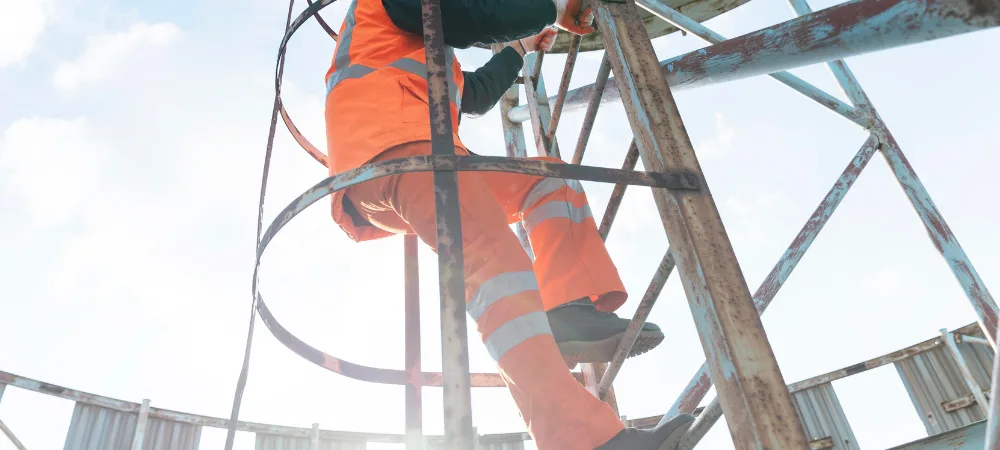
Fall Protection and Working at Height Training Across the UAE
A harness that isn’t clipped to anything is a costume, not equipment — and one of the most common findings on any working-at-height audit is exactly that: correct PPE, worn correctly, connected to nothing. Fall protection only works as a system, and the weakest link decides the outcome, whether that weak link is the anchor point, the lanyard length, or the plan for what happens in the minutes after a fall is actually arrested.
Nathan Safety Training (NIMS) trains the foundational working-at-height and fall protection competency that sits beneath our method-specific courses — Scaffolding, Rope Access, MEWP — covering harness use, anchor point selection, fall arrest versus restraint, and the rescue planning that has to exist before anyone works suspended above the ground.
Why This Sits Beneath Our Other Height-Related Courses
Working at height is explicitly covered under Dubai Municipality’s Code of Construction Safety Practice and ADOSH-SF’s Codes of Practice as a distinct, specifically regulated activity, and falls remain one of the most consistently cited causes of serious construction injury across UAE sites regardless of how much other safety training has improved. This course teaches the underlying principles — hierarchy of fall protection, harness and lanyard use, anchor point assessment, rescue planning — that our Scaffolding, Rope Access and MEWP courses each apply to their specific method.
The hierarchy matters as a decision sequence, not just a list: eliminate the need to work at height first where possible, then use collective protection like guardrails, then fall restraint that prevents reaching a fall hazard at all, and fall arrest — stopping a fall already in progress — only as the last line of defence, not the default plan.
A rescue plan is not optional once fall arrest is in use. A worker left suspended in a harness after a fall is arrested faces a genuine medical risk from suspension trauma within minutes, which means ‘how do we get them down, and how fast’ has to be answered before the work starts, not improvised afterward.
What an Unprotected Fall Actually Costs
Falls from height are disproportionately represented in the most serious injury outcomes reviewed across UAE construction sites, and the severity doesn’t scale gently with height — falls from surprisingly modest heights can still cause life-changing injury, which is part of why ‘it’s not that high’ is one of the most dangerous informal judgement calls made on a site.
Beyond the immediate human cost, a fall incident typically triggers an immediate halt to all height-related work across the site pending investigation, and insurers increasingly scrutinise fall protection training records specifically when assessing claims involving height-related injury.
Who Needs This Training
This is a foundational course relevant to almost anyone whose work involves height, before they move to a method-specific course.
- Construction trades working from scaffolding, ladders or fixed platforms
- MEP contractors installing services in elevated plant rooms or ceiling voids
- Facade and building maintenance staff working near unprotected edges
- Warehouse staff accessing high-level racking or mezzanine areas
- Anyone being assessed as a rescue-capable team member for a site working at height
Where We Deliver This Training
Working-at-height demand tracks each emirate’s construction and maintenance activity. We deliver onsite across all seven:
- Dubai — continuous high-rise and infrastructure construction generates the country’s highest working-at-height training volume across trades
- Abu Dhabi — government megaprojects and industrial facility maintenance both carry significant working-at-height exposure
- Sharjah — Industrial Areas facility maintenance and construction, generally lower-rise work than Dubai’s tower sites
- Ajman — the mid-rise residential construction boom is driving fall protection training demand faster than many contractors’ existing programmes have kept pace with
- Ras Al Khaimah — industrial and quarrying facility access work, alongside growing hospitality construction
- Fujairah — FOIZ terminal structure access and maintenance work at height
- Umm Al Quwain — smaller-scale construction and maintenance, still requiring the same fall protection fundamentals
Hierarchy of Fall Protection
Level | Approach | Example |
1 — Eliminate | Remove the need to work at height at all | Assemble at ground level, then lift into place |
2 — Prevent | Collective protection that stops a fall happening | Guardrails, edge protection |
3 — Restrain | Prevent the worker reaching the fall hazard | Restraint lanyard limiting travel distance |
4 — Arrest | Stop a fall already in progress | Fall arrest harness and energy-absorbing lanyard |
Where Fall Protection Systems Actually Fail
The PPE is almost always present. The system connecting it to something solid is where the gap actually sits.
If I had to check one thing first on any working-at-height audit, it’s whether the anchor point being used is rated for fall arrest specifically — not just something sturdy-looking nearby.
- Harness worn correctly but not actually clipped to a rated anchor point — present as PPE, absent as protection
- Anchor points selected because they’re convenient and look strong, without confirming their actual rated capacity
- Fall arrest used where simple restraint would have prevented reaching the hazard at all — skipping straight to the last line of defence
- No rescue plan for a worker left suspended after a fall is arrested, despite the genuine time-critical risk of suspension trauma
- Lanyard length not adjusted for the specific height available, creating a real risk of hitting the ground or a lower level before the system arrests the fall
How We Teach the Hierarchy, Not Just the Harness
We built this course as the shared foundation underneath our other height-related training specifically, so a worker moving between scaffolding, rope access or MEWP work carries the same core judgement with them rather than relearning fall protection principles from scratch each time.
hsemanpower.ae, part of the same group, can supply additional fall-protection-certified personnel for projects needing capacity as well as certification for their existing team.
- The elimination-to-arrest hierarchy taught as a genuine decision sequence, not a poster on the wall
- Anchor point assessment as hands-on, site-specific judgement, not a generic ‘find something solid’ instruction
- Rescue planning built into every course, including suspension trauma awareness and practical retrieval methods
- Content that feeds directly into our Scaffolding, Rope Access and MEWP courses, so the fundamentals are consistent across every method
- PPE inspection habits taught as a pre-use routine, not an annual formality
Nathan Safety Training (NIMS) trains the foundational working-at-height and fall protection competency that sits beneath our method-specific courses — Scaffolding, Rope Access, MEWP — covering harness use, anchor point selection, fall arrest versus restraint, and the rescue planning that has to exist before anyone works suspended above the ground.
FAQ
How is this different from your Scaffolding, Rope Access and MEWP courses?
This course covers the foundational principles — harness use, anchor points, the fall protection hierarchy, rescue planning — that apply across any working-at-height method. Scaffolding, Rope Access and MEWP each then apply those principles to their specific equipment and technique. Most workers need this foundational course before or alongside the method-specific one.
What's the difference between fall restraint and fall arrest?
Restraint prevents a worker physically reaching a fall hazard at all, by limiting how far a lanyard lets them travel. Arrest stops a fall that’s already happening, after the worker has gone over the edge. Restraint is the safer, preferred approach wherever it’s achievable — arrest is the last line of defence, not the default plan.
Why does a rescue plan matter if the fall arrest system already stopped the fall?
A worker left suspended in a harness after arrest faces a genuine risk of suspension trauma within minutes, caused by the harness restricting blood flow while hanging motionless. Getting them down quickly is time-critical, which means the rescue method has to be planned and rehearsed before the work starts, not figured out after a fall happens.
What counts as a valid anchor point?
One rated by a competent person or manufacturer specifically for fall arrest loads — not simply something that looks sturdy. Structural steel, purpose-built anchor points and engineered systems qualify; an assumed-strong pipe or railing generally doesn’t without verification.
Is there a minimum height at which this training becomes necessary?
UAE working-at-height guidance doesn’t set a single blanket trigger height, and falls from surprisingly modest heights can still cause serious injury — the safer approach is applying the hierarchy of controls to any work where a fall is possible, rather than waiting for a specific height threshold.
Do you train on ladder safety, or only harness-based fall protection?
Yes, ladder safety and the judgement of when a ladder is genuinely appropriate versus when it should be replaced by a safer method sits inside this course, since ladders remain a disproportionately common source of height-related injury despite feeling low-risk.
How long does Fall Protection training take?
Our core course runs one day, covering the hierarchy of controls, harness and lanyard use, anchor point assessment and rescue planning, with hands-on equipment practice included.
How long is certification valid?
We recommend renewal every two to three years, and immediately following any fall-related incident or near-miss, given how much of this depends on consistent habit rather than one-time understanding.
Do you inspect our existing harnesses and PPE as part of the course?
We can, and we recommend it — fall arrest equipment has a defined service life and inspection schedule, and equipment past its usable condition is a common finding we flag during onsite delivery.
Is this course a prerequisite for your Rope Access or MEWP courses?
It’s not a strict formal prerequisite, but we strongly recommend it as the foundation, since it establishes the fall protection hierarchy and rescue planning principles that both of those method-specific courses build directly on.
Can this be combined with Scaffolding Erection training?
Yes, and many clients schedule them together, since scaffold erectors are working at height throughout the build phase and benefit directly from the fall protection fundamentals alongside scaffold-specific technique.
Do you deliver this training across all seven emirates?
Yes, across Dubai, Abu Dhabi, Sharjah, Ajman, Ras Al Khaimah, Fujairah and Umm Al Quwain, ideally conducted against your actual work-at-height scenarios and equipment.
Book Fall Protection Training
Whether your team needs foundational fall protection before moving to a method-specific course, or a refresher for an existing height-work crew, tell us your typical work-at-height scenarios and we’ll scope accordingly.
Nathan Safety Training (NIMS) — Fall protection and working at height training across Dubai, Abu Dhabi, Sharjah, Ajman, Ras Al Khaimah, Fujairah and Umm Al Quwain.