

Home / H2S Awareness & Breathing Apparatus Training
H2s awareness & Breathing Apparatus Training
H2S Doesn't Warn You Twice: Awareness & Breathing Apparatus Training for UAE Oil & Gas
Hydrogen sulphide announces itself as a rotten-egg smell at low concentration — and then, at the concentrations that actually kill, it shuts down the sense of smell entirely within a breath or two. The gas that warned you a moment ago goes silent right when the danger is highest, which is exactly why H2S is treated differently from almost every other industrial hazard: there is no reliable human early warning system, only trained response and instrumentation.
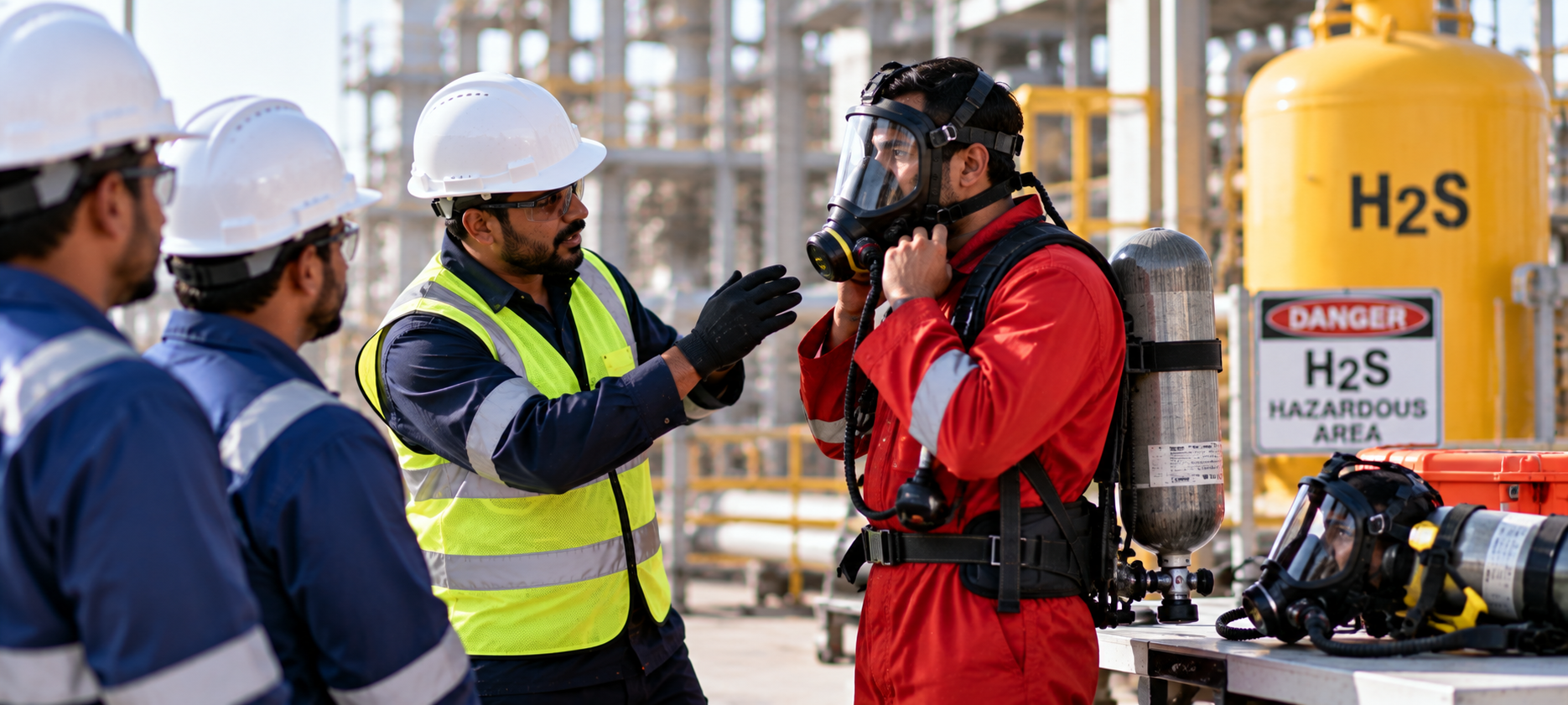
Nathan Safety Training (NIMS) trains personnel across UAE oil, gas, petrochemical and wastewater operations to recognise H2S exposure, operate gas detection correctly, and use escape and self-contained breathing apparatus under the pressure of an actual alarm — not just understand the theory in a classroom.
Why H2S Gets Its Own Course, Not a Mention Inside Chemical Safety
H2S training in the UAE oil and gas sector commonly aligns with OPITO’s internationally recognised Basic H2S standard, and ADNOC facilities typically expect personnel to hold H2S Level 2 Awareness & Escape competency before working in exposure-prone areas — well sites, gas plants, tank farms, pipelines and sewage or wastewater systems all fall inside that scope. Where H2S risk overlaps with confined space entry, which it frequently does, Abu Dhabi’s ADOSH-SF confined space Code of Practice applies alongside the H2S-specific competency requirement, not instead of it.
Recognised occupational exposure references — a recommended exposure limit around 10 ppm, an OSHA-style ceiling limit around 20 ppm, and an immediately-dangerous-to-life-or-health threshold around 100 ppm — illustrate exactly why this can’t be folded into a general chemical safety overview: the margin between ‘detectable’ and ‘immediately dangerous’ is narrow, and it closes fast.
If a specific client or ADNOC contract explicitly requires OPITO-badged certification, tell us in advance — OPITO operates as a formal accredited assessment scheme with its own certification pathway, and we’ll advise on the right route alongside training aligned to the same standard.
What an Untrained Response to H2S Actually Costs
H2S incidents escalate faster than almost any other industrial hazard because the danger window is measured in seconds to minutes, not the longer timelines that apply to chemical exposure or fire. A single collapsed worker in an H2S environment has historically been followed by a second casualty — a colleague attempting rescue without protection — which is precisely why ‘no unprotected rescue attempts’ is trained as an absolute rule, not a preference.
Beyond the immediate human stakes, an H2S incident on an ADNOC-contracted site typically triggers an immediate work stoppage across the surrounding area, a full incident investigation, and scrutiny of every other contractor’s H2S competency documentation on that project — a considerably larger operational disruption than the training that would have prevented it.
Who Needs This Training
H2S exposure risk concentrates in specific environments, but those environments span more industries than oil and gas alone.
- Oil, gas and petrochemical operators — well sites, gas plants, tank farms, pipeline maintenance
- Marine and offshore personnel working near produced water or sour gas processes
- Wastewater and sewage treatment operators, where H2S generation from organic decomposition is common
- Confined space entrants and attendants working in tanks, pits or vessels with potential H2S accumulation
- Construction and utility crews excavating near older sewage or industrial infrastructure
Where We Deliver This Training
H2S exposure risk concentrates heavily around the UAE’s oil, gas and terminal infrastructure. We deliver onsite across all seven:
- Dubai — wastewater and utility infrastructure carries the primary H2S exposure risk here, distinct from the upstream oil & gas exposure common elsewhere
- Abu Dhabi — ADNOC group onshore and offshore operations represent the highest-volume H2S training demand in the country, frequently requiring Level 2 Awareness & Escape competency
- Sharjah — Hamriyah Free Zone’s industrial and process operations carry H2S exposure risk in specific processing contexts
- Ajman — lower H2S exposure risk overall, concentrated mainly around wastewater and utility infrastructure
- Ras Al Khaimah — industrial processing operations with occasional H2S exposure in specific process contexts
- Fujairah — FOIZ’s concentration of oil storage and bunkering operations makes this one of our most requested H2S training locations outside Abu Dhabi
- Umm Al Quwain — limited current exposure risk, mainly wastewater-related where relevant
H2S Exposure Reference Levels
Threshold | Approx. Level | Significance |
Recommended Exposure Limit (REL) | ~10 ppm | Level above which prolonged exposure is considered hazardous |
Ceiling Limit | ~20 ppm | Concentration that should never be exceeded, even briefly |
Olfactory Fatigue Onset | ~100 ppm and above | Sense of smell can shut down, removing the odour warning entirely |
Immediately Dangerous to Life or Health (IDLH) | ~100 ppm | Immediate threat to life; escape/rescue response required |
Where H2S Response Actually Breaks Down
Almost every serious H2S incident we review involves at least one of two failures: a detector that wasn’t actually functioning correctly, or a colleague attempting rescue without protection.
If I had to check one thing on any H2S-classified site, it’s whether personal gas detectors are genuinely bump-tested on the schedule the log claims, not just carried.
- Personal H2S monitors carried but not regularly bump-tested or calibrated, trusted anyway because the screen still lights up
- A colleague attempting to rescue a collapsed worker without donning breathing apparatus first — the single most common cause of a second casualty
- Escape breathing apparatus stored but not practised with, so donning takes far longer than the seconds it needs to under a real alarm
- Wind direction not factored into muster point selection during an actual response
- Confined space entry into a known or suspected H2S environment without the specific H2S competency layered on top of general confined space training
How We Train for the Seconds That Actually Matter
We built this course around donning speed and rescue discipline specifically, because H2S response is measured in seconds and theoretical knowledge alone doesn’t hold up under that time pressure.
hsemanpower.ae, part of the same group, can supply additional H2S-competent personnel for operators needing capacity as well as certification, and Nathan ISO Consulting can align this training with wider ISO 45001 process safety documentation.
- Hands-on donning practice with escape and self-contained breathing apparatus under timed conditions, not just equipment familiarisation
- Gas detection training on the instrument types most common across UAE oil & gas operations, including bump-test and calibration discipline
- The ‘no unprotected rescue’ rule trained as an absolute, with practical alternative response drilled repeatedly
- Course content aligned to OPITO’s Basic H2S standard and ADNOC H2S Level 2 expectations
- Scenario-based emergency response drills, not classroom theory alone
Courses Offered
- First Aid Course - CPR and AED
- Confined Space
- Fire Safety Awareness
- Scaffolding Inspection
- Scaffolding Erection & Dismantling
- Flagman Safety
- Chemical Safety and Handling Training
- Hazard and Risk Assessment
- Rigging and Slinging Training
- Traffic Safety
- Hand and Power Tools Operator
- Electrical Safety
- Lock Out and Tag Out (LOTO)
- Accident Incident Investigation
- Lifeguard Training
- Advanced Risk Assessment & Compliance Service
- Behavior-Based Safety Workplace Safety Consulting
- Construction Site Safety Induction Training
- Emergency Response Team Training
- Excavator Operator Training
- Forklift Operator Training
- H2S Awareness & Breathing Apparatus Training
- Hot Work Safety Training
- Incident Reporting & Root Cause Analysis Service
- MEWP Operator Training
- Mobile Crane Operator Training
- Permit to Work System Training
- Rope Access Training
- Working at Height & Fall Protection Safety Training
- Oil & Gas Safety Training
- Fire Warden Training
- Manual Handling Training
- Banksman Safety Training
- Gas Tester Training
- Defensive Driving Training
- HAZMAT Awareness Training
- Machine Safety and Machine Guarding Training
- Spill Response and Spill Control Training
- Welding Safety Training
Need expert advice? Speak to our team today
FAQ
Is this the same as OPITO H2S certification?
OPITO is a specific accredited assessment scheme with its own formal certification pathway. Our training aligns with OPITO’s Basic H2S standard and ADNOC H2S Level 2 expectations — if your contract specifically requires an OPITO-badged certificate, tell us in advance and we’ll advise on the appropriate route.
Why can't I smell H2S at dangerous concentrations if it has a strong odour at low levels?
H2S causes olfactory fatigue — at higher, genuinely dangerous concentrations, it deadens the sense of smell within a breath or two, which is precisely why smell can’t be relied on as a warning system and gas detection instrumentation is treated as mandatory rather than optional.
What should someone do if a colleague collapses in a suspected H2S environment?
Raise the alarm, evacuate to the muster point accounting for wind direction, and never attempt an unprotected rescue — a second person entering without breathing apparatus becomes a second casualty far more often than a successful rescue. Trained, protected rescue response is the only safe intervention.
Does this course include breathing apparatus training, or is that separate?
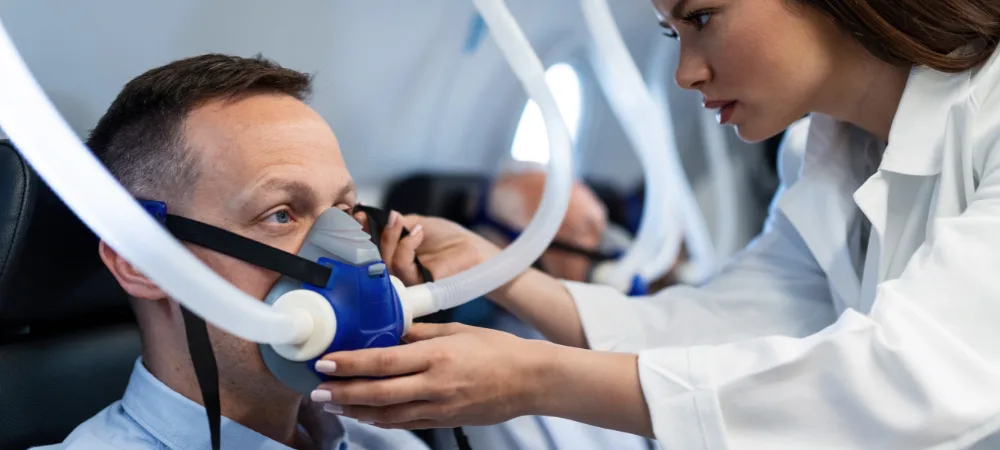
It’s included — escape breathing apparatus (EBA) and self-contained breathing apparatus (SCBA) hands-on donning and use are core to this course, not an optional add-on, since awareness without the practical response skill doesn’t actually protect anyone.
How often should personal H2S monitors be bump-tested?
Before every use at minimum, with periodic full calibration on a defined schedule — a monitor that hasn’t been genuinely bump-tested is one of the most common single points of failure we find behind H2S incidents.
Is H2S training relevant outside oil and gas, such as wastewater treatment?
Yes — H2S is commonly generated by organic decomposition in sewage and wastewater systems, and confined space entry into pits, tanks or drains in that sector carries genuine H2S exposure risk requiring the same competency.
How does this relate to your Confined Space training?
They’re complementary, not interchangeable — Confined Space training covers general atmospheric testing, permit and rescue principles across all confined space hazards. This course covers H2S specifically in depth, including breathing apparatus use, and is often required in addition to general confined space training where H2S risk is present.
How long does H2S Awareness & Breathing Apparatus training take?
Our core course typically runs one day, combining classroom content on H2S properties and detection with hands-on breathing apparatus donning and emergency response practice.
How long is H2S certification valid?
Industry practice generally treats H2S competency as valid for two years, consistent with how quickly emergency response skills under pressure decay without refresher practice.
Is this training required before entering an ADNOC-contracted site?
For roles working in H2S-prone areas, yes — ADNOC group companies typically require documented H2S Level 2 Awareness & Escape competency before authorising personnel into exposure-prone zones.
Do you provide the breathing apparatus equipment, or train on what our site already has?
We train hands-on with breathing apparatus equipment, and wherever possible we train directly on the specific SCBA or EBA models your site actually deploys, since familiarity with your own equipment under pressure matters more than generic exposure to a different model.
Do you deliver this training across all seven emirates?
Yes, with the highest concentration of delivery in Abu Dhabi and Fujairah given the density of oil, gas and terminal operations in those emirates.
- First Aid Course - CPR and AED
- Confined Space
- Fire Safety Awareness
- Scaffolding Inspection
- Scaffolding Erection & Dismantling
- Flagman Safety
- Chemical Safety and Handling Training
- Hazard and Risk Assessment
- Rigging and Slinging Training
- Traffic Safety
- Hand and Power Tools Operator
- Electrical Safety
- Lock Out and Tag Out (LOTO)
- Accident Incident Investigation
- Lifeguard Training
- Advanced Risk Assessment & Compliance Service
- Behavior-Based Safety Workplace Safety Consulting
- Construction Site Safety Induction Training
- Emergency Response Team Training
- Excavator Operator Training
- Forklift Operator Training
- H2S Awareness & Breathing Apparatus Training
- Hot Work Safety Training
- Incident Reporting & Root Cause Analysis Service
- MEWP Operator Training
- Mobile Crane Operator Training
- Permit to Work System Training
- Rope Access Training
- Working at Height & Fall Protection Safety Training
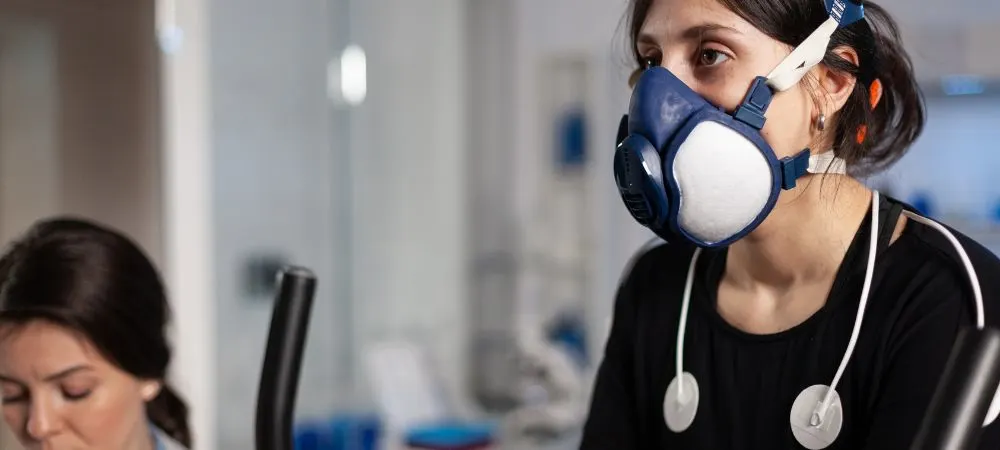
H2S Doesn't Warn You Twice: Awareness & Breathing Apparatus Training for UAE Oil & Gas
Hydrogen sulphide announces itself as a rotten-egg smell at low concentration — and then, at the concentrations that actually kill, it shuts down the sense of smell entirely within a breath or two. The gas that warned you a moment ago goes silent right when the danger is highest, which is exactly why H2S is treated differently from almost every other industrial hazard: there is no reliable human early warning system, only trained response and instrumentation.
Nathan Safety Training (NIMS) trains personnel across UAE oil, gas, petrochemical and wastewater operations to recognise H2S exposure, operate gas detection correctly, and use escape and self-contained breathing apparatus under the pressure of an actual alarm — not just understand the theory in a classroom.
Why H2S Gets Its Own Course, Not a Mention Inside Chemical Safety
H2S training in the UAE oil and gas sector commonly aligns with OPITO’s internationally recognised Basic H2S standard, and ADNOC facilities typically expect personnel to hold H2S Level 2 Awareness & Escape competency before working in exposure-prone areas — well sites, gas plants, tank farms, pipelines and sewage or wastewater systems all fall inside that scope. Where H2S risk overlaps with confined space entry, which it frequently does, Abu Dhabi’s ADOSH-SF confined space Code of Practice applies alongside the H2S-specific competency requirement, not instead of it.
Recognised occupational exposure references — a recommended exposure limit around 10 ppm, an OSHA-style ceiling limit around 20 ppm, and an immediately-dangerous-to-life-or-health threshold around 100 ppm — illustrate exactly why this can’t be folded into a general chemical safety overview: the margin between ‘detectable’ and ‘immediately dangerous’ is narrow, and it closes fast.
If a specific client or ADNOC contract explicitly requires OPITO-badged certification, tell us in advance — OPITO operates as a formal accredited assessment scheme with its own certification pathway, and we’ll advise on the right route alongside training aligned to the same standard.
What an Untrained Response to H2S Actually Costs
H2S incidents escalate faster than almost any other industrial hazard because the danger window is measured in seconds to minutes, not the longer timelines that apply to chemical exposure or fire. A single collapsed worker in an H2S environment has historically been followed by a second casualty — a colleague attempting rescue without protection — which is precisely why ‘no unprotected rescue attempts’ is trained as an absolute rule, not a preference.
Beyond the immediate human stakes, an H2S incident on an ADNOC-contracted site typically triggers an immediate work stoppage across the surrounding area, a full incident investigation, and scrutiny of every other contractor’s H2S competency documentation on that project — a considerably larger operational disruption than the training that would have prevented it.
Who Needs This Training
H2S exposure risk concentrates in specific environments, but those environments span more industries than oil and gas alone.
- Oil, gas and petrochemical operators — well sites, gas plants, tank farms, pipeline maintenance
- Marine and offshore personnel working near produced water or sour gas processes
- Wastewater and sewage treatment operators, where H2S generation from organic decomposition is common
- Confined space entrants and attendants working in tanks, pits or vessels with potential H2S accumulation
- Construction and utility crews excavating near older sewage or industrial infrastructure
Where We Deliver This Training
H2S exposure risk concentrates heavily around the UAE’s oil, gas and terminal infrastructure. We deliver onsite across all seven:
- Dubai — wastewater and utility infrastructure carries the primary H2S exposure risk here, distinct from the upstream oil & gas exposure common elsewhere
- Abu Dhabi — ADNOC group onshore and offshore operations represent the highest-volume H2S training demand in the country, frequently requiring Level 2 Awareness & Escape competency
- Sharjah — Hamriyah Free Zone’s industrial and process operations carry H2S exposure risk in specific processing contexts
- Ajman — lower H2S exposure risk overall, concentrated mainly around wastewater and utility infrastructure
- Ras Al Khaimah — industrial processing operations with occasional H2S exposure in specific process contexts
- Fujairah — FOIZ’s concentration of oil storage and bunkering operations makes this one of our most requested H2S training locations outside Abu Dhabi
- Umm Al Quwain — limited current exposure risk, mainly wastewater-related where relevant
H2S Exposure Reference Levels
Threshold | Approx. Level | Significance |
Recommended Exposure Limit (REL) | ~10 ppm | Level above which prolonged exposure is considered hazardous |
Ceiling Limit | ~20 ppm | Concentration that should never be exceeded, even briefly |
Olfactory Fatigue Onset | ~100 ppm and above | Sense of smell can shut down, removing the odour warning entirely |
Immediately Dangerous to Life or Health (IDLH) | ~100 ppm | Immediate threat to life; escape/rescue response required |
Where H2S Response Actually Breaks Down
Almost every serious H2S incident we review involves at least one of two failures: a detector that wasn’t actually functioning correctly, or a colleague attempting rescue without protection.
If I had to check one thing on any H2S-classified site, it’s whether personal gas detectors are genuinely bump-tested on the schedule the log claims, not just carried.
- Personal H2S monitors carried but not regularly bump-tested or calibrated, trusted anyway because the screen still lights up
- A colleague attempting to rescue a collapsed worker without donning breathing apparatus first — the single most common cause of a second casualty
- Escape breathing apparatus stored but not practised with, so donning takes far longer than the seconds it needs to under a real alarm
- Wind direction not factored into muster point selection during an actual response
- Confined space entry into a known or suspected H2S environment without the specific H2S competency layered on top of general confined space training
How We Train for the Seconds That Actually Matter
We built this course around donning speed and rescue discipline specifically, because H2S response is measured in seconds and theoretical knowledge alone doesn’t hold up under that time pressure.
hsemanpower.ae, part of the same group, can supply additional H2S-competent personnel for operators needing capacity as well as certification, and Nathan ISO Consulting can align this training with wider ISO 45001 process safety documentation.
- Hands-on donning practice with escape and self-contained breathing apparatus under timed conditions, not just equipment familiarisation
- Gas detection training on the instrument types most common across UAE oil & gas operations, including bump-test and calibration discipline
- The ‘no unprotected rescue’ rule trained as an absolute, with practical alternative response drilled repeatedly
- Course content aligned to OPITO’s Basic H2S standard and ADNOC H2S Level 2 expectations
- Scenario-based emergency response drills, not classroom theory alone
FAQ
Is this the same as OPITO H2S certification?
OPITO is a specific accredited assessment scheme with its own formal certification pathway. Our training aligns with OPITO’s Basic H2S standard and ADNOC H2S Level 2 expectations — if your contract specifically requires an OPITO-badged certificate, tell us in advance and we’ll advise on the appropriate route.
Why can't I smell H2S at dangerous concentrations if it has a strong odour at low levels?
H2S causes olfactory fatigue — at higher, genuinely dangerous concentrations, it deadens the sense of smell within a breath or two, which is precisely why smell can’t be relied on as a warning system and gas detection instrumentation is treated as mandatory rather than optional.
What should someone do if a colleague collapses in a suspected H2S environment?
Raise the alarm, evacuate to the muster point accounting for wind direction, and never attempt an unprotected rescue — a second person entering without breathing apparatus becomes a second casualty far more often than a successful rescue. Trained, protected rescue response is the only safe intervention.
Does this course include breathing apparatus training, or is that separate?
It’s included — escape breathing apparatus (EBA) and self-contained breathing apparatus (SCBA) hands-on donning and use are core to this course, not an optional add-on, since awareness without the practical response skill doesn’t actually protect anyone.
How often should personal H2S monitors be bump-tested?
Before every use at minimum, with periodic full calibration on a defined schedule — a monitor that hasn’t been genuinely bump-tested is one of the most common single points of failure we find behind H2S incidents.
Is H2S training relevant outside oil and gas, such as wastewater treatment?
Yes — H2S is commonly generated by organic decomposition in sewage and wastewater systems, and confined space entry into pits, tanks or drains in that sector carries genuine H2S exposure risk requiring the same competency.
How does this relate to your Confined Space training?
They’re complementary, not interchangeable — Confined Space training covers general atmospheric testing, permit and rescue principles across all confined space hazards. This course covers H2S specifically in depth, including breathing apparatus use, and is often required in addition to general confined space training where H2S risk is present.
How long does H2S Awareness & Breathing Apparatus training take?
Our core course typically runs one day, combining classroom content on H2S properties and detection with hands-on breathing apparatus donning and emergency response practice.
How long is H2S certification valid?
Industry practice generally treats H2S competency as valid for two years, consistent with how quickly emergency response skills under pressure decay without refresher practice.
Is this training required before entering an ADNOC-contracted site?
For roles working in H2S-prone areas, yes — ADNOC group companies typically require documented H2S Level 2 Awareness & Escape competency before authorising personnel into exposure-prone zones.
Do you provide the breathing apparatus equipment, or train on what our site already has?
We train hands-on with breathing apparatus equipment, and wherever possible we train directly on the specific SCBA or EBA models your site actually deploys, since familiarity with your own equipment under pressure matters more than generic exposure to a different model.
Do you deliver this training across all seven emirates?
Yes, with the highest concentration of delivery in Abu Dhabi and Fujairah given the density of oil, gas and terminal operations in those emirates.
Book H2S & Breathing Apparatus Training
Whether you need Basic H2S awareness or full breathing apparatus competency for personnel working in exposure-prone zones, tell us your site type and we’ll scope the right level.
Nathan Safety Training (NIMS) — H2S awareness and breathing apparatus training across Dubai, Abu Dhabi, Sharjah, Ajman, Ras Al Khaimah, Fujairah and Umm Al Quwain.