

Home / Excavator Operator Training
Excavator Operator Training
Excavator Operator Training UAE: The Workplace Competency Certificate Your RTA License Doesn't Cover
An RTA Category 8 licence proves an operator can legally drive an excavator. It doesn’t prove they can read a specific site’s ground conditions, judge a load chart on a slope, or recognise where a buried utility line changes everything about how deep it’s safe to dig. Those are two genuinely different competencies, tested by two different bodies, and UAE sites need both — confusing one for the other is a common and avoidable gap.
Nathan Safety Training (NIMS) provides the workplace competency certification — the site-safety layer that sits alongside, not instead of, an operator’s RTA driving licence — covering ground assessment, utility strike prevention, load handling and the specific hazards Dubai Municipality and ADOSH-SF inspectors actually check for.
Two Certificates, Two Different Purposes
UAE regulation actually splits excavator operation into two separate requirements that are frequently confused. The RTA Category 8 Heavy Mechanical Equipment licence is the federal legal requirement to drive the machine at all, obtained through an authorised driving institute after a road test, with a minimum age of twenty. Separately, workplace safety regulation — Dubai Municipality’s Code of Construction Safety Practice and ADOSH-SF in Abu Dhabi — requires a workplace competency certificate that validates whether the operator actually understands site-specific hazards: blind spots, load charts, ground stability and buried services.
A worker can legally hold an RTA licence and still be genuinely unsafe to operate on a specific site without this second layer — the RTA test doesn’t examine site-specific ground conditions, utility strike risk or the excavation method statement a particular project requires.
We issue the workplace competency certificate. If your operator doesn’t yet hold the RTA Category 8 licence itself, we can point you to an authorised driving institute for that separate legal requirement — the two processes run in parallel, not in sequence, and both are needed before an operator should be working unsupervised.
What an Untrained Operator Actually Risks
Excavator incidents concentrate around a small set of repeat causes: utility strikes on buried gas, water or electrical lines, trench or excavation wall collapse, and struck-by incidents involving the machine’s swing radius and ground personnel. Each of these is preventable through competency the RTA driving test doesn’t examine at all.
A utility strike specifically carries cost well beyond the excavator work itself — service disruption, emergency response mobilisation, and in the case of a gas line, an evacuation radius that can shut down an entire area of a project for hours or days while the incident is managed and investigated.
Who Needs This Certification
This applies to anyone operating excavation equipment on a UAE construction, utility or industrial site.
- Construction contractors carrying out foundation, basement or trenching excavation work
- Utility contractors excavating near or across existing gas, water, electrical or telecom infrastructure
- Demolition contractors using excavators for structural clearance
- Landscaping and infrastructure contractors on larger civil projects
- Plant hire companies certifying operators before deployment to a client site
Where We Deliver This Training
Ground conditions and utility density both vary significantly by emirate. We deliver onsite across all seven:
- Dubai — dense underground utility networks across established areas make utility strike prevention the dominant focus, alongside deep basement excavation for high-rise foundations
- Abu Dhabi — large-scale government infrastructure and KEZAD industrial excavation, often larger-volume earthworks than typical Dubai commercial sites
- Sharjah — Industrial Areas expansion and facility construction excavation, generally smaller-scale than Dubai or Abu Dhabi megaprojects
- Ajman — growing residential and infrastructure excavation work alongside the emirate’s construction boom
- Ras Al Khaimah — quarrying-adjacent excavation around Al Hamra brings genuinely different ground conditions — rock and aggregate rather than typical soil profiles
- Fujairah — FOIZ-related infrastructure and pipeline excavation, where utility and existing infrastructure awareness carries particularly high consequence
- Umm Al Quwain — smaller-scale excavation work, but the same competency and utility-awareness requirements apply
What Each Certificate Actually Covers
Requirement | Issued By | What It Proves |
RTA Category 8 Licence | RTA-authorised driving institute | Legal right to operate heavy mechanical equipment |
Workplace Competency Certificate | Third-party HSE provider (e.g. NIMS) | Site-safety competency: load charts, ground assessment, utility awareness |
Where Excavator Incidents Actually Trace Back To
Almost none of the incidents we review involve a mechanically faulty machine. Nearly all involve a gap in site-specific awareness that a driving test was never designed to catch.
If a site can’t produce an up-to-date utility drawing before excavation starts, that’s the single biggest red flag we look for — everything downstream depends on that document being accurate and actually consulted.
- Excavation started without confirming current utility drawings against the actual site, relying on outdated plans
- Ground assessment skipped on the assumption that ‘it looked the same as the last job’
- Spotters and ground personnel working inside the machine’s swing radius without the operator’s clear awareness
- Load charts not consulted for slope or reach conditions specific to that day’s excavation
- An operator holding an RTA licence but never assessed against this specific site’s excavation method statement
What Our Workplace Certification Actually Assesses
We built this course around the specific gap the RTA test doesn’t cover, since that’s the gap that actually shows up in incident reviews, not general machine handling.
hsemanpower.ae, part of the same group, can supply additional certified excavator operators for projects needing capacity as well as certification for their existing team.
- Ground assessment and utility strike prevention as a dedicated module, not a passing mention
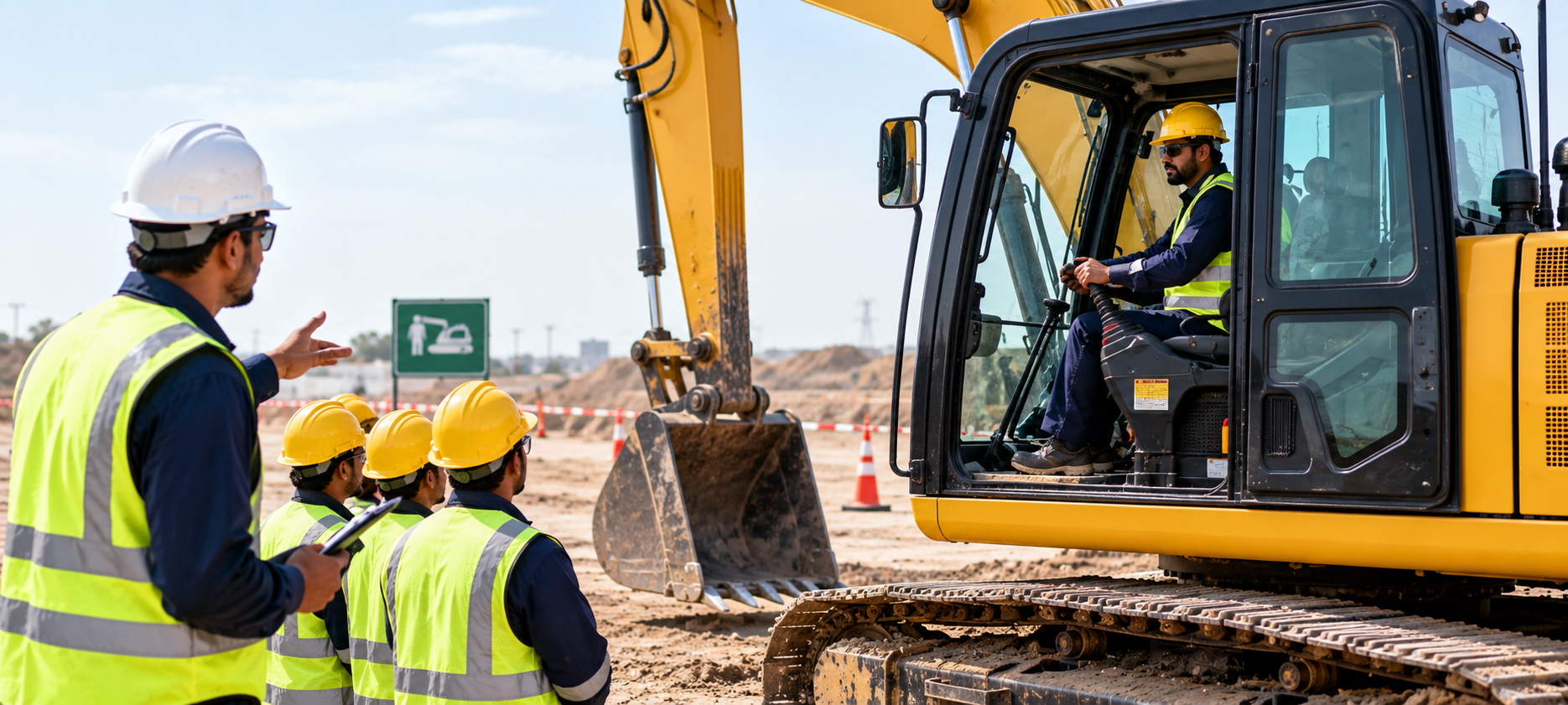
- Practical assessment on your actual site conditions where possible, not a generic training yard only
- Load chart interpretation for slope, reach and ground-bearing variation
- Clear guidance on how this certificate relates to — and doesn’t replace — the RTA Category 8 licensing process
- Certification documentation formatted for immediate production during a Dubai Municipality or ADOSH-SF site inspection
Courses Offered
- First Aid Course - CPR and AED
- Confined Space
- Fire Safety Awareness
- Scaffolding Inspection
- Scaffolding Erection & Dismantling
- Flagman Safety
- Chemical Safety and Handling Training
- Hazard and Risk Assessment
- Rigging and Slinging Training
- Traffic Safety
- Hand and Power Tools Operator
- Electrical Safety
- Lock Out and Tag Out (LOTO)
- Accident Incident Investigation
- Lifeguard Training
- Advanced Risk Assessment & Compliance Service
- Behavior-Based Safety Workplace Safety Consulting
- Construction Site Safety Induction Training
- Emergency Response Team Training
- Excavator Operator Training
- Forklift Operator Training
- H2S Awareness & Breathing Apparatus Training
- Hot Work Safety Training
- Incident Reporting & Root Cause Analysis Service
- MEWP Operator Training
- Mobile Crane Operator Training
- Permit to Work System Training
- Rope Access Training
- Working at Height & Fall Protection Safety Training
- Oil & Gas Safety Training
- Fire Warden Training
- Manual Handling Training
- Banksman Safety Training
- Gas Tester Training
- Defensive Driving Training
- HAZMAT Awareness Training
- Machine Safety and Machine Guarding Training
- Spill Response and Spill Control Training
- Welding Safety Training
Need expert advice? Speak to our team today
FAQ
Do I need an RTA licence and your training, or just one of them?
Both, for different reasons. The RTA Category 8 licence is the legal requirement to operate the machine at all, obtained through an authorised driving institute. Our workplace competency certificate validates site-specific safety knowledge — load charts, ground assessment, utility awareness — that the RTA test doesn’t examine. UAE sites generally expect operators to hold both.
Can you issue the RTA Category 8 licence directly?
No — that licence is issued specifically by RTA-authorised driving institutes after their road test. We issue the separate workplace safety competency certificate. If you need the RTA licence arranged, tell us and we can point you to the right authorised institute.
What's the minimum age to operate an excavator in the UAE?
The RTA Category 8 Heavy Mechanical Equipment licence requires a minimum age of twenty. Our workplace competency training follows the same minimum age expectation.
Does this course cover utility strike prevention specifically?
Yes, as a dedicated module — utility strikes are one of the most common and costly excavator incidents on UAE sites, and confirming current utility drawings against actual ground conditions before digging starts is a core part of what we assess.
Do you assess operators on our actual site, or only in a training yard?
Where practical, yes — assessing against real ground conditions and the actual excavation method statement gives a far more accurate competency picture than a generic training yard alone, and we build this in wherever the site allows it.
How long does the workplace competency course take?
Our core course runs one to two days depending on prior experience, combining theory — load charts, ground assessment, utility awareness — with practical operating assessment.
Is this certification accepted by Dubai Municipality and ADOSH-SF?
Yes, our course content and documentation are built to match what both frameworks expect an employer to demonstrate for excavator operator competency during a site inspection.
How long is the certificate valid?
We recommend renewal every two to three years, or sooner following any incident involving excavation equipment, given how much site-specific judgement is involved beyond basic machine operation.
Do experienced operators from other countries still need this UAE-specific certification?
Yes — prior international experience is valuable but doesn’t substitute for UAE-specific competency assessment, since ground conditions, utility density and the specific regulatory expectations here differ from other markets.
Does this course cover trench and excavation collapse prevention?
Yes — excavation wall stability, shoring requirements and safe approach distances are covered alongside operating competency, since a mechanically correct dig can still collapse if the ground assessment behind it was wrong.
Can plant hire companies certify multiple operators at once before deployment?
Yes, this is a common booking pattern — we can certify a batch of operators together ahead of a project mobilisation rather than one at a time.
Do you deliver this training across all seven emirates?
Yes, adjusted for local ground conditions — rock and aggregate terrain around Ras Al Khaimah’s quarrying areas is a genuinely different assessment context from dense-utility urban excavation in Dubai.
- First Aid Course - CPR and AED
- Confined Space
- Fire Safety Awareness
- Scaffolding Inspection
- Scaffolding Erection & Dismantling
- Flagman Safety
- Chemical Safety and Handling Training
- Hazard and Risk Assessment
- Rigging and Slinging Training
- Traffic Safety
- Hand and Power Tools Operator
- Electrical Safety
- Lock Out and Tag Out (LOTO)
- Accident Incident Investigation
- Lifeguard Training
- Advanced Risk Assessment & Compliance Service
- Behavior-Based Safety Workplace Safety Consulting
- Construction Site Safety Induction Training
- Emergency Response Team Training
- Excavator Operator Training
- Forklift Operator Training
- H2S Awareness & Breathing Apparatus Training
- Hot Work Safety Training
- Incident Reporting & Root Cause Analysis Service
- MEWP Operator Training
- Mobile Crane Operator Training
- Permit to Work System Training
- Rope Access Training
- Working at Height & Fall Protection Safety Training

Excavator Operator Training UAE: The Workplace Competency Certificate Your RTA License Doesn't Cover
An RTA Category 8 licence proves an operator can legally drive an excavator. It doesn’t prove they can read a specific site’s ground conditions, judge a load chart on a slope, or recognise where a buried utility line changes everything about how deep it’s safe to dig. Those are two genuinely different competencies, tested by two different bodies, and UAE sites need both — confusing one for the other is a common and avoidable gap.
Nathan Safety Training (NIMS) provides the workplace competency certification — the site-safety layer that sits alongside, not instead of, an operator’s RTA driving licence — covering ground assessment, utility strike prevention, load handling and the specific hazards Dubai Municipality and ADOSH-SF inspectors actually check for.
Two Certificates, Two Different Purposes
UAE regulation actually splits excavator operation into two separate requirements that are frequently confused. The RTA Category 8 Heavy Mechanical Equipment licence is the federal legal requirement to drive the machine at all, obtained through an authorised driving institute after a road test, with a minimum age of twenty. Separately, workplace safety regulation — Dubai Municipality’s Code of Construction Safety Practice and ADOSH-SF in Abu Dhabi — requires a workplace competency certificate that validates whether the operator actually understands site-specific hazards: blind spots, load charts, ground stability and buried services.
A worker can legally hold an RTA licence and still be genuinely unsafe to operate on a specific site without this second layer — the RTA test doesn’t examine site-specific ground conditions, utility strike risk or the excavation method statement a particular project requires.
We issue the workplace competency certificate. If your operator doesn’t yet hold the RTA Category 8 licence itself, we can point you to an authorised driving institute for that separate legal requirement — the two processes run in parallel, not in sequence, and both are needed before an operator should be working unsupervised.
What an Untrained Operator Actually Risks
Excavator incidents concentrate around a small set of repeat causes: utility strikes on buried gas, water or electrical lines, trench or excavation wall collapse, and struck-by incidents involving the machine’s swing radius and ground personnel. Each of these is preventable through competency the RTA driving test doesn’t examine at all.
A utility strike specifically carries cost well beyond the excavator work itself — service disruption, emergency response mobilisation, and in the case of a gas line, an evacuation radius that can shut down an entire area of a project for hours or days while the incident is managed and investigated.
Who Needs This Certification
This applies to anyone operating excavation equipment on a UAE construction, utility or industrial site.
- Construction contractors carrying out foundation, basement or trenching excavation work
- Utility contractors excavating near or across existing gas, water, electrical or telecom infrastructure
- Demolition contractors using excavators for structural clearance
- Landscaping and infrastructure contractors on larger civil projects
- Plant hire companies certifying operators before deployment to a client site
Where We Deliver This Training
Ground conditions and utility density both vary significantly by emirate. We deliver onsite across all seven:
- Dubai — dense underground utility networks across established areas make utility strike prevention the dominant focus, alongside deep basement excavation for high-rise foundations
- Abu Dhabi — large-scale government infrastructure and KEZAD industrial excavation, often larger-volume earthworks than typical Dubai commercial sites
- Sharjah — Industrial Areas expansion and facility construction excavation, generally smaller-scale than Dubai or Abu Dhabi megaprojects
- Ajman — growing residential and infrastructure excavation work alongside the emirate’s construction boom
- Ras Al Khaimah — quarrying-adjacent excavation around Al Hamra brings genuinely different ground conditions — rock and aggregate rather than typical soil profiles
- Fujairah — FOIZ-related infrastructure and pipeline excavation, where utility and existing infrastructure awareness carries particularly high consequence
- Umm Al Quwain — smaller-scale excavation work, but the same competency and utility-awareness requirements apply
What Each Certificate Actually Covers
Requirement | Issued By | What It Proves |
RTA Category 8 Licence | RTA-authorised driving institute | Legal right to operate heavy mechanical equipment |
Workplace Competency Certificate | Third-party HSE provider (e.g. NIMS) | Site-safety competency: load charts, ground assessment, utility awareness |
Where Excavator Incidents Actually Trace Back To
Almost none of the incidents we review involve a mechanically faulty machine. Nearly all involve a gap in site-specific awareness that a driving test was never designed to catch.
If a site can’t produce an up-to-date utility drawing before excavation starts, that’s the single biggest red flag we look for — everything downstream depends on that document being accurate and actually consulted.
- Excavation started without confirming current utility drawings against the actual site, relying on outdated plans
- Ground assessment skipped on the assumption that ‘it looked the same as the last job’
- Spotters and ground personnel working inside the machine’s swing radius without the operator’s clear awareness
- Load charts not consulted for slope or reach conditions specific to that day’s excavation
- An operator holding an RTA licence but never assessed against this specific site’s excavation method statement
What Our Workplace Certification Actually Assesses
We built this course around the specific gap the RTA test doesn’t cover, since that’s the gap that actually shows up in incident reviews, not general machine handling.
hsemanpower.ae, part of the same group, can supply additional certified excavator operators for projects needing capacity as well as certification for their existing team.
- Ground assessment and utility strike prevention as a dedicated module, not a passing mention
- Practical assessment on your actual site conditions where possible, not a generic training yard only
- Load chart interpretation for slope, reach and ground-bearing variation
- Clear guidance on how this certificate relates to — and doesn’t replace — the RTA Category 8 licensing process
- Certification documentation formatted for immediate production during a Dubai Municipality or ADOSH-SF site inspection
FAQ
Do I need an RTA licence and your training, or just one of them?
Both, for different reasons. The RTA Category 8 licence is the legal requirement to operate the machine at all, obtained through an authorised driving institute. Our workplace competency certificate validates site-specific safety knowledge — load charts, ground assessment, utility awareness — that the RTA test doesn’t examine. UAE sites generally expect operators to hold both.
Can you issue the RTA Category 8 licence directly?
No — that licence is issued specifically by RTA-authorised driving institutes after their road test. We issue the separate workplace safety competency certificate. If you need the RTA licence arranged, tell us and we can point you to the right authorised institute.
What's the minimum age to operate an excavator in the UAE?
The RTA Category 8 Heavy Mechanical Equipment licence requires a minimum age of twenty. Our workplace competency training follows the same minimum age expectation.
Does this course cover utility strike prevention specifically?
Yes, as a dedicated module — utility strikes are one of the most common and costly excavator incidents on UAE sites, and confirming current utility drawings against actual ground conditions before digging starts is a core part of what we assess.
Do you assess operators on our actual site, or only in a training yard?
Where practical, yes — assessing against real ground conditions and the actual excavation method statement gives a far more accurate competency picture than a generic training yard alone, and we build this in wherever the site allows it.
How long does the workplace competency course take?
Our core course runs one to two days depending on prior experience, combining theory — load charts, ground assessment, utility awareness — with practical operating assessment.
Is this certification accepted by Dubai Municipality and ADOSH-SF?
Yes, our course content and documentation are built to match what both frameworks expect an employer to demonstrate for excavator operator competency during a site inspection.
How long is the certificate valid?
We recommend renewal every two to three years, or sooner following any incident involving excavation equipment, given how much site-specific judgement is involved beyond basic machine operation.
Do experienced operators from other countries still need this UAE-specific certification?
Yes — prior international experience is valuable but doesn’t substitute for UAE-specific competency assessment, since ground conditions, utility density and the specific regulatory expectations here differ from other markets.
Does this course cover trench and excavation collapse prevention?
Yes — excavation wall stability, shoring requirements and safe approach distances are covered alongside operating competency, since a mechanically correct dig can still collapse if the ground assessment behind it was wrong.
Can plant hire companies certify multiple operators at once before deployment?
Yes, this is a common booking pattern — we can certify a batch of operators together ahead of a project mobilisation rather than one at a time.
Do you deliver this training across all seven emirates?
Yes, adjusted for local ground conditions — rock and aggregate terrain around Ras Al Khaimah’s quarrying areas is a genuinely different assessment context from dense-utility urban excavation in Dubai.
Get Your Excavator Operators Certified
Whether your operators already hold an RTA licence and need the workplace competency layer, or you’re certifying a new team from scratch, tell us your project type and ground conditions, and we’ll scope accordingly.
Nathan Safety Training (NIMS) — Excavator operator workplace competency training across Dubai, Abu Dhabi, Sharjah, Ajman, Ras Al Khaimah, Fujairah and Umm Al Quwain.