

Home / Emergency Response Team Training
Emergency Response Team Training
Emergency Response Team (ERT) Training in the UAE
Civil Defence response in UAE cities is genuinely fast. It is still not instant, and on an industrial site the first several minutes of a fire, chemical release or structural emergency are usually decided by whoever is already there — not by whoever arrives after being called. That gap is what an Emergency Response Team exists to close, and it’s a different capability from having trained fire wardens who evacuate the building.
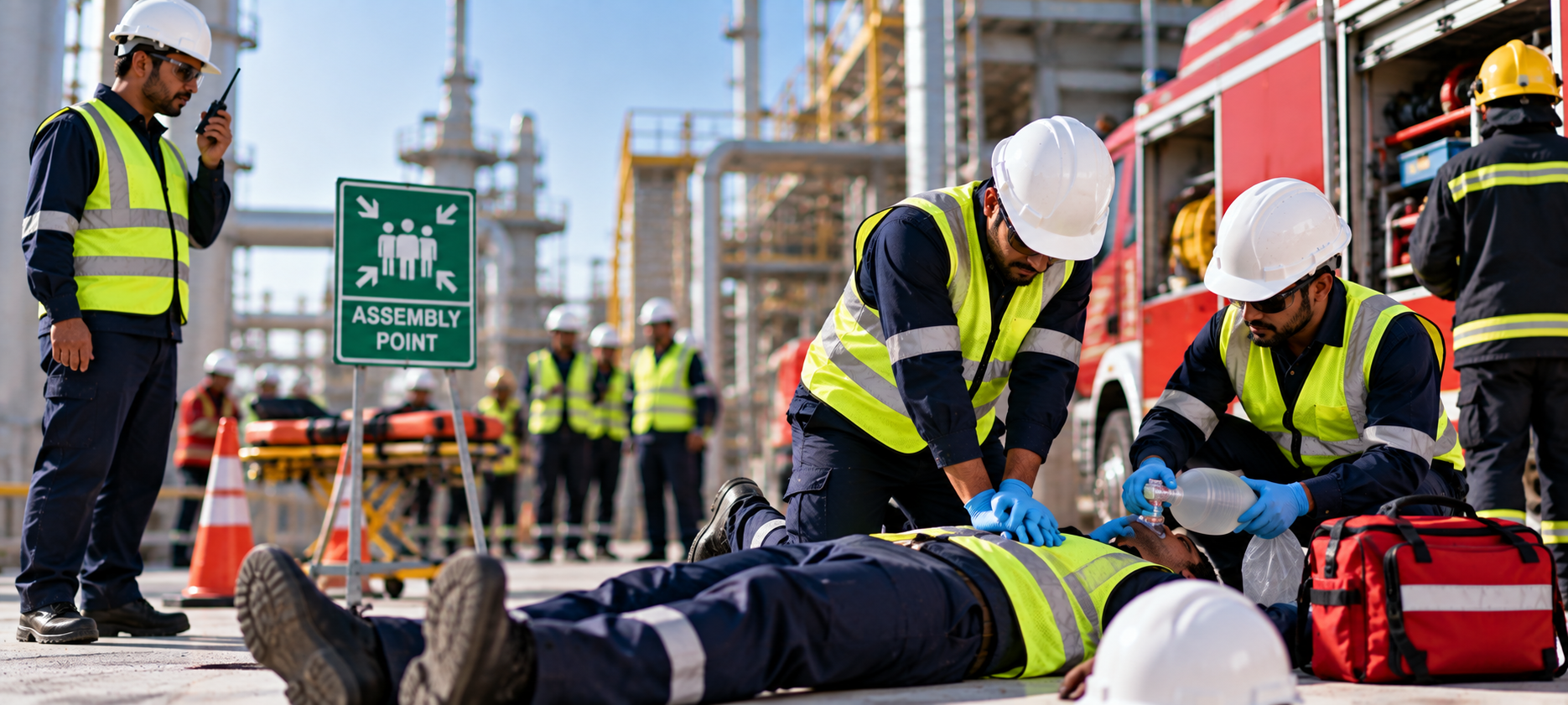
Nathan Safety Training (NIMS) trains and forms Emergency Response Teams for UAE industrial, commercial and high-hazard sites — personnel equipped and drilled to actively intervene across fire, medical, chemical and confined space scenarios in the critical window before external emergency services take over.
How This Differs From Fire Warden Coverage
Fire warden training, which we cover separately, focuses on evacuation — sweeping a zone, directing people out, liaising with Civil Defence on arrival. An Emergency Response Team is built for active intervention: entering a hazard zone to control a small fire before it grows, providing advanced first response to a medical emergency, or supporting a confined space rescue, all before or alongside external emergency services arriving.
UAE construction and industrial HSE frameworks increasingly expect higher-hazard sites — oil & gas, large-scale manufacturing, high-occupancy commercial developments — to maintain a dedicated response capability beyond baseline fire warden coverage, particularly where the site’s risk profile or remoteness makes external response time a genuine factor rather than a formality.
This is deliberately a higher commitment than fire warden training: ERT members need broader cross-hazard competency, regular live drilling, and equipment most standard occupants never touch — which is why we treat team formation and ongoing drill programmes as part of the service, not just an initial course.
What Having (or Not Having) a Trained ERT Actually Means
The difference an ERT makes shows up specifically in the incidents that could have escalated but didn’t — the small fire controlled before it spread, the medical event stabilised in the first critical minutes rather than waited out. None of that shows up as a dramatic statistic, because a well-run ERT’s success looks like nothing happening.
The exposure without one is direct: sites without a genuine response capability rely entirely on external services for a window of time that can be the difference between a contained incident and a major one, and increasingly, clients and insurers factor documented ERT coverage into risk pricing for higher-hazard facilities.
Who Needs a Trained ERT
This is most relevant for sites where risk profile or remoteness makes response time a genuine operational factor.
- Oil, gas and petrochemical facilities with process fire, chemical release or confined space rescue exposure
- Large-scale manufacturing plants with high-consequence machinery or material handling risk
- High-occupancy hospitality, events and entertainment venues with large transient crowds
- Remote or semi-remote industrial sites where Civil Defence response time is genuinely longer than in dense urban areas
- Facilities management companies responsible for large commercial or mixed-use developments
Where We Form and Train ERTs
Response time expectations and hazard profile both shift by emirate. We work across all seven:
- Dubai — high-occupancy hospitality, events and high-rise commercial developments, where crowd density raises the value of an ERT capable of stabilising a situation before evacuation is fully complete
- Abu Dhabi — ADNOC group and Mussafah industrial facilities, frequently our most demanding ERT engagements given process fire and chemical release exposure
- Sharjah — Hamriyah and SAIF Zone industrial tenants, where response time from external services can be longer than in central Dubai or Abu Dhabi
- Ajman — growing industrial and manufacturing facilities beginning to formalise response capability beyond basic fire warden coverage
- Ras Al Khaimah — quarrying and cement operations around Al Hamra, where remoteness from central emergency services makes an onsite ERT particularly valuable
- Fujairah — FOIZ terminal operators, where the concentration of high-consequence hazards makes a dedicated ERT close to essential rather than optional
- Umm Al Quwain — lighter industrial density, but growing demand from manufacturers formalising emergency response capability for the first time
ERT Role Tiers
Role | Responsibility | Typical Training Duration |
Team Member | First response actions — fire control, casualty care, initial containment | 3–4 days initial, quarterly drills |
Team Leader | Coordinates team response, liaises with site control room and arriving services | 5 days, includes Team Member content |
Incident Commander | Overall site emergency decision authority until external services take command | Extended programme, scenario-based assessment |
Where ERT Programmes Look Good on Paper and Fail in Practice
An ERT roster is easy to produce. A team that actually performs under pressure is not, and the gap between the two only becomes visible during a real event or a genuinely unannounced drill.
The single biggest predictor of whether a team performs is drill frequency — not initial training quality. Skills this specific decay fast without regular practice.
- A named ERT roster that hasn’t actually drilled together in over a year
- Equipment — breathing apparatus, rescue kits — stored but not regularly checked or practised with
- Team members rostered without confirming they’re actually on shift and available when an incident occurs
- No clear handover protocol for when external emergency services arrive and take command
- Cross-hazard gaps — a team drilled thoroughly on fire response but never on chemical release or confined space rescue
How We Build ERT Capability That Actually Holds Up
We built this programme around drill frequency as the real driver of team performance, because initial training quality matters far less than most sites assume once six months have passed without practice.
hsemanpower.ae, part of the same group, can supply additional trained ERT-capable personnel for sites needing to build out team coverage across shifts, and Nathan ISO Consulting can align ERT documentation with a wider ISO 45001 emergency preparedness element.
- Cross-hazard training covering fire, medical, chemical and confined space scenarios, not a single-hazard focus
- Scenario-based drilling using realistic, sometimes unannounced exercises, not scripted walk-throughs
- Clear command-and-handover protocol training for the transition to arriving Civil Defence or ambulance services
- Ongoing quarterly drill programmes available, not just an initial certification with no follow-up
- Equipment familiarisation on the actual breathing apparatus and rescue kit your site holds, not generic models
Courses Offered
- First Aid Course - CPR and AED
- Confined Space
- Fire Safety Awareness
- Scaffolding Inspection
- Scaffolding Erection & Dismantling
- Flagman Safety
- Chemical Safety and Handling Training
- Hazard and Risk Assessment
- Rigging and Slinging Training
- Traffic Safety
- Hand and Power Tools Operator
- Electrical Safety
- Lock Out and Tag Out (LOTO)
- Accident Incident Investigation
- Lifeguard Training
- Advanced Risk Assessment & Compliance Service
- Behavior-Based Safety Workplace Safety Consulting
- Construction Site Safety Induction Training
- Emergency Response Team Training
- Excavator Operator Training
- Forklift Operator Training
- H2S Awareness & Breathing Apparatus Training
- Hot Work Safety Training
- Incident Reporting & Root Cause Analysis Service
- MEWP Operator Training
- Mobile Crane Operator Training
- Permit to Work System Training
- Rope Access Training
- Working at Height & Fall Protection Safety Training
- Oil & Gas Safety Training
- Fire Warden Training
- Manual Handling Training
- Banksman Safety Training
- Gas Tester Training
- Defensive Driving Training
- HAZMAT Awareness Training
- Machine Safety and Machine Guarding Training
- Spill Response and Spill Control Training
- Welding Safety Training
Need expert advice? Speak to our team today
FAQ
How is ERT different from fire warden training?
Fire wardens are trained to evacuate people safely and liaise with Civil Defence on arrival. An ERT is trained to actively intervene — controlling a small fire, providing advanced first response, supporting a rescue — in the window before or alongside external services arriving. Many sites need both, at different tiers of their workforce.
Is having an ERT a legal requirement in the UAE?
There’s no single blanket statute naming ERT formation for every site, but UAE HSE frameworks increasingly expect higher-hazard facilities — oil & gas, large manufacturing, high-occupancy venues — to demonstrate a response capability beyond baseline fire warden coverage, and insurers increasingly factor it into risk pricing for those facility types.
Does ERT training cover medical response as well as fire?
Yes — our ERT programme is deliberately cross-hazard, covering fire control, advanced first response, chemical release containment and confined space rescue support, rather than training a team on fire response alone and leaving other emergency types uncovered.
How often does an ERT need to drill to stay effective?
We recommend quarterly drills at minimum, since ERT-specific skills decay faster than general safety awareness without regular practice — a team that trained well a year ago and hasn’t drilled since is a materially weaker team than the certificate suggests.
What happens when Civil Defence or ambulance services actually arrive?
A trained ERT hands over command to arriving external services under a clear protocol, continuing to support rather than compete for control — this handover discipline is a specific, trained skill, not something teams should be improvising in the moment.
Do you provide the equipment, or only the training?
We train your team on the equipment your site already holds or is planning to procure — breathing apparatus, rescue kits, medical response equipment — rather than supplying generic equipment unrelated to what the team will actually use during a real event.
How large does an ERT need to be?
It depends on site size, shift pattern and hazard profile rather than a fixed headcount — a facility running continuous shifts needs ERT coverage on every shift, not just a single daytime team, which is something we help size during scoping.
Is this suitable for high-occupancy hospitality or event venues, not just industrial sites?
Yes — large hotels, exhibition venues and entertainment complexes increasingly form ERTs specifically because crowd density during an emergency benefits enormously from trained staff who can stabilise a situation before full evacuation and external response are complete.
Do you run unannounced drills, or only scheduled ones?
Both, and we specifically recommend a mix — scheduled drills build initial competency and confidence, while unannounced scenario drills reveal whether the team actually performs under the realistic pressure of not knowing an exercise is coming.
What's the difference between a Team Member and an Incident Commander in this course?
Team Members execute specific first-response actions — fire control, casualty care. An Incident Commander holds overall site emergency decision authority until external services take command, coordinating the whole response rather than performing a single task.
Do you deliver ERT training and drills across all seven emirates?
Yes, with particular depth in Abu Dhabi and Fujairah given the concentration of high-hazard oil & gas and industrial facilities in those emirates, alongside high-occupancy venue coverage in Dubai.
Can ERT training be combined with our existing First Aid and Fire Safety programmes?
Yes, and it typically should be — ERT members usually hold First Aid and often Fire Warden certification as a baseline, with ERT training adding the cross-hazard intervention and drilling layer on top.
- First Aid Course - CPR and AED
- Confined Space
- Fire Safety Awareness
- Scaffolding Inspection
- Scaffolding Erection & Dismantling
- Flagman Safety
- Chemical Safety and Handling Training
- Hazard and Risk Assessment
- Rigging and Slinging Training
- Traffic Safety
- Hand and Power Tools Operator
- Electrical Safety
- Lock Out and Tag Out (LOTO)
- Accident Incident Investigation
- Lifeguard Training
- Advanced Risk Assessment & Compliance Service
- Behavior-Based Safety Workplace Safety Consulting
- Construction Site Safety Induction Training
- Emergency Response Team Training
- Excavator Operator Training
- Forklift Operator Training
- H2S Awareness & Breathing Apparatus Training
- Hot Work Safety Training
- Incident Reporting & Root Cause Analysis Service
- MEWP Operator Training
- Mobile Crane Operator Training
- Permit to Work System Training
- Rope Access Training
- Working at Height & Fall Protection Safety Training


Emergency Response Team (ERT) Training in the UAE
Civil Defence response in UAE cities is genuinely fast. It is still not instant, and on an industrial site the first several minutes of a fire, chemical release or structural emergency are usually decided by whoever is already there — not by whoever arrives after being called. That gap is what an Emergency Response Team exists to close, and it’s a different capability from having trained fire wardens who evacuate the building.
Nathan Safety Training (NIMS) trains and forms Emergency Response Teams for UAE industrial, commercial and high-hazard sites — personnel equipped and drilled to actively intervene across fire, medical, chemical and confined space scenarios in the critical window before external emergency services take over.
How This Differs From Fire Warden Coverage
Fire warden training, which we cover separately, focuses on evacuation — sweeping a zone, directing people out, liaising with Civil Defence on arrival. An Emergency Response Team is built for active intervention: entering a hazard zone to control a small fire before it grows, providing advanced first response to a medical emergency, or supporting a confined space rescue, all before or alongside external emergency services arriving.
UAE construction and industrial HSE frameworks increasingly expect higher-hazard sites — oil & gas, large-scale manufacturing, high-occupancy commercial developments — to maintain a dedicated response capability beyond baseline fire warden coverage, particularly where the site’s risk profile or remoteness makes external response time a genuine factor rather than a formality.
This is deliberately a higher commitment than fire warden training: ERT members need broader cross-hazard competency, regular live drilling, and equipment most standard occupants never touch — which is why we treat team formation and ongoing drill programmes as part of the service, not just an initial course.
What Having (or Not Having) a Trained ERT Actually Means
The difference an ERT makes shows up specifically in the incidents that could have escalated but didn’t — the small fire controlled before it spread, the medical event stabilised in the first critical minutes rather than waited out. None of that shows up as a dramatic statistic, because a well-run ERT’s success looks like nothing happening.
The exposure without one is direct: sites without a genuine response capability rely entirely on external services for a window of time that can be the difference between a contained incident and a major one, and increasingly, clients and insurers factor documented ERT coverage into risk pricing for higher-hazard facilities.
Who Needs a Trained ERT
This is most relevant for sites where risk profile or remoteness makes response time a genuine operational factor.
- Oil, gas and petrochemical facilities with process fire, chemical release or confined space rescue exposure
- Large-scale manufacturing plants with high-consequence machinery or material handling risk
- High-occupancy hospitality, events and entertainment venues with large transient crowds
- Remote or semi-remote industrial sites where Civil Defence response time is genuinely longer than in dense urban areas
- Facilities management companies responsible for large commercial or mixed-use developments
Where We Form and Train ERTs
Response time expectations and hazard profile both shift by emirate. We work across all seven:
- Dubai — high-occupancy hospitality, events and high-rise commercial developments, where crowd density raises the value of an ERT capable of stabilising a situation before evacuation is fully complete
- Abu Dhabi — ADNOC group and Mussafah industrial facilities, frequently our most demanding ERT engagements given process fire and chemical release exposure
- Sharjah — Hamriyah and SAIF Zone industrial tenants, where response time from external services can be longer than in central Dubai or Abu Dhabi
- Ajman — growing industrial and manufacturing facilities beginning to formalise response capability beyond basic fire warden coverage
- Ras Al Khaimah — quarrying and cement operations around Al Hamra, where remoteness from central emergency services makes an onsite ERT particularly valuable
- Fujairah — FOIZ terminal operators, where the concentration of high-consequence hazards makes a dedicated ERT close to essential rather than optional
- Umm Al Quwain — lighter industrial density, but growing demand from manufacturers formalising emergency response capability for the first time
ERT Role Tiers
Role | Responsibility | Typical Training Duration |
Team Member | First response actions — fire control, casualty care, initial containment | 3–4 days initial, quarterly drills |
Team Leader | Coordinates team response, liaises with site control room and arriving services | 5 days, includes Team Member content |
Incident Commander | Overall site emergency decision authority until external services take command | Extended programme, scenario-based assessment |
Where ERT Programmes Look Good on Paper and Fail in Practice
An ERT roster is easy to produce. A team that actually performs under pressure is not, and the gap between the two only becomes visible during a real event or a genuinely unannounced drill.
The single biggest predictor of whether a team performs is drill frequency — not initial training quality. Skills this specific decay fast without regular practice.
- A named ERT roster that hasn’t actually drilled together in over a year
- Equipment — breathing apparatus, rescue kits — stored but not regularly checked or practised with
- Team members rostered without confirming they’re actually on shift and available when an incident occurs
- No clear handover protocol for when external emergency services arrive and take command
- Cross-hazard gaps — a team drilled thoroughly on fire response but never on chemical release or confined space rescue
How We Build ERT Capability That Actually Holds Up
We built this programme around drill frequency as the real driver of team performance, because initial training quality matters far less than most sites assume once six months have passed without practice.
hsemanpower.ae, part of the same group, can supply additional trained ERT-capable personnel for sites needing to build out team coverage across shifts, and Nathan ISO Consulting can align ERT documentation with a wider ISO 45001 emergency preparedness element.
- Cross-hazard training covering fire, medical, chemical and confined space scenarios, not a single-hazard focus
- Scenario-based drilling using realistic, sometimes unannounced exercises, not scripted walk-throughs
- Clear command-and-handover protocol training for the transition to arriving Civil Defence or ambulance services
- Ongoing quarterly drill programmes available, not just an initial certification with no follow-up
- Equipment familiarisation on the actual breathing apparatus and rescue kit your site holds, not generic models
FAQ
How is ERT different from fire warden training?
Fire wardens are trained to evacuate people safely and liaise with Civil Defence on arrival. An ERT is trained to actively intervene — controlling a small fire, providing advanced first response, supporting a rescue — in the window before or alongside external services arriving. Many sites need both, at different tiers of their workforce.
Is having an ERT a legal requirement in the UAE?
There’s no single blanket statute naming ERT formation for every site, but UAE HSE frameworks increasingly expect higher-hazard facilities — oil & gas, large manufacturing, high-occupancy venues — to demonstrate a response capability beyond baseline fire warden coverage, and insurers increasingly factor it into risk pricing for those facility types.
Does ERT training cover medical response as well as fire?
Yes — our ERT programme is deliberately cross-hazard, covering fire control, advanced first response, chemical release containment and confined space rescue support, rather than training a team on fire response alone and leaving other emergency types uncovered.
How often does an ERT need to drill to stay effective?
We recommend quarterly drills at minimum, since ERT-specific skills decay faster than general safety awareness without regular practice — a team that trained well a year ago and hasn’t drilled since is a materially weaker team than the certificate suggests.
What happens when Civil Defence or ambulance services actually arrive?
A trained ERT hands over command to arriving external services under a clear protocol, continuing to support rather than compete for control — this handover discipline is a specific, trained skill, not something teams should be improvising in the moment.
Do you provide the equipment, or only the training?
We train your team on the equipment your site already holds or is planning to procure — breathing apparatus, rescue kits, medical response equipment — rather than supplying generic equipment unrelated to what the team will actually use during a real event.
How large does an ERT need to be?
It depends on site size, shift pattern and hazard profile rather than a fixed headcount — a facility running continuous shifts needs ERT coverage on every shift, not just a single daytime team, which is something we help size during scoping.
Is this suitable for high-occupancy hospitality or event venues, not just industrial sites?
Yes — large hotels, exhibition venues and entertainment complexes increasingly form ERTs specifically because crowd density during an emergency benefits enormously from trained staff who can stabilise a situation before full evacuation and external response are complete.
Do you run unannounced drills, or only scheduled ones?
Both, and we specifically recommend a mix — scheduled drills build initial competency and confidence, while unannounced scenario drills reveal whether the team actually performs under the realistic pressure of not knowing an exercise is coming.
What's the difference between a Team Member and an Incident Commander in this course?
Team Members execute specific first-response actions — fire control, casualty care. An Incident Commander holds overall site emergency decision authority until external services take command, coordinating the whole response rather than performing a single task.
Do you deliver ERT training and drills across all seven emirates?
Yes, with particular depth in Abu Dhabi and Fujairah given the concentration of high-hazard oil & gas and industrial facilities in those emirates, alongside high-occupancy venue coverage in Dubai.
Can ERT training be combined with our existing First Aid and Fire Safety programmes?
Yes, and it typically should be — ERT members usually hold First Aid and often Fire Warden certification as a baseline, with ERT training adding the cross-hazard intervention and drilling layer on top.
Build or Strengthen Your ERT
Whether you’re forming a team from scratch or need an existing ERT re-drilled and reassessed, tell us your site’s hazard profile and shift pattern, and we’ll scope the right role mix and drill schedule.
Nathan Safety Training (NIMS) — Emergency Response Team training and drilling across Dubai, Abu Dhabi, Sharjah, Ajman, Ras Al Khaimah, Fujairah and Umm Al Quwain.