

Importance of HSE Manpower in Oil and Gas Projects
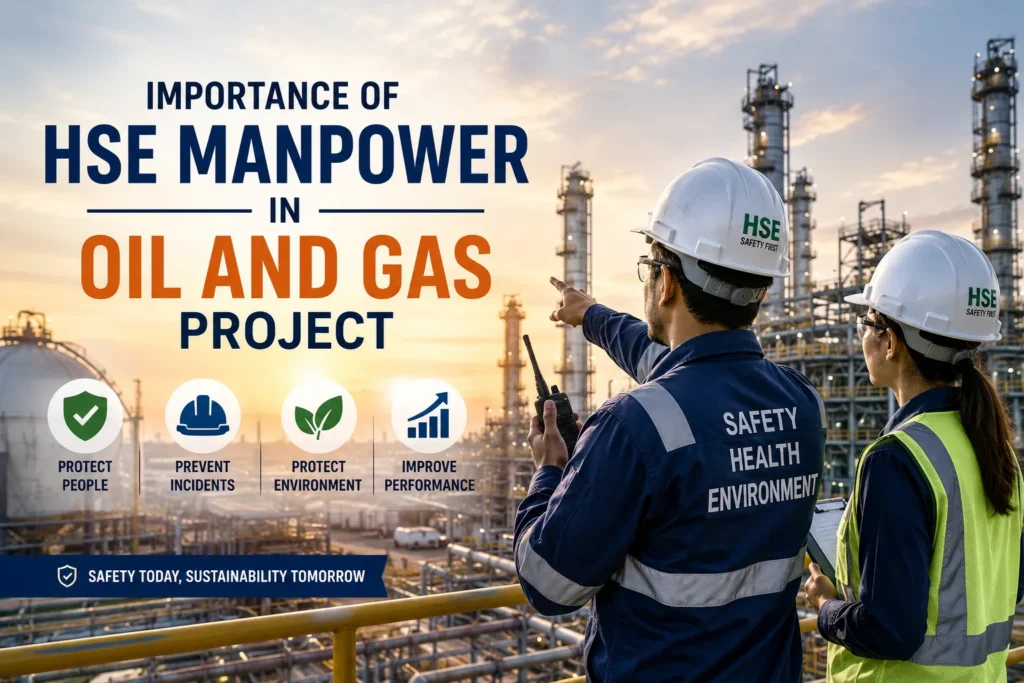
Oil and gas projects are among the most hazardous industrial environments in the world. High-pressure systems, flammable materials, heavy machinery, and complex logistics create daily risks that demand expert oversight.
HSE manpower in oil and gas projects is essential for preventing risks from escalating into disasters, ensuring continuous project safety.
Whether you are an oil and gas company looking to staff a new project or a safety professional seeking your next opportunity in the sector, this guide explains what HSE manpower is, why it matters, what it costs you to go without it, and how NIMS delivers qualified HSE professionals across the UAE and the wider GCC region.
What Is HSE Manpower?
HSE manpower refers to the skilled professionals hired to manage health, safety, and environmental responsibilities on industrial projects.
In oil and gas, HSE professionals are integral to operations, ensuring accident prevention, regulatory compliance, and environmental protection.
HSE manpower includes:
- HSE Officers: Frontline safety supervisors on active worksites
- HSE Managers: Senior professionals overseeing entire safety programs
- Environmental Specialists: professionals managing environmental impact and compliance
- Safety Trainers: qualified personnel who run HSE induction and ongoing training
- Risk and Compliance Advisors: Specialists who assess regulatory alignment and project risk
The qualifications that matter most in this space include NEBOSH, IOSH, OSHA, and oil and gas-specific certifications such as BOSIET and HUET.
Common HSE Roles in Oil and Gas Projects
Understanding who does what helps companies make the right hiring decisions and helps candidates position themselves correctly.
Role | Core Responsibility | Typical Qualification |
HSE Officer | Site inspections, permit-to-work, toolbox talks | NEBOSH IGC, IOSH |
HSE Manager | Program management, regulatory reporting, KPIs | NEBOSH Diploma, degree |
HSE Manager | Environmental monitoring, waste management | BSc Environmental Science |
Environmental Specialist | HSE inductions, emergency drills, awareness programs | Train-the-Trainer, NEBOSH |
Risk Assessor | Job hazard analysis, risk registers, HAZOP | Engineering background + HSE cert |
Incident Investigator | Root cause analysis, corrective action tracking | Advanced HSE, investigative training |
Each of these roles requires both technical knowledge and hands-on oil and gas experience. Book knowledge alone is not enough in this sector.
Why HSE Manpower Is Important in Oil and Gas Projects
Workplace Safety
Oil and gas worksites carry risks that most industries never encounter. Blowouts, fires, toxic gas exposure, confined space incidents, and equipment failures are documented hazards across upstream, midstream, and downstream operations.
Qualified HSE professionals reduce these risks by:
- Conducting daily site safety checks
- Enforcing permit-to-work systems
- Running toolbox talks before high-risk tasks
- Monitoring personal protective equipment (PPE) compliance
- Identifying near-misses before they become fatalities
According to the International Labour Organization (ILO), approximately 2.3 million workers die from work-related causes globally each year. In high-hazard industries like oil and gas, effective HSE manpower is the single most direct intervention that reduces this number.
Regulatory Compliance
In the UAE and across GCC countries, oil and gas projects operate under strict HSE regulatory frameworks:
- UAE Ministerial Decree No. 32 of 1982 and occupational health regulations
- Abu Dhabi EHSMS (Environment, Health and Safety Management System)
- ADNOC HSE Standards for contractors and vendors
- ISO 45001 occupational health and safety management
- ISO 14001 environmental management standards
Without dedicated HSE manpower, projects risk non-compliance. Penalties include heavy fines, project shutdowns, license revocations, and legal liability. Compliance is not optional, and it cannot be managed without people who know these standards inside out.
Risk Reduction
Every oil and gas project carries a documented risk register. HSE professionals are responsible for keeping that register current, conducting hazard identification studies (HAZID/HAZOP), and implementing controls before work begins.
Risk reduction through proper HSE manpower leads to:
- Fewer lost-time injuries (LTIs)
- Lower insurance premiums
- Reduced project claims and litigation costs
- Better contractor and client relationships
Projects that invest in HSE staffing from day one consistently outperform those that treat safety as a checkbox activity.
Operational Efficiency
There is a direct link between safety performance and project efficiency. When incidents occur, everything stops. Investigations begin. Regulators get involved. Contractors go on standby. Costs escalate.
Experienced HSE manpower prevents this by keeping operations moving safely. When everyone on site knows and follows the safety procedures, production targets are met, shift handovers are smooth, and emergency shutdowns are rare.
Key Responsibilities of HSE Professionals in Oil and Gas
Risk Assessments
HSE officers and managers conduct formal risk assessments before any high-risk task begins. This includes:
- Job Hazard Analysis (JHA): Identifying hazards step by step in a task
- HAZID workshops: Structured sessions identifying hazards at the design stage
- HAZOP studies: Systematic examination of process operations for risk
- Bow-tie analysis: Mapping threat pathways and recovery controls
These are not paper exercises. They translate directly into the safety instructions that workers follow on site.
Safety Audits
Regular safety audits are a core HSE function. These include:
- Internal site audits: Weekly or monthly inspections of site conditions and practices
- Regulatory audits: Preparing for and responding to government safety inspections
- Contractor audits: Verifying subcontractors meet the same safety standards
- Documentation audits: Checking that safety records, permits, and logs are complete
Good audit outcomes depend entirely on having HSE professionals who know what to look for.
Incident Investigation
When incidents occur, even near-misses, qualified HSE professionals lead the investigation. The process includes:
- Securing the scene and preserving evidence
- Conducting witness interviews
- Performing root cause analysis (RCA)
- Producing an investigation report with corrective actions
- Following up to confirm corrective measures are implemented
A thorough investigation prevents repeat incidents. It also demonstrates due diligence to regulators, which matters greatly if the incident leads to legal proceedings.
Training and Awareness
HSE professionals design and deliver safety training programs across the project lifecycle. These include:
- Site inductions for all new workers and visitors
- Emergency response drills (fire, evacuation, first aid, man-overboard)
- Task-specific training (working at heights, confined space, hot work)
- Toolbox talks, short, daily briefings on specific hazards or procedures
- Leadership safety programs for project managers and supervisors
An informed workforce is a safer workforce. HSE manpower ensures that safety knowledge reaches every level of the project team.
Benefits of Hiring Qualified HSE Manpower
Reduced Accidents
Projects staffed with qualified HSE professionals see measurably fewer incidents. This is not a claim; it is consistently documented in industry data from regulators, insurers, and industry bodies like IADC, IPIECA, and OHSAS.
Fewer accidents mean fewer fatalities, fewer injuries, and fewer costly emergency responses.
Improved Productivity
When workers feel safe, they work with confidence. When procedures are clear and enforced consistently, tasks are completed efficiently. Projects with strong HSE cultures typically report:
- Higher workforce morale
- Lower absenteeism
- Faster task completion due to reduced rework after incidents
Lower Project Delays
Incidents cause delays. Investigations, equipment repairs, regulatory reviews, and medical responses all take time; time that costs the project money. Properly staffed HSE teams prevent most incidents and manage the ones that occur quickly and competently.
Better Compliance
Regulatory compliance in oil and gas is an ongoing requirement, not a one-time approval. Dedicated HSE professionals track regulatory updates, prepare compliance documentation, liaise with government authorities, and ensure that the project stays aligned with current standards throughout its lifecycle.
Challenges Faced by Oil and Gas Projects Without HSE Manpower
Safety Incidents
The most direct consequence of inadequate HSE manpower is a higher incidence rate. Without trained eyes on site, hazards go unnoticed. Without proper procedures, workers improvise. Without enforcement, safety shortcuts become standard practice.
The results are predictable: injuries, fatalities, and equipment damage.
Regulatory Penalties
UAE and GCC regulators actively inspect oil and gas projects. An under-staffed HSE function will not survive a serious regulatory audit. Penalties range from financial fines to full project suspension.
In Abu Dhabi, non-compliance with ADNOC HSE standards can result in contractor blacklisting, a consequence that affects a company’s ability to operate in the region for years.
Downtime
Every serious incident triggers an operational shutdown while investigation and remediation take place. Depending on severity, these shutdowns can last days, weeks, or longer. For oil and gas projects operating on tight schedules and tighter margins, unplanned downtime is expensive by any measure.
Reputation Risks
In an industry where client decisions are driven heavily by contractor track records, a poor HSE record follows a company. Safety statistics are reviewed in every tender evaluation. Clients, insurers, and JV partners all conduct HSE due diligence before signing agreements.
A single high-profile incident, especially one linked to understaffing or negligence, can cost far more in lost contracts than the investment in proper HSE manpower would have cost.
Why NIMS HSE Manpower Stands Out in UAE
NIMS is a specialized HSE manpower and staffing company operating across the UAE and GCC, with a focus on oil and gas, petrochemical, construction, and industrial sectors.
Qualified Professionals
Every NIMS HSE professional is vetted for:
- Relevant technical certification (NEBOSH, IOSH, OSHA, IADC)
- Documented oil and gas project experience
- Familiarity with UAE and GCC regulatory requirements
- Competency assessments conducted before deployment
NIMS does not place candidates who do not meet minimum criteria. The standard is professionals who can contribute from their first day on site.
Industry Experience
NIMS has placed HSE professionals on projects across:
- Upstream exploration and drilling operations
- Midstream pipeline and processing facilities
- Downstream refinery and petrochemical plants
- Offshore platform operations
- LNG and gas plant projects
This sector depth means NIMS understands the specific risk environments, client HSE requirements, and regulatory frameworks that apply to different project types.
Rapid Deployment
Oil and gas projects operate on compressed timelines. When a project mobilizes, HSE staffing cannot become a bottleneck. NIMS maintains an active pool of pre-screened, document-ready HSE professionals who can be deployed quickly across UAE locations including Abu Dhabi, Dubai, Sharjah, and project sites across the emirates.
Flexible Staffing Solutions
NIMS offers staffing models that match how oil and gas projects actually work:
- Contract staffing: For defined project durations
- Permanent placement: For long-term operational roles
- Temporary / emergency coverage: For urgent gaps or workforce surges
- Payroll management: Handling visa, insurance, and HR administration
Whether you need a single HSE officer for a shutdown or a full HSE department for a greenfield project, NIMS structures a solution around your actual requirement.
Conclusion
HSE manpower in oil and gas projects is not a cost; it is the infrastructure that keeps everything else running. Projects that get this right finish on time, stay compliant, and bring their people home safely. Those that don’t, pay for it in ways that go far beyond the budget line.
NIMS delivers the qualified HSE professionals that make the difference. Talk to us before your next project mobilizes.
Ready to Strengthen Your Project Safety Team?
Build your team with confidence. NIMS connects you with qualified, pre-screened HSE professionals who are ready to work when you need them.
Frequently Asked Questions
At minimum, an HSE officer working on oil and gas projects should hold a NEBOSH International General Certificate (IGC) or equivalent. Sector-specific certifications such as BOSIET (Basic Offshore Safety Induction and Emergency Training) are required for offshore roles. IOSH Managing Safely is common for supervisory roles. Many clients in Abu Dhabi and Dubai also require candidates to have completed ADNOC-approved safety training.
The ratio depends on project size, scope, and risk level. A common industry benchmark is one HSE officer for every 25–50 workers on high-risk sites. Larger projects require HSE managers, environmental officers, safety trainers, and administrative support in addition to frontline officers. Regulatory requirements in the UAE may also specify minimum staffing ratios.
An HSE officer works on the frontline — conducting inspections, issuing permits, running toolbox talks, and ensuring daily compliance. An HSE manager oversees the entire safety program, manages a team of officers, reports to senior project leadership, liaises with regulators, and is accountable for overall safety performance metrics.
NIMS specializes in HSE and technical manpower for industrial sectors. This means every candidate is assessed against sector-specific technical criteria, not just general employment checks. NIMS also understands UAE and GCC regulatory requirements, handles complex compliance documentation, and can deploy rapidly against project timelines — capabilities that general staffing agencies typically do not have.
Yes. NIMS provides contract and temporary HSE staffing specifically for shutdowns, turnarounds, and project-based requirements where workforce needs spike for a defined period. This includes short-term contracts, rapid mobilization, and full HR administration for the engagement.