
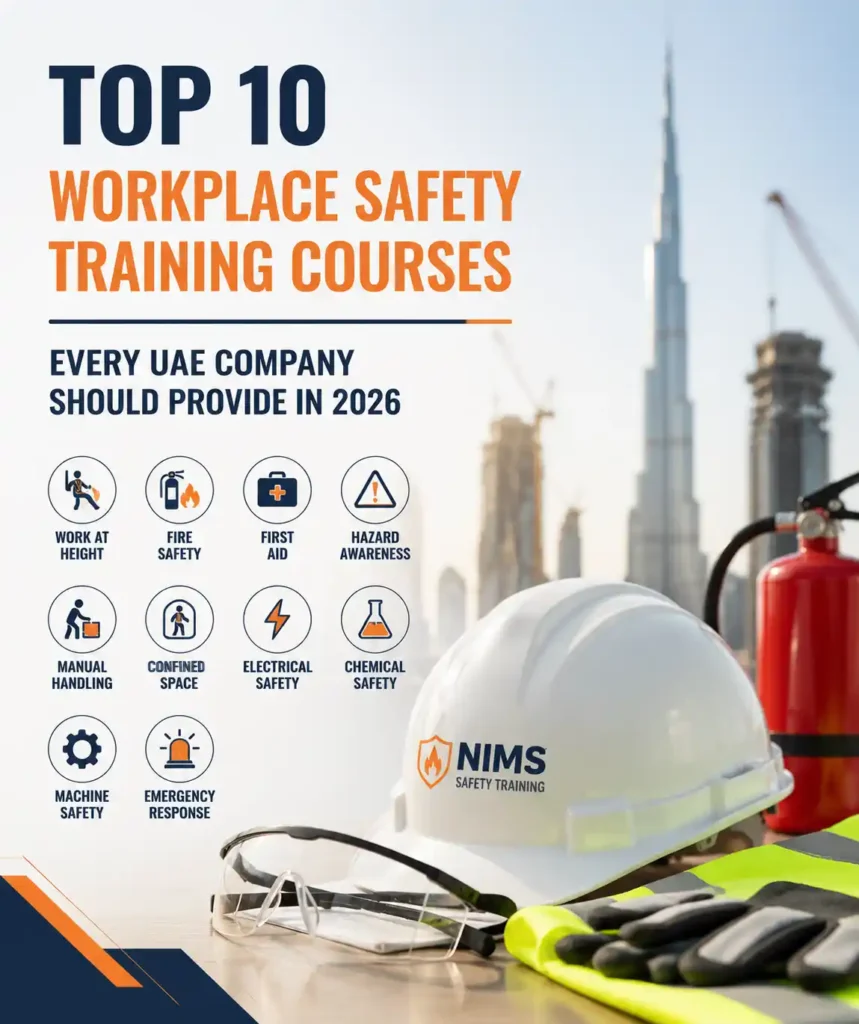
Top 10 Workplace Safety Training Courses Every UAE Company Should Provide in 2026
Workplace safety has become a major business priority across the UAE. Companies are now judged not only by productivity and project delivery but also by how well they protect employees, contractors and visitors.
For organisations in construction, oil and gas, logistics, manufacturing, marine services, facilities management, warehousing and infrastructure, proper safety training can prevent injuries, reduce downtime and improve client confidence.
A company may invest in modern equipment, personal protective equipment and detailed procedures, but these controls will not be effective unless employees understand the hazards around them. This is why practical safety training in the UAE should be based on real workplace risks rather than generic classroom content.
The exact training requirements will depend on the company’s activities, size, location, workforce and risk profile. However, the following ten workplace safety courses in the UAE are highly relevant to most medium- and high-risk organisations in 2026.
Why Workplace Safety Training Matters in the UAE
The UAE has a diverse workforce with employees from different countries, languages and professional backgrounds. Clear communication, practical demonstrations and role-based training are therefore essential.
Poor safety practices can lead to injuries, project delays, damaged equipment, legal exposure and loss of client confidence. A strong occupational safety training programme in the UAE helps employees understand how to work safely, respond to emergencies and report hazards before they become incidents.
Training should not be treated as a one-time requirement. Safety induction, refresher training, toolbox talks, drills and competency assessments should all form part of the company’s HSE programme.
First Aid and CPR Training
Medical emergencies can happen in any workplace.
An employee may suffer a fall, electric shock, breathing difficulty, burn, cut or sudden cardiac emergency. In these situations, the first few minutes are often critical.
First Aid training in the UAE prepares employees to assess an emergency, raise the alarm and provide basic support until professional medical assistance arrives.
A good CPR training course in Dubai should include practical exercises. Participants should learn how to respond to an unconscious person, manage choking, control bleeding and perform cardiopulmonary resuscitation.
Companies should ensure that trained first aiders are available across all shifts and work locations.
Fire Safety and Fire Warden Training
Fire is one of the most serious workplace emergencies.
Electrical faults, hot work, flammable liquids, gas cylinders, fuel storage, batteries and temporary electrical connections can all create fire hazards.
Fire safety training in the UAE should help employees understand how fires start, how they spread and what actions are required when an alarm is raised.
General training should cover evacuation routes, assembly points, emergency contacts and the safe use of portable fire extinguishers.
Selected employees should also receive Fire Warden training in Dubai. Their responsibilities may include checking assigned areas, directing people towards safe exits, supporting evacuation drills and reporting missing persons.
Confined Space Entry Training
Confined spaces are common in oil and gas, marine, construction, wastewater and industrial operations.
Examples include tanks, pits, manholes, vessels, silos, ducts and enclosed service areas.
These spaces may contain oxygen deficiency, toxic gases, heat, restricted access and engulfment risks.
Confined Space Entry training in the UAE should explain how to identify a confined space, assess hazards and control entry through a formal permit system.
Training should cover entrants, attendants, supervisors, gas testers and rescue personnel.
A safe confined-space entry programme should include atmospheric testing, ventilation, isolation, communication, standby arrangements and a practical rescue plan.
Career and Salary Prospects After Certification
Once certified, doors open across several high-demand sectors in the UAE:
- Construction & infrastructure: Steel erection, precast work, high-rise projects
- Oil & gas and petrochemicals: Plant lifting and shutdown support
- Ports, marine, and logistics: Container and heavy cargo handling
- Power and utilities: Transformer and generator installation
- Manufacturing: Machinery installation and heavy maintenance
Certified operators are consistently in demand across Dubai’s major project corridors, and experience on different crane types (hydraulic, all-terrain, rough-terrain) tends to open up better-paying, more specialized roles over time.
Working at Height Training
Falls from height remain a major risk in construction, maintenance, warehousing, telecommunications and facilities management.
Working at Height training in Dubai should cover ladders, scaffolds, mobile elevated work platforms, rooftops, anchor points and fall-protection systems.
Employees must understand that wearing a harness does not automatically make the work safe. The company should first consider whether the task can be completed from the ground or with collective protection such as guardrails or approved platforms.
The course should also address equipment inspection, safe access, dropped-object risks and rescue planning.
Permit to Work System Training
A Permit to Work, or PTW, is a formal control system used for high-risk or non-routine work.
It is commonly applied to hot work, confined-space entry, excavation, electrical isolation, work at height, line breaking and critical maintenance activities.
Permit to Work training in the UAE teaches employees that a permit is not simply a signed form. It is a structured process that confirms the work scope, hazards, controls, isolations and responsibilities.
A strong PTW course in Dubai should be role-specific. Permit issuers, permit receivers, area owners, supervisors and contractors need different levels of training.
Poor PTW systems often fail because permits are copied, issued without site checks or left open after the work is complete.
Electrical Safety Training
Electrical hazards exist in almost every workplace.
Electric shock, arc flash, burns, fire and secondary falls can result from damaged cables, exposed conductors, incorrect connections or unsafe maintenance.
Electrical safety training in the UAE is relevant not only to electricians but also to employees using portable tools, extension leads, temporary supplies, switchboards or battery systems.
General awareness should cover damaged plugs, overloaded sockets, wet conditions, unauthorised repairs and emergency isolation.
Qualified electrical personnel need deeper instruction in testing, earthing, safe approach distances and energy isolation.
Lockout/Tagout Training
Unexpected energisation is a serious risk during cleaning, maintenance and repair.
Machinery may restart, pressure may release, valves may open or stored energy may move equipment without warning.
Lockout/Tagout training in the UAE, also known as LOTO training, teaches employees how to identify energy sources, isolate equipment, apply locks and tags, verify zero-energy status and restore equipment safely.
A complete programme should cover electrical, hydraulic, pneumatic, thermal, chemical, mechanical and gravitational energy.
Practical exercises are essential because employees must be able to demonstrate the process, not simply recognise the terminology.
Incident Investigation Training
An incident report should explain why an event happened, not only what happened.
Incident investigation training in the UAE teaches supervisors and HSE personnel how to gather evidence, interview witnesses, prepare timelines and identify immediate, underlying and organisational causes.
A strong investigation avoids automatically blaming the worker. It examines planning, supervision, competence, equipment condition, communication and the effectiveness of existing controls.
Near misses should also be investigated because they often reveal weaknesses before someone is injured.
A practical root cause analysis course in Dubai can improve reporting quality and corrective-action decisions.
H2S Awareness Training
Hydrogen sulphide, or H2S, may be present in oil and gas facilities, wastewater systems, sewage plants, tanks and certain industrial operations.
It is highly toxic and can affect a person very quickly.
H2S awareness training in the UAE should explain the properties of the gas, possible exposure routes, alarm response, escape routes, wind direction and emergency actions.
Workers must understand that smell is not a reliable warning method.
Sites with potential H2S exposure should have gas detection, defined alarm levels, emergency arrangements and trained response personnel.
Risk Assessment and Job Safety Analysis Training
Risk assessment connects every other safety course.
Employees and supervisors should be able to break a job into steps, identify hazards, evaluate risk and select suitable controls.
Risk assessment training in Dubai should use real company activities such as lifting, chemical handling, hot work, confined-space entry, electrical work or maintenance.
The course should also explain the hierarchy of controls and why elimination, substitution and engineering controls are generally more reliable than warnings or personal protective equipment.
Job Safety Analysis training in the UAE helps teams prepare better JSAs, Task Risk Assessments and toolbox talks.
How to Build an Effective HSE Training Programme
A strong training programme begins with a role-based training matrix.
Each position should be linked to:
- General safety induction
- Task-specific training
- Refresher training
- Competency assessments
- Emergency responsibilities
- Required licences or authorisations
Training records should show who attended, what was covered, who delivered the session and whether competence was assessed.
For multilingual workforces, training should use visual materials, demonstrations, simple explanations and translated content where necessary.
Companies should also combine classroom learning with toolbox talks, observations, coaching and emergency drills.
The real measure of corporate safety training in the UAE is not the number of certificates issued. It is whether employees apply the knowledge correctly in the workplace.
Choosing the Right HSE Training Provider
A reliable HSE training provider in the UAE should understand the client’s industry, job roles and operational hazards.
Training should include practical exercises, assessments and site-specific examples rather than generic presentations.
Companies looking for customised safety training in Dubai should choose a provider that can align the courses with existing procedures, risk assessments and client requirements.
How NIMS Can Support UAE Companies
NIMS provides practical workplace safety courses across the UAE for construction, oil and gas, industrial services, logistics, manufacturing, marine and facilities management companies.
Training programmes can include:
- First Aid and CPR
- Fire Safety and Fire Warden
- Confined Space Entry
- Working at Height
- Permit to Work
- Electrical Safety
- Lockout/Tagout
- Incident Investigation
- H2S Awareness
- Risk Assessment and Job Safety Analysis
NIMS can deliver employee safety training in Dubai, Abu Dhabi and other locations based on the organisation’s workforce, project requirements and operational risks.
For companies preparing for a new project, client audit or HSE improvement programme, NIMS can help develop a focused and practical training plan.
Contact NIMS for customised safety training in the UAE designed to improve workforce competence, strengthen compliance and reduce workplace risk.