

Home / Scaffolding Erection & Dismantling
Scaffolding Erection & Dismantling
Certified Scaffolder Training for UAE Erection and Dismantling Crews
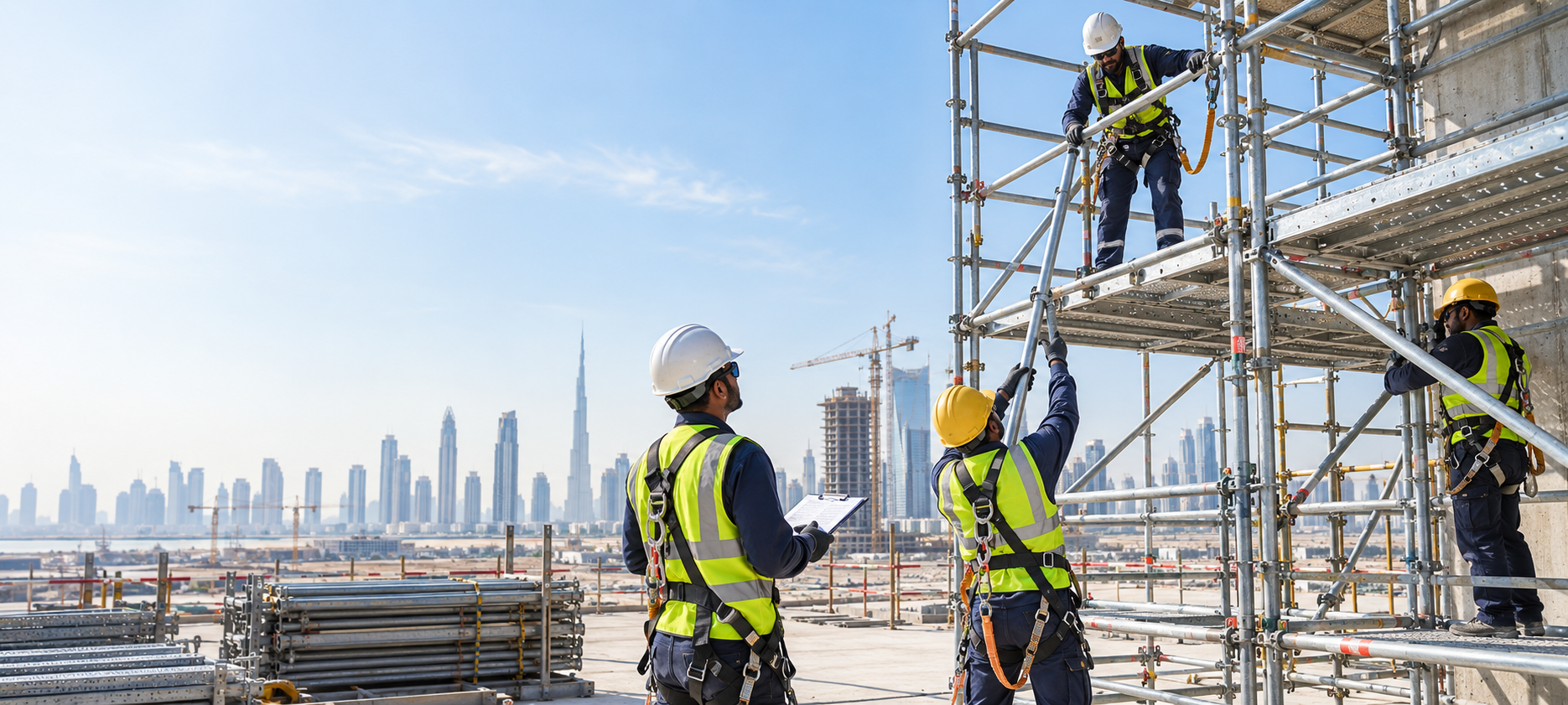
Scaffolding is at its most dangerous while it’s being built and while it’s being taken down — not while it’s standing finished with every guardrail in place. An erector working the top lift before the fall protection above them exists, or a dismantling crew pulling ties in the wrong order because it’s faster, are the two moments where most scaffold-related falls and collapses actually happen. The finished structure isn’t where this course focuses. The build and the strip-down are.
Nathan Safety Training (NIMS) trains scaffolders — the crew doing the physical erection and dismantling — to Dubai Municipality and ADOSH-SF requirements, with the sequencing discipline that keeps a partially-built structure from becoming the hazard it’s meant to protect against.
A Different Course From Inspection — Deliberately
This course is not the same as our Scaffolding Inspection course, and the distinction matters more here than on almost any other pairing on our schedule. Inspection trains the competent person who signs off a finished structure as safe. This course trains the crew physically assembling and disassembling it — a different skill set governed by the same Dubai Municipality Code of Construction Safety Practice (Chapter 8) and ADOSH-SF Code of Practice 26, but focused on sequencing, fall protection during the build itself, and structural load discipline rather than after-the-fact checking.
Erection and dismantling both require a permit to work in most UAE HSE frameworks, and both are explicitly flagged as special activity permits requiring a method statement under Dubai Municipality’s construction safety requirements — not something authorised under a general daily permit.
Main contractors and insurers increasingly treat scaffolder certification as its own line item, distinct from general site induction. A crew holding only generic safety induction certificates, without documented erection-specific training, is now more likely to be flagged during subcontractor prequalification on larger UAE projects than it would have been five years ago.
The Structure Is Most Dangerous Before It's Finished
Every serious scaffold incident we’ve reviewed happened during the build or the strip-down, not after handover — which means the riskiest hours of a scaffold’s entire life are also the ones least likely to have a completed structure’s guardrails in place. That’s not a reason to rush erection. It’s the reason erection needs its own dedicated training, separate from general site safety awareness.
Getting it wrong doesn’t just risk the erection crew. A partially-built structure that fails takes down whatever and whoever is nearby, and the investigation that follows examines the sequencing decisions made hours or days earlier, not just the moment of failure.
Who This Course Is For
This is a hands-on trade skill course, aimed at the people physically building and stripping scaffolding, not the people signing it off afterwards.
- Scaffolding contractors’ erection and dismantling crews
- Construction main contractors running in-house scaffold teams
- Oil & gas shutdown and turnaround scaffold labour
- Facilities maintenance teams erecting temporary access scaffolds
- Supervisors responsible for sequencing and handover to the inspection competent person
- Marine and offshore fabrication yards erecting access scaffolding around vessels and rigs
- Event production companies erecting large-scale temporary structures for concerts and exhibitions
Construction Cycles Differ by Emirate — So Does Demand
Erection crew demand tracks each emirate’s construction cycle closely. We deliver onsite across all seven:
- Dubai — continuous tower construction across Business Bay, Downtown and JAFZA keeps erection crew demand the highest and steadiest in the country
- Abu Dhabi — KEZAD and government megaproject construction drive large, complex scaffold configurations that lean toward our Advanced Scaffolder course
- Sharjah — Industrial Areas manufacturing facilities need erection crews more for maintenance access than new-build construction
- Ajman — the mid-rise residential construction boom is generating erection crew demand faster than the emirate’s existing scaffolding labour pool can absorb
- Ras Al Khaimah — quarry and cement plant access scaffolding around Al Hamra requires crews comfortable erecting around live industrial equipment, not just open construction sites
- Fujairah — FOIZ terminal maintenance scaffolding is erected inside a live operating environment, which raises the sequencing stakes considerably above a standard construction site
- Umm Al Quwain — a smaller construction volume, but the same Chapter 8 erection and dismantling sequencing rules apply on every job, regardless of scale
Course Levels at a Glance
Course | Duration | Covers |
Basic Scaffolder | 3 days | Tube and fitting/system erection, foundations, ties, working platforms |
Advanced Scaffolder | 4 days | Complex configurations, cantilevers, birdcages, load calculations |
Scaffold Supervisor | 2 days | Sequencing planning, permit authorisation, handover to inspection |
Every Serious Incident Traces Back to Sequencing
Every serious scaffold incident we’ve reviewed traces back to sequencing, not materials.
The dismantling sequence is where I’d focus a spot-check first — it gets rushed more often than erection, precisely because the job already feels finished.
- Erectors working the top lift before guardrails exist below them, relying on balance instead of fall protection
- Dismantling started from the middle of a structure instead of strictly top-down, destabilising sections still in use
- Ties removed early to speed up the strip-down, while the remaining structure still depends on them
- Boards and fittings staged below an active work platform, creating a dropped-object hazard for anyone passing
- No clean handover to the inspection competent person before the scaffold is put into use
Built by People Who've Run Scaffold Crews
We built this course specifically for the build and strip-down phases, because that’s where the incident data actually concentrates — not the finished structure.
hsemanpower.ae can supply additional certified scaffolders directly for projects with a defined, time-limited programme of works, drawing on the same group relationship rather than a separate recruitment process.
- Hands-on erection and dismantling practice on real structures, not diagrams alone
- Instructors who’ve run scaffold crews on live UAE construction and shutdown sites
- Fall protection technique built into every stage of the course, not taught as a separate topic
- Sequencing discipline for dismantling specifically, where most serious incidents concentrate
- Clear handover documentation training so your erection crew and inspection team are working from the same standard
Courses Offered
- First Aid Course - CPR and AED
- Confined Space
- Fire Safety Awareness
- Scaffolding Inspection
- Scaffolding Erection & Dismantling
- Flagman Safety
- Chemical Safety and Handling Training
- Hazard and Risk Assessment
- Rigging and Slinging Training
- Traffic Safety
- Hand and Power Tools Operator
- Electrical Safety
- Lock Out and Tag Out (LOTO)
- Accident Incident Investigation
- Lifeguard Training
- Advanced Risk Assessment & Compliance Service
- Behavior-Based Safety Workplace Safety Consulting
- Construction Site Safety Induction Training
- Emergency Response Team Training
- Excavator Operator Training
- Forklift Operator Training
- H2S Awareness & Breathing Apparatus Training
- Hot Work Safety Training
- Incident Reporting & Root Cause Analysis Service
- MEWP Operator Training
- Mobile Crane Operator Training
- Permit to Work System Training
- Rope Access Training
- Working at Height & Fall Protection Safety Training
- Oil & Gas Safety Training
- Fire Warden Training
- Manual Handling Training
- Banksman Safety Training
- Gas Tester Training
- Defensive Driving Training
- HAZMAT Awareness Training
- Machine Safety and Machine Guarding Training
- Spill Response and Spill Control Training
- Welding Safety Training
Need expert advice? Speak to our team today
FAQ
How is this different from your Scaffolding Inspection course?
Inspection trains the competent person who signs a finished scaffold off as safe to use. This course trains the crew who physically build and dismantle it. They’re governed by the same code of practice but are genuinely different skills — most sites need people trained in both, but not necessarily the same people.
Do erection crews need a permit to work?
Yes. Scaffold erection and dismantling are treated as special activity permits under Dubai Municipality’s construction safety framework, requiring a method statement, not just a general daily site permit.
What's the biggest safety difference between erecting and dismantling?
Dismantling is generally the higher-risk activity because it happens in reverse, under time pressure, and workers are removing the very structural elements — ties, bracing — that are keeping the remaining scaffold stable. The sequence has to be followed as strictly coming down as it was going up.
How long does Basic Scaffolder certification take?
Our Basic Scaffolder course runs three days, covering tube-and-fitting and system scaffold erection, foundations, tie placement and working platform standards to a level suitable for standard construction access scaffolds.
What does Advanced Scaffolder training add?
Complex configurations that basic erection doesn’t cover — cantilevered sections, birdcage scaffolds, load calculations for non-standard configurations, and structures erected around existing plant or equipment where standard geometry doesn’t apply.
Is fall protection covered as part of this course?
Yes, throughout, not as a separate module — because the highest fall risk during scaffolding work happens during erection itself, before the permanent guardrails the finished structure will have are actually in place.
Can this be combined with rigging and slinging training?
Often, yes, particularly for teams handling material hoisting during erection on larger structures. We can scope a combined programme if your crew regularly does both.
Do you train supervisors separately from the erection crew?
Yes — our Scaffold Supervisor course focuses on sequencing planning, permit authorisation and managing the handover to the inspection competent person, which is a different responsibility from the physical build.
Is this course relevant to oil & gas shutdown work specifically?
Very much — shutdown and turnaround projects erect large volumes of scaffolding on tight, compressed schedules, which is exactly the pressure that tends to compromise sequencing discipline if crews aren’t properly trained.
Do you deliver this training onsite?
Yes, and we recommend it — erection and dismantling technique is best trained against the scaffold systems and configurations your crew will actually be using, across Dubai, Abu Dhabi, Sharjah, Ajman, Ras Al Khaimah, Fujairah and Umm Al Quwain.
Is there enough demand to justify onsite training for a smaller crew in Ajman or Umm Al Quwain?
Yes — we run the same onsite model regardless of emirate or crew size, since travelling our instructors to your site is generally more practical than pulling a construction crew off a live job to attend a classroom elsewhere.
How large a crew can be trained in one session?
We typically train six to twelve people per session for hands-on erection and dismantling practice, since smaller groups get more individual correction on technique. Larger crews are split across consecutive sessions rather than combined into one oversized group.
Do you cover working at height certification as part of this course, or separately?
Fall protection technique is built into the erection and dismantling course throughout, since it’s the primary hazard during the build phase specifically — we don’t treat it as a bolt-on module taught once at the start.
Is this the equivalent of a CISRS scaffolder card?
CISRS is a UK-specific scheme, so we don’t issue CISRS cards directly, but our Basic and Advanced Scaffolder courses cover equivalent erection, dismantling and inspection-handover competencies, mapped to Dubai Municipality and ADOSH-SF requirements rather than a UK framework. Tell us if a client is specifically requesting CISRS and we’ll advise on the closest UAE-recognised equivalent.
- First Aid Course - CPR and AED
- Confined Space
- Fire Safety Awareness
- Scaffolding Inspection
- Scaffolding Erection & Dismantling
- Flagman Safety
- Chemical Safety and Handling Training
- Hazard and Risk Assessment
- Rigging and Slinging Training
- Traffic Safety
- Hand and Power Tools Operator
- Electrical Safety
- Lock Out and Tag Out (LOTO)
- Accident Incident Investigation
- Lifeguard Training
- Advanced Risk Assessment & Compliance Service
- Behavior-Based Safety Workplace Safety Consulting
- Construction Site Safety Induction Training
- Emergency Response Team Training
- Excavator Operator Training
- Forklift Operator Training
- H2S Awareness & Breathing Apparatus Training
- Hot Work Safety Training
- Incident Reporting & Root Cause Analysis Service
- MEWP Operator Training
- Mobile Crane Operator Training
- Permit to Work System Training
- Rope Access Training
- Working at Height & Fall Protection Safety Training


Certified Scaffolder Training for UAE Erection and Dismantling Crews
Scaffolding is at its most dangerous while it’s being built and while it’s being taken down — not while it’s standing finished with every guardrail in place. An erector working the top lift before the fall protection above them exists, or a dismantling crew pulling ties in the wrong order because it’s faster, are the two moments where most scaffold-related falls and collapses actually happen. The finished structure isn’t where this course focuses. The build and the strip-down are.
Nathan Safety Training (NIMS) trains scaffolders — the crew doing the physical erection and dismantling — to Dubai Municipality and ADOSH-SF requirements, with the sequencing discipline that keeps a partially-built structure from becoming the hazard it’s meant to protect against.
A Different Course From Inspection — Deliberately
This course is not the same as our Scaffolding Inspection course, and the distinction matters more here than on almost any other pairing on our schedule. Inspection trains the competent person who signs off a finished structure as safe. This course trains the crew physically assembling and disassembling it — a different skill set governed by the same Dubai Municipality Code of Construction Safety Practice (Chapter 8) and ADOSH-SF Code of Practice 26, but focused on sequencing, fall protection during the build itself, and structural load discipline rather than after-the-fact checking.
Erection and dismantling both require a permit to work in most UAE HSE frameworks, and both are explicitly flagged as special activity permits requiring a method statement under Dubai Municipality’s construction safety requirements — not something authorised under a general daily permit.
Main contractors and insurers increasingly treat scaffolder certification as its own line item, distinct from general site induction. A crew holding only generic safety induction certificates, without documented erection-specific training, is now more likely to be flagged during subcontractor prequalification on larger UAE projects than it would have been five years ago.
The Structure Is Most Dangerous Before It's Finished
Every serious scaffold incident we’ve reviewed happened during the build or the strip-down, not after handover — which means the riskiest hours of a scaffold’s entire life are also the ones least likely to have a completed structure’s guardrails in place. That’s not a reason to rush erection. It’s the reason erection needs its own dedicated training, separate from general site safety awareness.
Getting it wrong doesn’t just risk the erection crew. A partially-built structure that fails takes down whatever and whoever is nearby, and the investigation that follows examines the sequencing decisions made hours or days earlier, not just the moment of failure.
Who This Course Is For
This is a hands-on trade skill course, aimed at the people physically building and stripping scaffolding, not the people signing it off afterwards.
- Scaffolding contractors’ erection and dismantling crews
- Construction main contractors running in-house scaffold teams
- Oil & gas shutdown and turnaround scaffold labour
- Facilities maintenance teams erecting temporary access scaffolds
- Supervisors responsible for sequencing and handover to the inspection competent person
- Marine and offshore fabrication yards erecting access scaffolding around vessels and rigs
- Event production companies erecting large-scale temporary structures for concerts and exhibitions
Construction Cycles Differ by Emirate — So Does Demand
Erection crew demand tracks each emirate’s construction cycle closely. We deliver onsite across all seven:
- Dubai — continuous tower construction across Business Bay, Downtown and JAFZA keeps erection crew demand the highest and steadiest in the country
- Abu Dhabi — KEZAD and government megaproject construction drive large, complex scaffold configurations that lean toward our Advanced Scaffolder course
- Sharjah — Industrial Areas manufacturing facilities need erection crews more for maintenance access than new-build construction
- Ajman — the mid-rise residential construction boom is generating erection crew demand faster than the emirate’s existing scaffolding labour pool can absorb
- Ras Al Khaimah — quarry and cement plant access scaffolding around Al Hamra requires crews comfortable erecting around live industrial equipment, not just open construction sites
- Fujairah — FOIZ terminal maintenance scaffolding is erected inside a live operating environment, which raises the sequencing stakes considerably above a standard construction site
- Umm Al Quwain — a smaller construction volume, but the same Chapter 8 erection and dismantling sequencing rules apply on every job, regardless of scale
Course Levels at a Glance
Course | Duration | Covers |
Basic Scaffolder | 3 days | Tube and fitting/system erection, foundations, ties, working platforms |
Advanced Scaffolder | 4 days | Complex configurations, cantilevers, birdcages, load calculations |
Scaffold Supervisor | 2 days | Sequencing planning, permit authorisation, handover to inspection |
Every Serious Incident Traces Back to Sequencing
Every serious scaffold incident we’ve reviewed traces back to sequencing, not materials.
The dismantling sequence is where I’d focus a spot-check first — it gets rushed more often than erection, precisely because the job already feels finished.
- Erectors working the top lift before guardrails exist below them, relying on balance instead of fall protection
- Dismantling started from the middle of a structure instead of strictly top-down, destabilising sections still in use
- Ties removed early to speed up the strip-down, while the remaining structure still depends on them
- Boards and fittings staged below an active work platform, creating a dropped-object hazard for anyone passing
- No clean handover to the inspection competent person before the scaffold is put into use
Built by People Who've Run Scaffold Crews
We built this course specifically for the build and strip-down phases, because that’s where the incident data actually concentrates — not the finished structure.
hsemanpower.ae can supply additional certified scaffolders directly for projects with a defined, time-limited programme of works, drawing on the same group relationship rather than a separate recruitment process.
- Hands-on erection and dismantling practice on real structures, not diagrams alone
- Instructors who’ve run scaffold crews on live UAE construction and shutdown sites
- Fall protection technique built into every stage of the course, not taught as a separate topic
- Sequencing discipline for dismantling specifically, where most serious incidents concentrate
- Clear handover documentation training so your erection crew and inspection team are working from the same standard
FAQ
How is this different from your Scaffolding Inspection course?
Inspection trains the competent person who signs a finished scaffold off as safe to use. This course trains the crew who physically build and dismantle it. They’re governed by the same code of practice but are genuinely different skills — most sites need people trained in both, but not necessarily the same people.
Do erection crews need a permit to work?
Yes. Scaffold erection and dismantling are treated as special activity permits under Dubai Municipality’s construction safety framework, requiring a method statement, not just a general daily site permit.
What's the biggest safety difference between erecting and dismantling?
Dismantling is generally the higher-risk activity because it happens in reverse, under time pressure, and workers are removing the very structural elements — ties, bracing — that are keeping the remaining scaffold stable. The sequence has to be followed as strictly coming down as it was going up.
How long does Basic Scaffolder certification take?
Our Basic Scaffolder course runs three days, covering tube-and-fitting and system scaffold erection, foundations, tie placement and working platform standards to a level suitable for standard construction access scaffolds.
What does Advanced Scaffolder training add?
Complex configurations that basic erection doesn’t cover — cantilevered sections, birdcage scaffolds, load calculations for non-standard configurations, and structures erected around existing plant or equipment where standard geometry doesn’t apply.
Is fall protection covered as part of this course?
Yes, throughout, not as a separate module — because the highest fall risk during scaffolding work happens during erection itself, before the permanent guardrails the finished structure will have are actually in place.
Can this be combined with rigging and slinging training?
Often, yes, particularly for teams handling material hoisting during erection on larger structures. We can scope a combined programme if your crew regularly does both.
Do you train supervisors separately from the erection crew?
Yes — our Scaffold Supervisor course focuses on sequencing planning, permit authorisation and managing the handover to the inspection competent person, which is a different responsibility from the physical build.
Is this course relevant to oil & gas shutdown work specifically?
Very much — shutdown and turnaround projects erect large volumes of scaffolding on tight, compressed schedules, which is exactly the pressure that tends to compromise sequencing discipline if crews aren’t properly trained.
Do you deliver this training onsite?
Yes, and we recommend it — erection and dismantling technique is best trained against the scaffold systems and configurations your crew will actually be using, across Dubai, Abu Dhabi, Sharjah, Ajman, Ras Al Khaimah, Fujairah and Umm Al Quwain.
Is there enough demand to justify onsite training for a smaller crew in Ajman or Umm Al Quwain?
Yes — we run the same onsite model regardless of emirate or crew size, since travelling our instructors to your site is generally more practical than pulling a construction crew off a live job to attend a classroom elsewhere.
How large a crew can be trained in one session?
We typically train six to twelve people per session for hands-on erection and dismantling practice, since smaller groups get more individual correction on technique. Larger crews are split across consecutive sessions rather than combined into one oversized group.
Do you cover working at height certification as part of this course, or separately?
Fall protection technique is built into the erection and dismantling course throughout, since it’s the primary hazard during the build phase specifically — we don’t treat it as a bolt-on module taught once at the start.
Is this the equivalent of a CISRS scaffolder card?
CISRS is a UK-specific scheme, so we don’t issue CISRS cards directly, but our Basic and Advanced Scaffolder courses cover equivalent erection, dismantling and inspection-handover competencies, mapped to Dubai Municipality and ADOSH-SF requirements rather than a UK framework. Tell us if a client is specifically requesting CISRS and we’ll advise on the closest UAE-recognised equivalent.
Train Your Erection Crew
Whether your crew needs Basic Scaffolder certification or Advanced-level training for complex structures, tell us the scaffold systems your crew works with and the complexity of your typical structures, and we’ll recommend Basic, Advanced or Supervisor level accordingly.
Nathan Safety Training (NIMS) — Scaffolding erection and dismantling training across Dubai, Abu Dhabi, Sharjah, Ajman, Ras Al Khaimah, Fujairah and Umm Al Quwain.