

Home / Confined Space
Confined Space
Confined Space Entry Training UAE — Atmospheric Testing, Permits and Rescue-Ready Crews
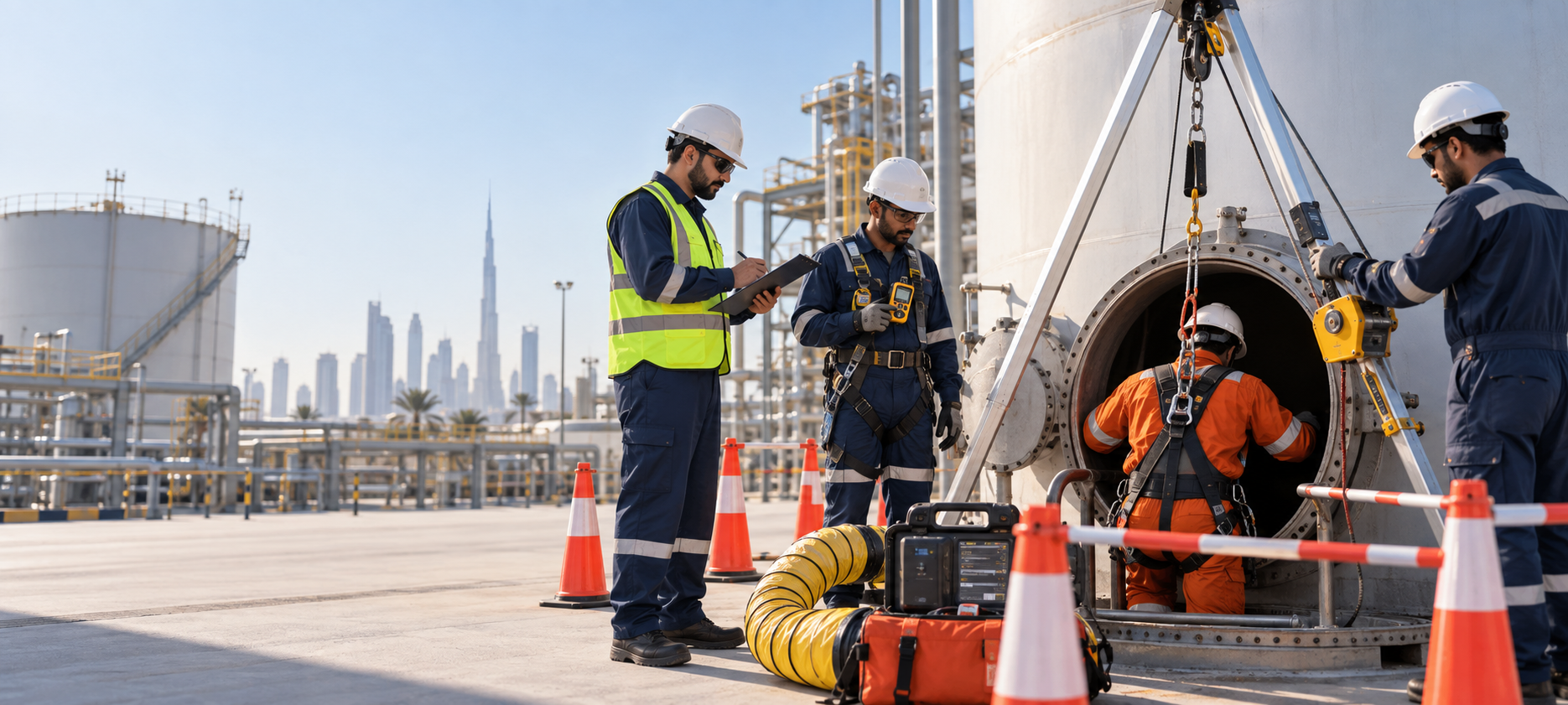
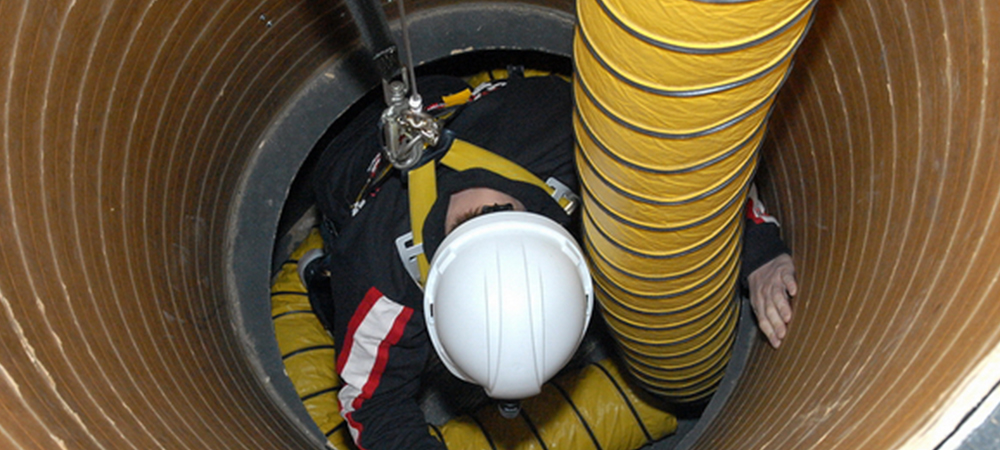
A storage tank looks empty. It isn’t — not of hazard. Residual vapour displaces oxygen, a worker climbing in for a five-minute inspection loses consciousness in under a minute, and the colleague who goes in after him without testing the atmosphere or wearing a harness becomes the second casualty, not the rescuer. Confined space incidents are disproportionately fatal precisely because the instinct to help is what kills the second person.
Nathan Safety Training (NIMS) trains entrants, attendants and supervisors to UAE confined space requirements across tanks, vessels, manholes, ducts, excavations and any enclosed or poorly-ventilated workspace — with the atmospheric testing and rescue planning that turns a permit from paperwork into an actual control.
Why This Is One of the Most Regulated Activities on a UAE Site
Dubai Municipality’s Code of Construction Safety Practice sets out explicit ventilation and atmospheric control requirements for confined and enclosed spaces — vaults, basements, tanks — and requires protective equipment wherever ventilation cannot adequately clear dust, fumes, vapours or gases. Special activity permits for confined space work are a defined category under Dubai Municipality’s project HSE requirements, separate from a general permit to work. In Abu Dhabi, ADOSH-SF (the emirate’s occupational safety framework, formerly branded OSHAD-SF) carries its own confined space Code of Practice under the same enforcement structure as scaffolding, electrical and chemical hazards.
The common thread across both frameworks is that confined space entry is never authorised on a general permit. It requires its own atmospheric testing record, its own named entrant and attendant, and its own rescue plan — reviewed before entry begins, not assumed to exist because a Permit to Work system is running elsewhere on site.
OSHAD-SF’s confined space Code of Practice and Dubai Municipality’s ventilation requirements both predate the current wave of digital permit platforms, but the underlying principle hasn’t changed: nobody enters until the atmosphere is tested, and nobody stays unmonitored. Where the two frameworks diverge slightly is documentation format, not the substance of what’s required — which is exactly why we train supervisors to recognise the underlying principle rather than memorise one authority’s paperwork.
The Incidents That Take Two People, Not One
Confined space fatalities disproportionately involve a second casualty — a colleague who goes in after the first without testing, without a harness, without really deciding to. That pattern is precisely why this training exists: it isn’t only about the entrant’s competence, it’s about building a team where the instinct to help doesn’t become the second emergency.
Operationally, a confined space incident doesn’t stay contained to the incident itself. It typically halts the surrounding work area, triggers a full authority investigation, and follows the company into its next prequalification review — long after the immediate cost of the incident has been settled.
Who This Course Is For
Confined space entry isn’t confined to one industry — it’s defined by the space, not the sector.
- Oil, gas and petrochemical operations — tanks, vessels, pipelines and process equipment
- Construction — manholes, basements, excavations, lift pits and drainage chambers
- Water, wastewater and utilities — reservoirs, sewers, pump stations and cable ducts
- Facilities management — HVAC ductwork, service risers, tank cleaning and inspection
- Marine and offshore — ballast tanks, cargo holds and enclosed compartments
- Manufacturing — silos, mixing vessels and enclosed process units
From Tank Farms to Terminal Vessels: Coverage by Emirate
The type of confined space differs sharply by emirate, so the training emphasis shifts with it. We deliver onsite across all seven:
- Dubai — DEWA and utility infrastructure work alongside JAFZA tank farms give Dubai the widest mix of confined space types in the country, from cable ducts to process vessels
- Abu Dhabi — ADNOC’s onshore processing facilities around Mussafah and ICAD mean a higher proportion of our Abu Dhabi bookings are supervisor and rescue level rather than awareness level
- Sharjah — Hamriyah Free Zone’s heavy industrial base includes bulk storage tanks that require the same atmospheric testing discipline as a much larger oil & gas site
- Ajman — port-adjacent storage and smaller-scale industrial vessels in Ajman Free Zone are frequently under-assessed simply because the site feels too small to carry major-hazard risk
- Ras Al Khaimah — RAK Ceramics’ kilns and processing vessels, plus quarrying-adjacent plant, bring confined space configurations most training providers outside RAK rarely see
- Fujairah — the Fujairah Oil Industry Zone has one of the highest concentrations of confined tank entry work anywhere in the UAE, which is why our Fujairah bookings skew heavily toward full rescue-level certification
- Umm Al Quwain — a lighter industrial footprint, but utility and drainage confined spaces still carry the same atmospheric hazard risk and the same ADOSH-SF and municipal expectations
Course Tiers by Role
Role | Duration | Covers |
Confined Space Awareness | 1 day | Hazard recognition, permit basics, when NOT to enter |
Entrant & Attendant | 2 days | Atmospheric testing, communication, emergency signals, PPE |
Supervisor & Rescue | 3 days | Permit authorisation, rescue planning, non-entry and entry rescue |
The Findings That Recur on Confined Space Audits
The regulation is rarely the problem. The gap between the permit and what happens on the ground is.
If I had to flag the single riskiest habit, it’s the attendant who steps away ‘just for a minute’ — that’s precisely the minute an entrant usually needs them.
- Atmosphere tested once before entry and never re-tested during long-duration work, missing gas build-up over time
- The attendant pulled away to help with something else, leaving the space unmonitored for ‘just a few minutes’
- A rescue plan that names the municipal fire service as the rescue method, with no realistic account of their response time
- Entrants without a harness and retrieval line because the space ‘isn’t that deep’
- Gas detectors that haven’t been calibrated or bump-tested in months, trusted anyway because the screen still lights up
Our Approach to Confined Space Certification
hsemanpower.ae, part of the same group, can supply trained standby attendants directly where a client needs coverage rather than only certification — useful for shorter projects that don’t justify training permanent staff to supervisor level.
- Practical entry and rescue drills using real confined space simulators, not classroom theory alone
- Instructors with direct oil & gas and industrial confined space experience
- Gas detection equipment training on the same instrument brands common across UAE sites
- Onsite delivery so training happens against your actual tanks, vessels or chambers where practical
- Rescue planning support that produces a usable, site-specific plan — not a generic template
Courses Offered
- First Aid Course - CPR and AED
- Confined Space
- Fire Safety Awareness
- Scaffolding Inspection
- Scaffolding Erection & Dismantling
- Flagman Safety
- Chemical Safety and Handling Training
- Hazard and Risk Assessment
- Rigging and Slinging Training
- Traffic Safety
- Hand and Power Tools Operator
- Electrical Safety
- Lock Out and Tag Out (LOTO)
- Accident Incident Investigation
- Lifeguard Training
- Advanced Risk Assessment & Compliance Service
- Behavior-Based Safety Workplace Safety Consulting
- Construction Site Safety Induction Training
- Emergency Response Team Training
- Excavator Operator Training
- Forklift Operator Training
- H2S Awareness & Breathing Apparatus Training
- Hot Work Safety Training
- Incident Reporting & Root Cause Analysis Service
- MEWP Operator Training
- Mobile Crane Operator Training
- Permit to Work System Training
- Rope Access Training
- Working at Height & Fall Protection Safety Training
- Oil & Gas Safety Training
- Fire Warden Training
- Manual Handling Training
- Banksman Safety Training
- Gas Tester Training
- Defensive Driving Training
- HAZMAT Awareness Training
- Machine Safety and Machine Guarding Training
- Spill Response and Spill Control Training
- Welding Safety Training
Need expert advice? Speak to our team today
FAQ
Is confined space entry training legally required in the UAE?
Yes. Dubai Municipality’s Code of Construction Safety Practice and Abu Dhabi’s ADOSH-SF both treat confined space entry as a distinct, specifically regulated activity requiring trained entrants, attendants and a dedicated permit — not general safety awareness.Yes. Dubai Municipality’s Code of Construction Safety Practice and Abu Dhabi’s ADOSH-SF both treat confined space entry as a distinct, specifically regulated activity requiring trained entrants, attendants and a dedicated permit — not general safety awareness.
What counts as a confined space?
Any space large enough to enter and perform work, with limited entry or exit, that isn’t designed for continuous occupancy — tanks, vessels, pits, manholes, ducts, silos and some excavations. Size isn’t the deciding factor; restricted egress and the potential for a hazardous atmosphere are.
How often does the atmosphere need to be tested?
Before every entry at minimum, and continuously or at defined intervals for the duration of the work if conditions could change — which they usually can. A single pre-entry reading with no ongoing monitoring is one of the most common gaps we find on audit.
What's the difference between entrant, attendant and supervisor roles?
The entrant physically goes into the space. The attendant stays outside, maintains communication, and initiates rescue if needed — and must never enter the space themselves to attempt a rescue. The supervisor authorises the permit, confirms conditions are met, and has authority to stop the work.
Do you provide rescue planning, or only entry training?
Both. Supervisor & Rescue level training includes building an actual site-specific rescue plan — non-entry retrieval methods first, entry rescue only where retrieval isn’t possible, and a realistic account of who responds and how fast.
Can the attendant also be the entrant on a small job?
No. This is one of the most common and most dangerous shortcuts we see. The attendant’s entire function is to stay outside and respond if the entrant is incapacitated; combining the roles removes the one safeguard designed to catch that exact failure.
What gas detection equipment do you train on?
We train on four-gas detectors (oxygen, combustible gas, carbon monoxide, hydrogen sulphide) consistent with the instruments most commonly deployed across UAE industrial and construction sites, including calibration and bump-testing procedure, not just how to read the display.
Is this course accepted for ADOSH-SF and Dubai Municipality compliance?
Yes, our course content and documentation are built to match what both frameworks expect an employer to demonstrate for confined space work — named trained personnel, a role-based structure, and a rescue plan on file.
How long is the certification valid?
We recommend refresher training every two years, or sooner if there’s been an incident, a near-miss, or a significant change to the types of spaces your team enters. Confined space skills, like resuscitation skills, decay faster than the certificate implies.
Do you train on excavations as well as tanks and vessels?
Yes, where an excavation meets the definition of a confined space — restricted access, potential for atmospheric hazard, or engulfment risk from unstable ground. Not every excavation qualifies, and part of the awareness-level course is learning to correctly identify which ones do.
Do you cover Fujairah's oil terminal and tank farm sites specifically?
Yes, and it’s one of our most requested locations for this course — FOIZ’s concentration of storage tanks means Fujairah bookings more often need full supervisor and rescue-level certification than a general awareness course.
Can you train a small team of two or three, or only larger groups?
Yes — entrant, attendant and supervisor roles genuinely require at least a small handful of trained people regardless of overall site headcount, so we run this course for teams as small as two or three as readily as for larger crews.
Is 'confined space awareness' the same as full entry certification?
No — awareness training explains hazard recognition and when not to enter, but doesn’t qualify anyone to actually enter, attend or supervise a confined space job. If your team physically enters tanks, vessels or manholes, they need Entrant & Attendant or Supervisor & Rescue level, not awareness alone.
- First Aid Course - CPR and AED
- Confined Space
- Fire Safety Awareness
- Scaffolding Inspection
- Scaffolding Erection & Dismantling
- Flagman Safety
- Chemical Safety and Handling Training
- Hazard and Risk Assessment
- Rigging and Slinging Training
- Traffic Safety
- Hand and Power Tools Operator
- Electrical Safety
- Lock Out and Tag Out (LOTO)
- Accident Incident Investigation
- Lifeguard Training
- Advanced Risk Assessment & Compliance Service
- Behavior-Based Safety Workplace Safety Consulting
- Construction Site Safety Induction Training
- Emergency Response Team Training
- Excavator Operator Training
- Forklift Operator Training
- H2S Awareness & Breathing Apparatus Training
- Hot Work Safety Training
- Incident Reporting & Root Cause Analysis Service
- MEWP Operator Training
- Mobile Crane Operator Training
- Permit to Work System Training
- Rope Access Training
- Working at Height & Fall Protection Safety Training

Confined Space Entry Training UAE — Atmospheric Testing, Permits and Rescue-Ready Crews
A storage tank looks empty. It isn’t — not of hazard. Residual vapour displaces oxygen, a worker climbing in for a five-minute inspection loses consciousness in under a minute, and the colleague who goes in after him without testing the atmosphere or wearing a harness becomes the second casualty, not the rescuer. Confined space incidents are disproportionately fatal precisely because the instinct to help is what kills the second person.
Nathan Safety Training (NIMS) trains entrants, attendants and supervisors to UAE confined space requirements across tanks, vessels, manholes, ducts, excavations and any enclosed or poorly-ventilated workspace — with the atmospheric testing and rescue planning that turns a permit from paperwork into an actual control.
Why This Is One of the Most Regulated Activities on a UAE Site
Dubai Municipality’s Code of Construction Safety Practice sets out explicit ventilation and atmospheric control requirements for confined and enclosed spaces — vaults, basements, tanks — and requires protective equipment wherever ventilation cannot adequately clear dust, fumes, vapours or gases. Special activity permits for confined space work are a defined category under Dubai Municipality’s project HSE requirements, separate from a general permit to work. In Abu Dhabi, ADOSH-SF (the emirate’s occupational safety framework, formerly branded OSHAD-SF) carries its own confined space Code of Practice under the same enforcement structure as scaffolding, electrical and chemical hazards.
The common thread across both frameworks is that confined space entry is never authorised on a general permit. It requires its own atmospheric testing record, its own named entrant and attendant, and its own rescue plan — reviewed before entry begins, not assumed to exist because a Permit to Work system is running elsewhere on site.
OSHAD-SF’s confined space Code of Practice and Dubai Municipality’s ventilation requirements both predate the current wave of digital permit platforms, but the underlying principle hasn’t changed: nobody enters until the atmosphere is tested, and nobody stays unmonitored. Where the two frameworks diverge slightly is documentation format, not the substance of what’s required — which is exactly why we train supervisors to recognise the underlying principle rather than memorise one authority’s paperwork.
The Incidents That Take Two People, Not One
Confined space fatalities disproportionately involve a second casualty — a colleague who goes in after the first without testing, without a harness, without really deciding to. That pattern is precisely why this training exists: it isn’t only about the entrant’s competence, it’s about building a team where the instinct to help doesn’t become the second emergency.
Operationally, a confined space incident doesn’t stay contained to the incident itself. It typically halts the surrounding work area, triggers a full authority investigation, and follows the company into its next prequalification review — long after the immediate cost of the incident has been settled.
Who This Course Is For
Confined space entry isn’t confined to one industry — it’s defined by the space, not the sector.
- Oil, gas and petrochemical operations — tanks, vessels, pipelines and process equipment
- Construction — manholes, basements, excavations, lift pits and drainage chambers
- Water, wastewater and utilities — reservoirs, sewers, pump stations and cable ducts
- Facilities management — HVAC ductwork, service risers, tank cleaning and inspection
- Marine and offshore — ballast tanks, cargo holds and enclosed compartments
- Manufacturing — silos, mixing vessels and enclosed process units
From Tank Farms to Terminal Vessels: Coverage by Emirate
The type of confined space differs sharply by emirate, so the training emphasis shifts with it. We deliver onsite across all seven:
- Dubai — DEWA and utility infrastructure work alongside JAFZA tank farms give Dubai the widest mix of confined space types in the country, from cable ducts to process vessels
- Abu Dhabi — ADNOC’s onshore processing facilities around Mussafah and ICAD mean a higher proportion of our Abu Dhabi bookings are supervisor and rescue level rather than awareness level
- Sharjah — Hamriyah Free Zone’s heavy industrial base includes bulk storage tanks that require the same atmospheric testing discipline as a much larger oil & gas site
- Ajman — port-adjacent storage and smaller-scale industrial vessels in Ajman Free Zone are frequently under-assessed simply because the site feels too small to carry major-hazard risk
- Ras Al Khaimah — RAK Ceramics’ kilns and processing vessels, plus quarrying-adjacent plant, bring confined space configurations most training providers outside RAK rarely see
- Fujairah — the Fujairah Oil Industry Zone has one of the highest concentrations of confined tank entry work anywhere in the UAE, which is why our Fujairah bookings skew heavily toward full rescue-level certification
- Umm Al Quwain — a lighter industrial footprint, but utility and drainage confined spaces still carry the same atmospheric hazard risk and the same ADOSH-SF and municipal expectations
Course Tiers by Role
Role | Duration | Covers |
Confined Space Awareness | 1 day | Hazard recognition, permit basics, when NOT to enter |
Entrant & Attendant | 2 days | Atmospheric testing, communication, emergency signals, PPE |
Supervisor & Rescue | 3 days | Permit authorisation, rescue planning, non-entry and entry rescue |
The Findings That Recur on Confined Space Audits
The regulation is rarely the problem. The gap between the permit and what happens on the ground is.
If I had to flag the single riskiest habit, it’s the attendant who steps away ‘just for a minute’ — that’s precisely the minute an entrant usually needs them.
- Atmosphere tested once before entry and never re-tested during long-duration work, missing gas build-up over time
- The attendant pulled away to help with something else, leaving the space unmonitored for ‘just a few minutes’
- A rescue plan that names the municipal fire service as the rescue method, with no realistic account of their response time
- Entrants without a harness and retrieval line because the space ‘isn’t that deep’
- Gas detectors that haven’t been calibrated or bump-tested in months, trusted anyway because the screen still lights up
Our Approach to Confined Space Certification
hsemanpower.ae, part of the same group, can supply trained standby attendants directly where a client needs coverage rather than only certification — useful for shorter projects that don’t justify training permanent staff to supervisor level.
- Practical entry and rescue drills using real confined space simulators, not classroom theory alone
- Instructors with direct oil & gas and industrial confined space experience
- Gas detection equipment training on the same instrument brands common across UAE sites
- Onsite delivery so training happens against your actual tanks, vessels or chambers where practical
- Rescue planning support that produces a usable, site-specific plan — not a generic template
FAQ
Is confined space entry training legally required in the UAE?
Yes. Dubai Municipality’s Code of Construction Safety Practice and Abu Dhabi’s ADOSH-SF both treat confined space entry as a distinct, specifically regulated activity requiring trained entrants, attendants and a dedicated permit — not general safety awareness.
What counts as a confined space?
Any space large enough to enter and perform work, with limited entry or exit, that isn’t designed for continuous occupancy — tanks, vessels, pits, manholes, ducts, silos and some excavations. Size isn’t the deciding factor; restricted egress and the potential for a hazardous atmosphere are.
How often does the atmosphere need to be tested?
Before every entry at minimum, and continuously or at defined intervals for the duration of the work if conditions could change — which they usually can. A single pre-entry reading with no ongoing monitoring is one of the most common gaps we find on audit.
What's the difference between entrant, attendant and supervisor roles?
The entrant physically goes into the space. The attendant stays outside, maintains communication, and initiates rescue if needed — and must never enter the space themselves to attempt a rescue. The supervisor authorises the permit, confirms conditions are met, and has authority to stop the work.
Do you provide rescue planning, or only entry training?
Both. Supervisor & Rescue level training includes building an actual site-specific rescue plan — non-entry retrieval methods first, entry rescue only where retrieval isn’t possible, and a realistic account of who responds and how fast.
Can the attendant also be the entrant on a small job?
No. This is one of the most common and most dangerous shortcuts we see. The attendant’s entire function is to stay outside and respond if the entrant is incapacitated; combining the roles removes the one safeguard designed to catch that exact failure.
What gas detection equipment do you train on?
We train on four-gas detectors (oxygen, combustible gas, carbon monoxide, hydrogen sulphide) consistent with the instruments most commonly deployed across UAE industrial and construction sites, including calibration and bump-testing procedure, not just how to read the display.
Is this course accepted for ADOSH-SF and Dubai Municipality compliance?
Yes, our course content and documentation are built to match what both frameworks expect an employer to demonstrate for confined space work — named trained personnel, a role-based structure, and a rescue plan on file.
How long is the certification valid?
We recommend refresher training every two years, or sooner if there’s been an incident, a near-miss, or a significant change to the types of spaces your team enters. Confined space skills, like resuscitation skills, decay faster than the certificate implies.
Do you train on excavations as well as tanks and vessels?
Yes, where an excavation meets the definition of a confined space — restricted access, potential for atmospheric hazard, or engulfment risk from unstable ground. Not every excavation qualifies, and part of the awareness-level course is learning to correctly identify which ones do.
Do you cover Fujairah's oil terminal and tank farm sites specifically?
Yes, and it’s one of our most requested locations for this course — FOIZ’s concentration of storage tanks means Fujairah bookings more often need full supervisor and rescue-level certification than a general awareness course.
Can you train a small team of two or three, or only larger groups?
Yes — entrant, attendant and supervisor roles genuinely require at least a small handful of trained people regardless of overall site headcount, so we run this course for teams as small as two or three as readily as for larger crews.
Is 'confined space awareness' the same as full entry certification?
No — awareness training explains hazard recognition and when not to enter, but doesn’t qualify anyone to actually enter, attend or supervise a confined space job. If your team physically enters tanks, vessels or manholes, they need Entrant & Attendant or Supervisor & Rescue level, not awareness alone.
Talk to Us Before Your Next Entry Job
Whether you need confined space awareness, full entrant and attendant certification, or supervisor and rescue training, tell us the types of spaces your team actually enters — tanks, ducts, manholes, vessels — and we’ll scope the right mix rather than a generic one-size course.
Nathan Safety Training (NIMS) — Confined space entry, atmospheric testing and rescue training across Dubai, Abu Dhabi, Sharjah, Ajman, Ras Al Khaimah, Fujairah and Umm Al Quwain.