

Home / Legionella & Water Hygiene Training
Legionella & Water Hygiene Training In Uae
Legionella & Water Hygiene Training UAE | NIMS — More Than a Compliance Tick: Legionella Risk Management and Water Hygiene Training in the UAE
A water safety logbook filed correctly and never acted on doesn’t protect anyone. A Legionella risk assessment gathering dust on a shelf doesn’t either. What actually protects the people drinking, showering, and breathing mist from your building’s water systems is a trained responsible person who knows what Legionella looks like in a risk register, what it means in practice on a walk-through, and what to do when water temperatures, disinfection residuals, or stagnation risk step outside the parameters that keep Legionella growth suppressed.
Nathan Safety Training (NIMS) built this Legionella and water hygiene course to close the gap between a risk assessment on paper and a water system actually managed in practice — trained to Dubai Municipality, ADDC, and DEWA Legionella guidance, with onsite delivery across the UAE.
The Regulatory Framework This Course Is Built Against
Dubai Municipality’s Public Health and Safety Department issues specific guidance on Legionella control in cooling towers, hot and cold water systems, and decorative water features — including obligations around risk assessment, written control schemes, and responsible person designation. In Abu Dhabi, both ADDC and the Department of Health layer water safety obligations across healthcare, hotel, and commercial building stock. DEWA’s technical requirements for building water systems add an additional layer for Dubai properties connected to district cooling or municipal supply.
In healthcare settings, the regulatory stakes are higher still: Joint Commission International (JCI) accreditation and the Department of Health Abu Dhabi both require documented water safety plans and trained responsible persons as a condition of licence — not a nice-to-have, but an accreditation finding if absent.
Facilities management contracts increasingly require responsible person certification as a condition of appointment. A building without a designated, trained responsible person isn’t just a compliance gap — it’s a contract risk.
What Legionella Risk Actually Looks Like in a UAE Building
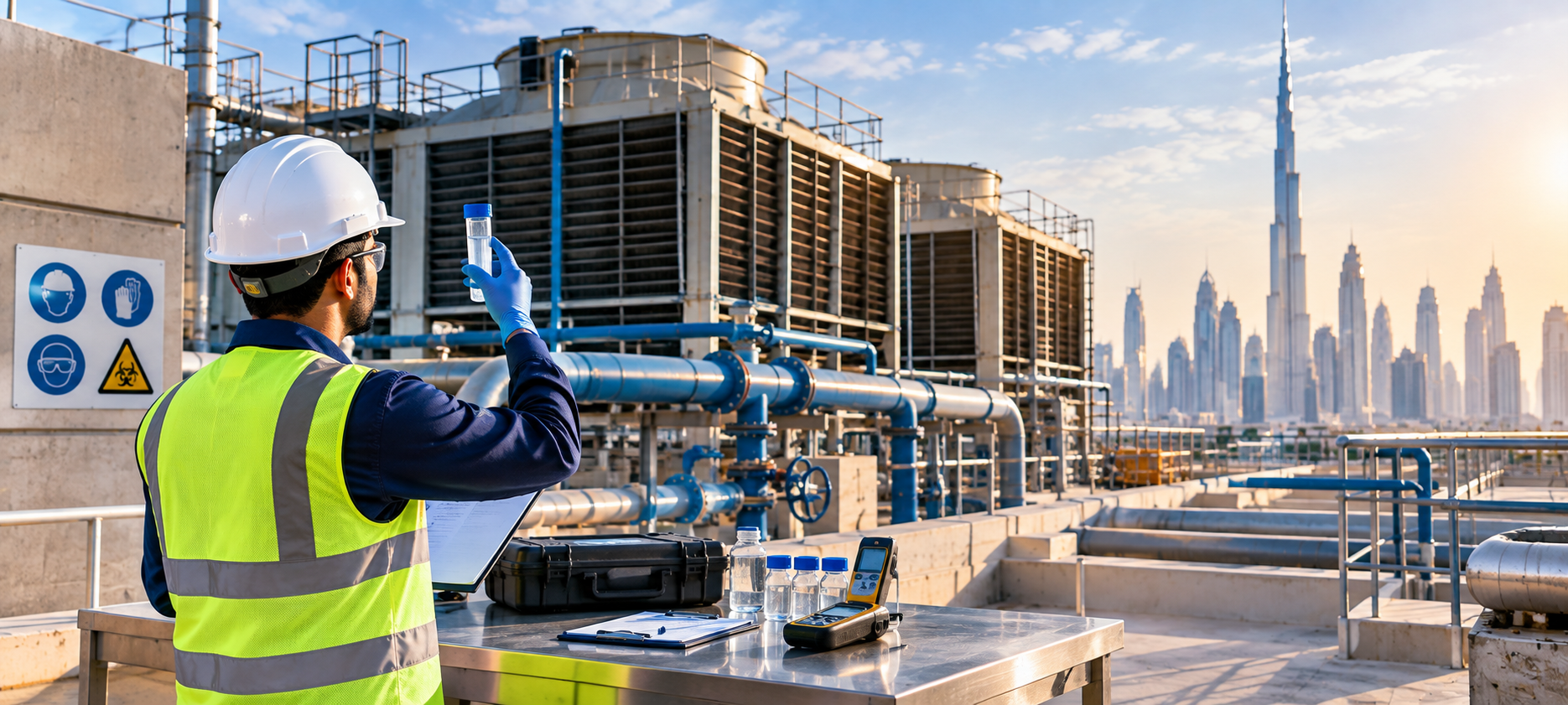
The UAE’s operating environment creates specific Legionella risk factors that differ from a European context. Incoming cold water at 30°C+ during summer months means “cold water” systems already sit within Legionella’s preferred growth temperature range before any building engineering adds heat. Cooling towers serving district-cooled buildings run continuously at high flow rates, creating aerosolisation risk across roof levels and neighbouring structures. Hotel pools, spa facilities, and decorative water features generate misting aerosol in occupied public spaces.
The training covers what each of those risk factors looks like in a site-specific context — not a generic Legionella lecture, but a course built around the systems your responsible person will actually be managing.
Who This Course Is For
- Facilities managers and building engineers designated as responsible persons for Legionella control
- Hotel engineering and maintenance teams managing cooling towers, spa and pool systems, and domestic hot and cold water
- Healthcare facilities managers where JCI or DoH water safety plan obligations apply
- FM contractors providing water hygiene services to commercial and residential clients
- HSE officers at sites with cooling towers, evaporative condensers, or high-risk water features
- Property management companies with obligations under Dubai Municipality or ADDC water safety guidance
Legionella Risk Across UAE Industries
Legionella exposure risk isn’t confined to large commercial buildings. We’ve delivered this training across:
- Hotels & hospitality — cooling towers, spa and wellness facilities, decorative fountains, and high-volume domestic hot water systems serving hundreds of rooms create layered risk that static risk assessments alone don’t capture
- Healthcare — hospitals, clinics, and long-term care facilities where immunocompromised patients make a Legionella case potentially fatal, and where JCI expects not just a plan but evidence of competent implementation
- Commercial real estate — DEWA-regulated buildings with centralised cooling towers and tenant fit-outs that alter water distribution without triggering a full risk reassessment
- Industrial & manufacturing — cooling water systems in production environments where the responsible person may also be managing process safety obligations simultaneously
- Education — university campuses and school complexes with seasonal occupancy patterns that create stagnation risk in unoccupied wings
- Retail & mixed-use — shopping centres and mixed-use developments where multiple tenants share water infrastructure but only one party holds the responsible person designation
Legionella Control in UAE Water Systems: Key Risk Zones
System / Location | Primary Legionella Risk Factor |
Cooling towers | Aerosolised water drift at elevated temperature — highest public exposure risk |
Hot water storage calorifiers | Storage below 60°C allows Legionella colonisation in deadlegs and sediment |
Cold water tanks and cisterns | Incoming supply at 30°C+ sits in Legionella’s preferred growth range in UAE summer |
Spa pools and hydrotherapy | Recirculated warm water with frequent occupant turnover and aerosolised mist |
Decorative fountains & misters | Public-facing aerosol generation in occupied outdoor and indoor spaces |
Infrequently used outlets | Stagnant water in deadlegs, little-used showers and taps concentrates bacterial growth |
What a Responsible Person Is Actually Expected to Do
The “responsible person” designation sounds administrative. In practice it carries specific operational obligations: maintaining a written Legionella control scheme, ensuring water temperature monitoring at defined frequencies, managing disinfection and flushing schedules, reviewing risk assessments after any system change, and keeping records that hold up to a regulatory inspection.
This course trains the responsible person to fulfil those obligations in practice — not just to understand what they are, but to carry them out against the systems on their specific site.
What We Cover
- Legionella biology: what conditions promote growth and why UAE ambient temperatures raise baseline risk
- UAE regulatory framework: Dubai Municipality, ADDC, DEWA, and healthcare-specific requirements under JCI and DoH
- Legionella risk assessment methodology: identifying risk sources, prioritising control measures, and structuring a written control scheme
- Temperature monitoring, disinfection dosing, and flushing regimes — frequency, method, and records
- Cooling tower management: drift eliminators, biocide treatment, inspection and cleaning schedules
- Spa pool, decorative feature, and misting system risk management
- Stagnation risk management: managing deadlegs, infrequently used outlets, and seasonal vacancy
- Record-keeping and logbook structure that meets regulatory and audit requirements
- Incident response: what to do when sampling identifies Legionella or a suspect case is reported
What Sets Our Water Hygiene Training Apart
We built this course around a consistent finding in UAE water safety: most Legionella control failures aren’t failures of risk assessment — they’re failures of implementation by a responsible person who understood the theory but wasn’t trained for the specific systems on their site.
- Training built around UAE ambient temperatures, incoming water conditions, and the specific cooling tower and domestic system types common across Dubai, Abu Dhabi, and the Northern Emirates
- Regulatory content mapped to Dubai Municipality Public Health guidance, ADDC, DEWA, and healthcare accreditation requirements — not a generic UK L8 course republished for the region
- Practical risk assessment sessions using actual site documentation, not classroom hypotheticals
- Record-keeping templates and control scheme frameworks your responsible person can implement immediately
- For clients pursuing ISO 45001 or pursuing JCI accreditation, Nathan ISO Consulting — part of the same group — can align water safety documentation directly with what a certification auditor expects
Courses Offered
- First Aid Course - CPR and AED
- Confined Space
- Fire Safety Awareness
- Scaffolding Inspection
- Scaffolding Erection & Dismantling
- Flagman Safety
- Chemical Safety and Handling Training
- Hazard and Risk Assessment
- Rigging and Slinging Training
- Traffic Safety
- Hand and Power Tools Operator
- Electrical Safety
- Lock Out and Tag Out (LOTO)
- Accident Incident Investigation
- Lifeguard Training
- Advanced Risk Assessment & Compliance Service
- Behavior-Based Safety Workplace Safety Consulting
- Construction Site Safety Induction Training
- Emergency Response Team Training
- Excavator Operator Training
- Forklift Operator Training
- H2S Awareness & Breathing Apparatus Training
- Hot Work Safety Training
- Incident Reporting & Root Cause Analysis Service
- MEWP Operator Training
- Mobile Crane Operator Training
- Permit to Work System Training
- Rope Access Training
- Working at Height & Fall Protection Safety Training
- Oil & Gas Safety Training
- Fire Warden Training
- Manual Handling Training
- Banksman Safety Training
- Gas Tester Training
- Defensive Driving Training
- HAZMAT Awareness Training
- Machine Safety and Machine Guarding Training
- Spill Response and Spill Control Training
- Welding Safety Training
Need expert advice? Speak to our team today
FAQ
What is a "responsible person" for Legionella control in the UAE?
The responsible person is the individual designated by the building owner or operator as accountable for ensuring Legionella control measures are implemented and maintained. Under Dubai Municipality and ADDC guidance, this person must be demonstrably competent — meaning trained, not just appointed. Designation without training is a paper responsibility that won’t withstand a regulatory inspection or an incident investigation.
Does UAE law require Legionella risk assessments?
Dubai Municipality’s Public Health and Safety Department requires cooling tower operators to maintain Legionella control programmes including risk assessment and written control schemes. In Abu Dhabi, ADDC guidance and DoH healthcare licensing requirements create equivalent obligations. JCI-accredited facilities face additional accreditation requirements for documented water safety plans regardless of emirate.
How does UAE ambient temperature affect Legionella risk?
Legionella grows most readily between 20°C and 45°C. UAE incoming cold water supply regularly reaches 30°C+ during summer months, meaning a building’s “cold” water system is already within the risk range before any heating adds to it. Standard cold water temperature control targets that work in a northern European climate don’t translate directly to the UAE context, which is why this course is built around UAE operating conditions, not generic guidance.
Are cooling towers the only high-risk system?
Cooling towers carry the highest profile because of their aerosolisation potential and public exposure range. But domestic hot water calorifiers, spa pools, hydrotherapy equipment, decorative fountains, misters, and infrequently used outlets all generate Legionella risk in different ways. A responsible person trained only on cooling tower management has an incomplete risk picture for most UAE building types.
How often should Legionella risk assessments be reviewed?
After any significant change to the water system, after any Legionella-related incident, and periodically as a matter of routine — most guidance suggests at least every two years as a minimum, with more frequent review for high-risk systems. A risk assessment that was accurate when written may not reflect what’s actually on site if fit-outs, system changes, or occupancy patterns have shifted.
What records does a responsible person need to maintain?
Temperature monitoring logs, disinfection and biocide dosing records, cleaning and inspection records for cooling towers and storage tanks, flushing records for infrequently used outlets, and a written control scheme reviewed against any system change. The exact format matters less than the fact that records exist, are current, and can be produced immediately if requested by a regulatory inspector or in the event of an incident investigation.
What happens if a Legionella case is linked to my building?
A confirmed Legionella case linked to a building triggers a regulatory investigation, potential site closure, compulsory remediation, and full public health review. The responsible person’s records — or their absence — become central to that investigation. A building that can produce contemporaneous temperature logs, cleaning records, and a signed-off control scheme is in a demonstrably different position to one that cannot.
Is this training relevant for hotel properties?
Very much so. Hotels combine multiple high-risk system types — cooling towers, spa and pool facilities, high-volume hot water serving hundreds of guest rooms, decorative water features — with a transient guest population that includes individuals of varying health status. Dubai Tourism and Dubai Municipality both have interests in hotel water safety that extend beyond building owner obligations.
Do you cover spa pool and misting system management?
Yes — spa pools, hydrotherapy systems, decorative misting features, and fountains are covered as distinct risk sources with specific control requirements. A spa pool is a fundamentally different Legionella risk environment to a cooling tower, and the control programme is different as well.
How long does the training take?
The core responsible person course runs two days, combining regulatory framework, risk assessment methodology, and practical record-keeping. For sites with cooling towers or healthcare settings, an extended version covering system-specific management in greater depth is available. We can deliver onsite at your facility against your actual water systems rather than classroom hypotheticals.
Train Your Responsible Person
Whether you’re designating a responsible person for the first time or upskilling an existing team against current Dubai Municipality, ADDC, or healthcare accreditation requirements, tell us your site type and water systems, and we’ll scope a course built around what your responsible person will actually be managing.
Nathan Safety Training (NIMS) — Legionella and water hygiene training across Dubai, Abu Dhabi, Sharjah, Ajman, Ras Al Khaimah, Fujairah and Umm Al Quwain.