
7 Proven Benefits of Scaffolding Inspection in Dubai for Teams
Why Your Team Needs Certified Scaffold Inspectors
If your company uses scaffolds on any site, someone on your team must check them, sign them off and tag them safe. This guide explains why investing in scaffolding inspection in Dubai for your own employees pays off, and how NIMS trains and certifies them for you.
It is written for HSE managers, project managers, HR and training heads, and business owners. In short, for anyone who needs certified people on site, not just a certificate in a file.
NIMS (Nathan Safety Training) delivers scaffolding inspection training across all seven emirates. We train your staff, assess them on real scaffolds and send them back to your sites as competent, audit-ready inspectors.
Quick Answer: What Does Your Company Gain?
Training your own employees as certified scaffold inspectors gives your company seven clear gains:
- Daily compliance with Dubai Municipality and free zone rules
- Fewer falls, collapses and site accidents
- Stronger tender and prequalification profiles
- Projects that stay on schedule
- An audit-ready tagging and record system
- Lower long-term safety costs
- A visible safety culture that clients trust
What Is Scaffolding Inspection in Dubai?
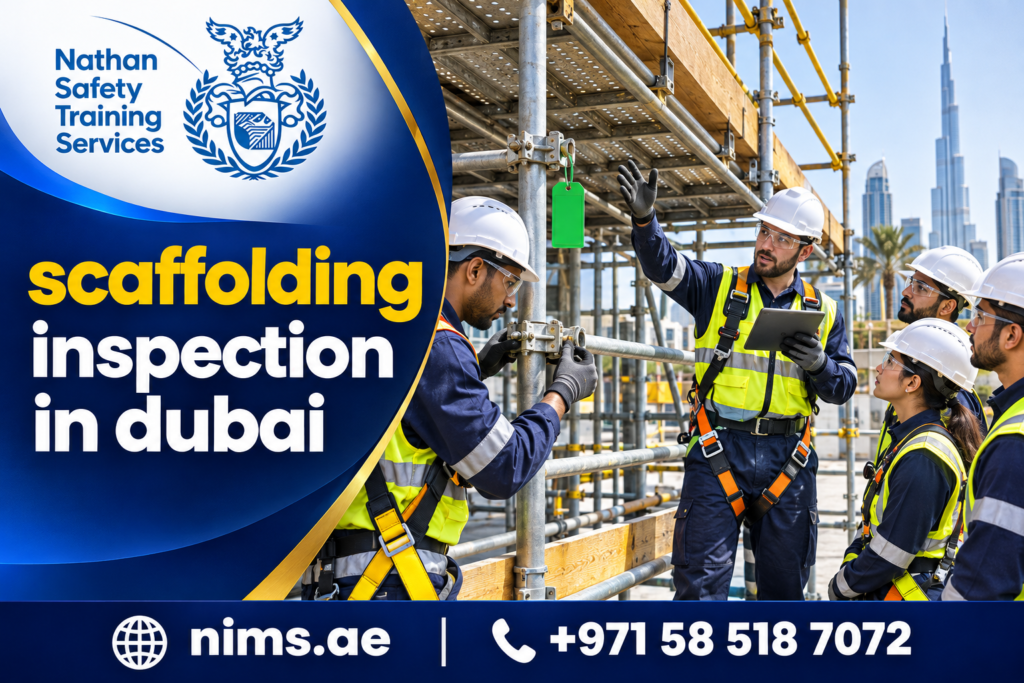
Scaffolding inspection is a hands-on check of a scaffold’s base, ties, boards, guardrails and load capacity. A trained competent person does it before first use and at set intervals after that.
The result is shown on a scaff-tag at the access point:
- Green tag: inspected and safe to use
- Red tag: unsafe, do not use
Dubai Municipality’s Code of Construction Safety Practice covers scaffolding in Chapter 8. Free zones such as Trakhees and DMCC can add their own rules on top of it.
The person who signs that tag must be properly trained. That is exactly what a competent person scaffolding course gives your employee.
Why Companies Need In-House Scaffold Inspectors
Many sites still let whoever is free that day sign the scaffold tag. That creates risk, because scaffolds change every day.
Here is what usually goes wrong:
- A tie is removed to let a delivery through and never put back
- A subcontractor’s crew loosens a ledger and does not report it
- The tag is not updated after a modification
- The check is done from the ground, without climbing the structure
An outside inspector cannot be on your site every day to catch these changes. Your own trained employee can.
That is why structured HSE training for employees is now a business need, not a nice extra. When your staff are trained, the inspection happens on time and the record stands up at audit.
7 Proven Benefits of Training Your Team in Scaffold Inspection
1. Stay Compliant With Dubai Rules Every Day
Regulators expect a competent person to inspect and sign off every scaffold. Trained employees know the Dubai Municipality scaffolding requirements in Chapter 8 and can apply them on every site.
They also learn where rules change:
- Free zones like Trakhees and DMCC add extra site conditions
- Abu Dhabi projects follow ADOSH-SF COP 26
- Each authority has its own inspection and record expectations
This keeps your company on the right side of workplace safety compliance in UAE, wherever your next project is.
2. Prevent Falls, Collapses and Costly Accidents
Most scaffold failures do not come from a total lack of inspection. They come from inspections that exist on paper but not in practice.
Trained inspectors close these gaps:
- They physically check ties, boards and guardrails, not just look up from the ground
- They use the right checklist for each scaffold type and load class
- They re-inspect after every change, not only on the weekly date
The result is better working at height safety for every worker who climbs. Pair it with our Working at Height & Fall Protection training for full coverage.
3. Win More Tenders and Pass Prequalification
Main contractors now review a subcontractor’s inspection and tagging history before awarding work. A gap in that record looks like a gap in competence.
A team with scaffold inspector certification helps you:
- Show named, certified inspectors in your tender documents
- Present a clean inspection and tagging history
- Answer client HSE questions with confidence
In a competitive market, this can be the difference between winning and losing a contract.
4. Keep Projects on Schedule
A scaffold incident can stop a whole project. It can also trigger an authority investigation that affects other permits on the same site.
With regular scaffolding inspection in Dubai handled by your own people, you get:
- Faster sign-offs, with no waiting for an outside inspector
- Fewer stop-work orders
- Early detection of problems before they become delays
5. Build an Audit-Ready Tagging and Record System
A tag is only as strong as the paperwork behind it. Our course trains your team on a proper scaffold tagging system and the records that must sit behind every tag.
Your team leaves with:
- A scaffold inspection checklist mapped to the relevant code of practice
- Tagging record templates ready to use on site
- Competent-person certificates you can show instantly at audit
If you are working toward ISO 9001 or ISO 45001, this documentation can be aligned with what your certification auditor expects.
6. Cut Long-Term Safety Costs
Training your own inspectors is a one-time investment with a long payback. You rely less on outside inspection support and lose less time to delays and rework.
Your savings come from:
- Fewer external inspection call-outs
- Less downtime from failed or late inspections
- Lower risk of incident costs, claims and penalties
- Simple refresher training every two to three years
7. Build a Safety Culture Clients Can See
Certified inspectors do more than sign tags. They coach crews, report issues early and set the standard for everyone on site.
This builds a culture where:
- Workers trust the scaffolds they climb
- Supervisors take inspection seriously
- Employees feel valued because you invested in their skills
Clients and site visitors notice this discipline, and it strengthens your reputation for future work.
Who in Your Company Should Attend
This is a competent-person course. It is for the people who sign a scaffold off as safe, not the crew who build it.
Send these team members:
- Site HSE officers and supervisors who approve scaffolds
- Quality and inspection staff of scaffolding contractors
- Facility and maintenance teams managing access scaffolds
- Shutdown and turnaround coordinators in oil & gas
- Main contractor staff who audit subcontractor scaffolds
- Experienced workers you plan to promote to supervisor roles
Need your crew trained to build and dismantle scaffolds too? See our Scaffolding Erection & Dismantling training. Many sites need both.
When Must a Scaffold Be Re-Inspected?
A scaffold is not inspected once and forgotten. Your inspectors must check it again whenever one of these triggers happens:
- Before first use: a full handover inspection from the erecting contractor
- Every 7 days: a full structural re-inspection and re-tag
- After any alteration: re-inspect before anyone uses it again
- After bad weather: high wind or heavy rain needs a structural check
- After an impact or suspected overload: full inspection before work continues
A tag older than seven days with no re-inspection is a compliance gap on almost every UAE site. Trained employees know these triggers by heart and act on them without being reminded.
How NIMS Trains and Certifies Your Team
We make it simple for companies to get certified inspectors on site. You tell us what you need, and we handle the training, assessment and records.
- Share your needs: number of employees, scaffold types, sites and emirates.
- We scope a course built around your real scaffold inventory.
- Training runs for two to three days, at our Dubai centre or as onsite scaffolding training at your project.
- Your team does hands-on inspection drills on live scaffolds, not just slides.
- Each employee is assessed and certified as a competent person.
- You receive inspection checklists, tagging templates and certification records.
- We remind you when refresher training is due, usually every two to three years.
We train single inspectors or full batches, so you can upskill a whole HSE team in one go. This flexible model makes NIMS a practical partner for corporate safety training in UAE.
Need certified HSE staff on site faster than you can train them? Our HSE Manpower Supply service can deploy qualified personnel while your team completes the course.
Industries We Train for Scaffold Inspection
Any business that puts workers on a scaffold needs a competent inspector. We regularly train teams from:
- Construction and civil engineering contractors (see our construction industry programmes)
- MEP contractors
- Oil & gas, EPC and shutdown or turnaround teams
- Facility management and real estate companies
- Scaffolding hire and erection companies
- Manufacturing and industrial plants
- Marine, shipyard and port operators
- High-rise and access-at-height projects
Each industry uses scaffolds differently, so we adapt the course to the structures your team actually works on. That focus on construction safety training in Dubai and beyond is what keeps our training practical.
Why Companies Choose NIMS
- Instructors with real construction and shutdown scaffolding experience
- Training mapped to Dubai Municipality Chapter 8 and ADOSH-SF COP 26
- Onsite delivery across all seven emirates
- Practical drills on live scaffolds
- Certification records kept ready for audits
- Internationally recognised by awarding bodies such as IOSH, NEBOSH and IEMA
- ISO 9001, ISO 14001 and ISO 45001 certified organisation
- Trusted by companies such as Al Habtoor, Binladin Contracting, Saipem, TK Elevator and Daikin
Frequently Asked Questions
How long does scaffold inspection training take?
Our core course runs two to three days. The exact length depends on how many scaffold types your site uses.
Can NIMS train our employees at our own site?
Yes. We deliver onsite training in Dubai, Abu Dhabi, Sharjah, Ajman, Ras Al Khaimah, Fujairah and Umm Al Quwain.
How often should scaffolding inspection in Dubai be done?
At least every seven days. It is also required before first use and after any alteration, bad weather, impact or suspected overload.
Is a scaffold inspector the same as a scaffold erector?
No. An erector builds and dismantles the scaffold. An inspector checks it and signs it off as safe. They need separate training.
How long is the certification valid?
We recommend refresher training every two to three years. Retrain sooner after any scaffold-related incident.
Do you provide checklists and tagging templates?
Yes. Your team receives inspection checklists and tagging record templates mapped to the relevant code of practice.
Can a main contractor's HSE officer inspect a subcontractor's scaffold?
Yes, provided that officer holds their own competent-person training. Many main contractors do this as an independent check.
How do we book training for a group of employees?
Call or email NIMS with your team size, scaffold types and site location. We will send a tailored training plan and quote.
Get Your Team Certified With NIMS Today
Every scaffold on your site is only as safe as the person who signs its tag. Give your company certified inspectors who protect your workers, your projects and your reputation.
When you book with NIMS, you get:
- A course scoped to your scaffolds, sites and team size
- Onsite or classroom training across all seven emirates
- Competent-person certificates and audit-ready records
- Checklists and tagging templates your team can use from day one
Explore the full scaffolding inspection course in Dubai or talk to our team now to plan scaffolding inspection in Dubai for your employees.