

How to Master Electrical Safety Training in Dubai, UAE: A Guide for UAE Companies
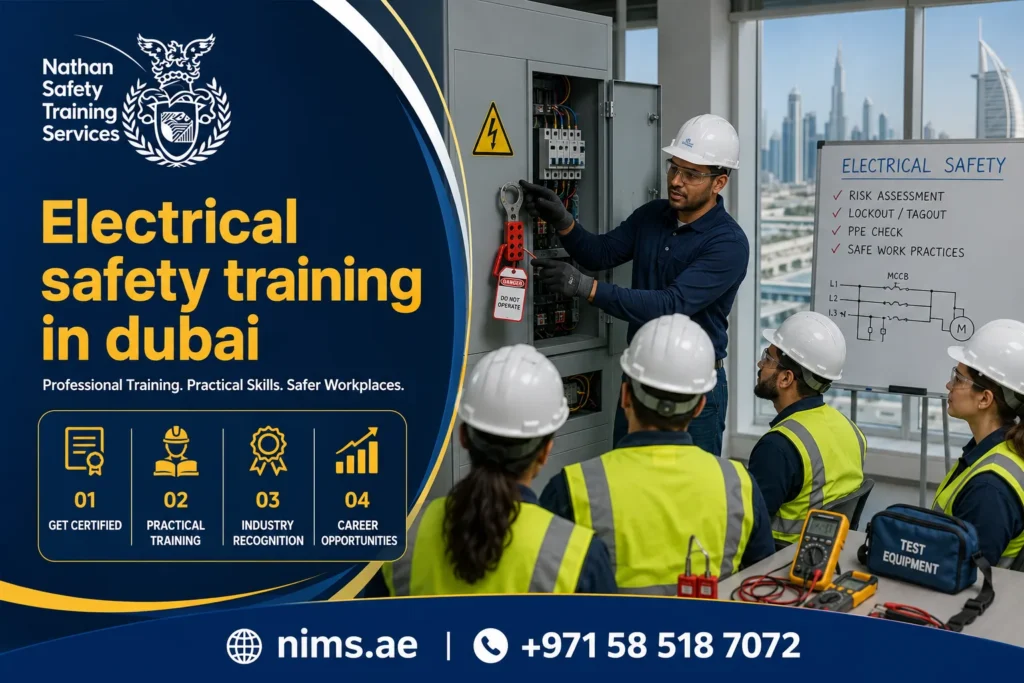
If your company operates anywhere in the UAE, electrical safety in Dubai, UAE, is not a box-ticking exercise; it’s a legal responsibility and a day-to-day business risk. Whether you run a construction site, a facilities management contract, a manufacturing plant, or an office tower with in-house maintenance staff, one untrained employee near a live circuit can cost you far more than the price of training.
This guide is written for the people who actually own this problem inside a company: HR managers, EHS/HSE officers, facility managers, and business owners responsible for getting their teams certified. We’ll cover why it matters, what a proper course includes, and how to train your workforce without disrupting operations.
Need this sorted for your team now? Skip ahead to our Electrical Safety Training Course in Dubai, UAE, and request a corporate batch.
Why Electrical Safety in Dubai, UAE, Is a Compliance Priority for Employers
Electricity powers almost every worksite in the UAE, but it’s also one of the most common causes of workplace injury when employees aren’t trained to recognize the risk. For employers, electrical safety in Dubai, UAE, sits at the intersection of three things: legal compliance, insurance exposure, and duty of care.
Here’s what’s typically at stake for a company that skips proper training:
- Regulatory exposure: UAE Labour Law and municipal/authority HSE requirements (e.g., OSHAD in Abu Dhabi, Dubai Municipality, and Civil Defence requirements in Dubai) expect employers to provide adequate safety training for staff exposed to workplace hazards, including electrical risk.
- Audit and tender readiness: Many client contracts, especially in construction, oil & gas, and facilities management, require proof of certified safety training before you’re even shortlisted.
- Insurance and liability: Untrained-employee incidents are far more likely to result in denied claims or higher premiums.
- Downtime and cost: A single electrical incident can shut down a site, trigger an investigation, and delay project handover.
In short: training your team isn’t just about avoiding a fine; it protects your contracts, your insurance standing, and your people.
Common Electrical Hazards in UAE Workplaces
Electricians don’t cause most electrical incidents; they’re caused by employees who work near electrical systems without realizing the risk. Common hazards our clients ask about include:
- Arc flash and arc blast exposure during switching or maintenance work
- Overloaded circuits and temporary wiring, especially common on active construction sites
- Damaged, exposed, or aging cabling in older facilities and retrofit projects
- Working near live low- or high-voltage equipment without proper isolation
- Moisture and heat exposure affecting electrical installations in outdoor and coastal environments
- Untrained staff attempting quick fixes instead of raising a permit or calling a qualified technician
A structured electrical risk assessment as part of your safety program helps identify which of these apply to your specific sites, and training is how you ensure staff actually act on that assessment.
What a Certified Electrical Safety Training Course Covers
Not all “safety briefings” are equal. A proper, certified course goes well beyond a slideshow. A solid electrical safety training program in the UAE, including NIMS’ Electrical Safety Training Course, aligned with the NFPA 70E Standard for Electrical Safety in the Workplace, typically covers:
- Electrical hazard identification and prevention
- Electrical shock prevention and emergency response
- Arc flash awareness and safe boundaries
- Lockout/Tagout (LOTO) procedures and safe isolation practices
- Personal protective equipment (PPE) selection and use
- Risk assessment for electrical work
- UAE workplace safety and compliance expectations
If your team also handles isolation work specifically, it’s worth pairing this with a dedicated Lockout and Tagout (LOTO) Training Program or Permit to Work System Training; both are natural follow-ons for teams working around live systems.
Business Benefits of Corporate Electrical Safety Training
For a business owner or HR manager, the real question isn’t “Is this a legal requirement?” it’s “What do we get for the investment?” Here’s the practical ROI:
- Fewer incidents, less downtime: Trained staff recognize and avoid hazards before they become accidents
- Stronger compliance position: Easier audits, tenders, and client due diligence checks
- Lower risk exposure: Supports your insurance and liability position
- Higher retention: Employees notice when a company invests in their safety
- Reputation protection: One preventable incident can undo years of client trust
For companies managing large or multi-site teams, this is also where a workforce partner matters. NIMS also offers HSE Manpower Supply & Deployment alongside training for companies that need trained personnel, not just a training slot.
How to Choose the Right Electrical Safety Training Provider in Dubai, UAE
If you’re comparing providers, look past the price sheet and check:
- Recognized standards: Does the course align with an established framework (e.g., NFPA 70E) rather than a generic in-house checklist?
- Trainer experience: Practical, site-based experience, not just classroom theory
- Industry customization: Can they adapt content for construction, facilities management, or industrial sites specifically?
- Corporate batch flexibility: On-site vs. off-site delivery, batch sizes, and scheduling that works around your shifts
- Documentation and certification: A certificate your team can present during audits or client checks
- Provider credibility: Accreditation and quality management systems (ISO 9001, ISO 45001, etc.) are a good signal of a mature training provider
Why UAE Companies Partner with NIMS for Electrical Safety Training
NIMS (Nathan Safety Training Services), based in Dubai, delivers its Electrical Safety Training Course for workers of all levels, from supervisors and full-time employees to part-time staff working on or near power systems. The course is built around the NFPA 70E standard, doesn’t require prior electrical training as a prerequisite, and results in a certificate of completion (industry best practice recommends renewal every 12 months).
It’s designed for a wide range of roles, including electricians, builders, communications engineers, energy providers, appliance repair technicians, and cable engineers, making it a practical fit for mixed-skill teams rather than just specialist electricians.
How Corporate Training Works With NIMS
Arranging group training shouldn’t be complicated for your HR or EHS team. Here’s the typical process:
- Reach out: Contact NIMS with your team size, roles, and site location(s)
- Scope the training: NIMS confirms course content and whether on-site or off-site delivery fits your operation
- Schedule around your shifts: Batches are arranged to minimize disruption to your work
- Deliver the training: Hands-on, practical sessions covering hazard awareness, LOTO, PPE, and emergency response
- Certify your team: Employees receive their certificate of completion for audit and compliance records
- Plan renewal: Build the recommended 1-year renewal into your HSE calendar
Frequently Asked Questions
Is electrical safety training legally required for UAE companies?
UAE labor law and workplace safety authorities expect employers to provide adequate safety training for staff exposed to workplace hazards, including electrical risk. Requirements can vary by emirate and sector, so it’s worth confirming what applies to your specific industry and site.
Who needs electrical safety training, not just electricians?
Anyone who works on or near electrical systems as part of their role—supervisors, maintenance staff, facility teams, construction crews, and part-time staff—benefits from training, even if they don’t handle live electrical components directly.
How long does a certificate stay valid?
NIMS’ Electrical Safety Training certificate has no fixed expiry date, but the recommended renewal interval, based on industry best practice, is one year.
Can training be delivered on-site for our company?
Yes. Corporate and group batches can typically be scheduled on-site or off-site depending on team size and operational needs. Reach out to confirm what works for your sites.
What's the difference between electrical safety training and LOTO training?
Electrical safety training gives a broad foundation in hazard recognition, PPE, and safe practices. LOTO (Lockout/Tagout) training focuses specifically on isolation procedures for teams that service or maintain equipment. Many companies enroll teams in both.
Get Your Team Certified
Electrical safety in Dubai, UAE, isn’t something to handle reactively; companies that stay ahead of it protect their people, contracts, and compliance records at the same time. If you’re ready to get your team certified, explore the Electrical Safety Training Course.