
Home / Food Manufacturing Safety Training UAE
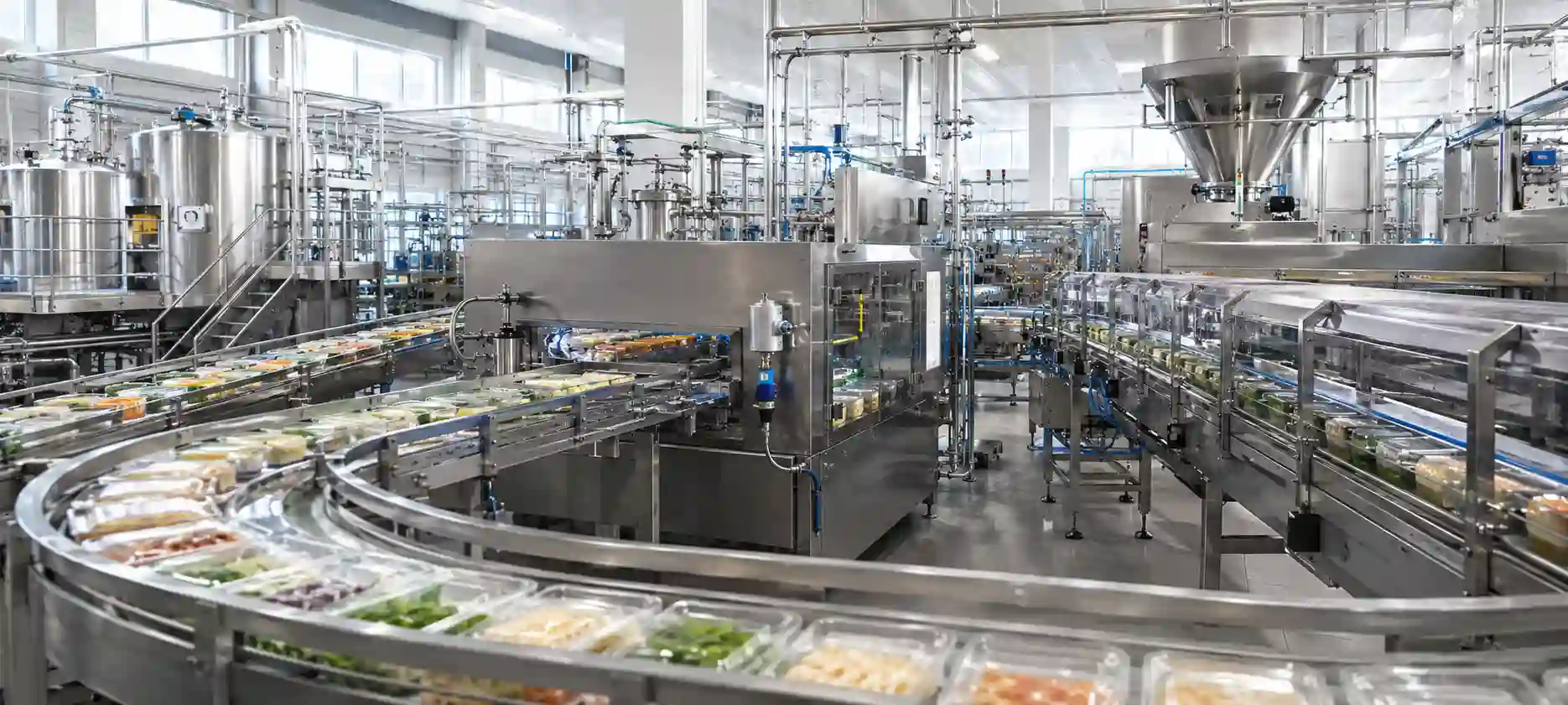
At two in the morning, when the lines have stopped and the day shift has gone home, a food factory becomes the most dangerous place it will be all day.
The sanitation crew is stripping guards off machines to reach surfaces that must be cleaned. Floors are running with water. Caustic and acid cleaning chemicals are being applied at concentration and temperature. Lighting is reduced. The crew is often the smallest, least experienced and most frequently changed team in the building, supervision is thin, and everything has to be finished before production restarts in a few hours.
Every one of those conditions exists because of food safety. The guards come off so the machine can be cleaned properly. The chemicals are aggressive because the surfaces must be sanitised. The water is there because dry cleaning would not achieve the standard. Food safety is not the enemy of worker safety, but the two do pull against each other more in this industry than in any other, and a training programme that pretends otherwise will not survive contact with the night shift.
Nathan Safety Training Services (NIMS) delivers food manufacturing safety training UAE programmes for food and beverage processors, dairy and juice plants, bakeries and confectionery manufacturers, meat and poultry processing, ready meal and catering production, cold storage and distribution operations, and the contract sanitation and maintenance providers who work inside them.
We deliver on site across Dubai Industrial City, Dubai Investments Park, Al Quoz, Jebel Ali and Food Tech Valley, Khalifa Economic Zone, ICAD and Mussafah, Al Ain, Sharjah Industrial Areas and Al Sajaa, Ajman, Ras Al Khaimah and Umm Al Quwain.
Book Food Sector HSE Training → · Request a Sanitation Shift Safety Review → · Request HSE Manpower →
Food Safety vs Worker Safety — Where HACCP and HSE Pull Against Each Other
These tensions are real and they are permanent. They cannot be resolved by choosing a side, only managed by training people to recognise them and by designing controls that satisfy both requirements at once.
Food Safety Requirement | Worker Safety Consequence | How Training Resolves It |
Machine guards removed for deep cleaning | Direct access to blades, augers, rollers and nip points | LOTO applied before guard removal, treated as non-negotiable |
Wet cleaning and washdown | Slip injuries, electrical risk, reduced footing on elevated platforms | Footwear standards, squeegee discipline, electrical inspection regime |
Strong caustic and acid sanitisers | Chemical burns, eye injury, respiratory irritation, mixing incidents | Chemical safety training, dosing controls, incompatibility awareness |
No loose clothing, jewellery or gloves near machinery | Reduced hand protection where cut hazards exist | Cut-resistant approved gloves, task-specific PPE selection |
Cold chain maintained throughout | Cold stress, condensation slips, restricted movement in PPE | Cold environment awareness, rotation, layering guidance |
High-care areas with restricted access | Delayed emergency response and evacuation from sealed zones | Evacuation planning for high-care, trained responders inside the zone |
Production continuity and short changeovers | Pressure to clear jams without stopping the line | Blockage clearing named explicitly in LOTO training |
Ammonia refrigeration for efficient cooling | Toxic and flammable gas inventory on site | Ammonia awareness, emergency response, evacuation drills |
Metal detection and X-ray inspection | Radiation source management and access control | Site induction covering restricted equipment and interlocks |
Sanitation Shift Safety Training — The Highest-Risk Window in a Food Plant
If a food manufacturer asked where to concentrate training spend, this is the answer. The sanitation shift concentrates more serious injury risk into a few hours than the whole of production does across a full day.
Why Injury Risk Concentrates on the Sanitation Shift
- Guards are off by design. The machine is deliberately opened to a degree that never occurs during production, exposing blades, augers, rollers, screws and nip points that are otherwise unreachable.
- Energy isolation is the only barrier left. With guarding removed, LOTO stops being one control among several and becomes the sole thing preventing contact. A shortcut here has no backup.
- Chemicals are at working strength. Cleaning agents are applied at concentrations and temperatures that would never be permitted during production, frequently by spray or foam application that generates aerosol.
- The environment is wet, warm and poorly lit. Slip risk peaks, visibility drops, and noise from high-pressure equipment masks communication.
- Crews are often contracted and high-turnover. Sanitation is frequently outsourced, and the workers with the highest exposure may have the least tenure, the least familiarity with the specific machines and the weakest connection to the site’s safety systems.
- Time pressure is absolute. Production restart is a fixed deadline, and everyone on the shift knows it.
Training for this population should be delivered separately from the production workforce, in the environment they actually work in, on the machines they actually strip. Lock Out Tag Out, Chemical Safety & Handling, machine-specific guarding awareness, slip prevention and confined space entry where tanks and vessels are cleaned form the core, delivered to contractors as rigorously as to direct employees.
Talk to an HSE Advisor → · Request Sanitation Crew Training →
Ammonia & CO₂ Refrigeration Safety Training for Food Plants
A food plant with ammonia refrigeration holds a toxic gas inventory that in any other industry would attract major hazard attention. In food manufacturing it sits behind a plant room door and is frequently treated as a maintenance matter.
Anhydrous ammonia is acutely toxic by inhalation, causes severe burns to skin and eyes, and is flammable within a range. It has an intense odour that gives good warning at low concentration, which is genuinely protective, but it also means a minor leak generates alarm and evacuation while a major release incapacitates before escape. Releases occur at compressor seals, valve packing, relief devices, and during maintenance and charging.
Carbon dioxide systems avoid the toxicity but introduce a different problem: CO₂ is heavier than air, odourless, and displaces oxygen in low-lying and enclosed areas without any warning whatsoever. A CO₂ release into a plant room, cold store or pit is an asphyxiation hazard that gives no sensory cue at all.
What Ammonia & CO₂ Awareness Training Covers
- Properties, health effects and exposure limits for ammonia and CO₂, and the very different warning characteristics of each.
- Detection and alarm systems, alarm level meaning, and the correct response to each stage.
- Immediate actions on release — evacuation direction relative to wind and gas density, muster point selection, and the prohibition on re-entry.
- Emergency response team capability including breathing apparatus, isolation of the plant, and coordination with Civil Defence.
- Cold store and enclosed space entry procedures where CO₂ accumulation is possible.
- First aid for ammonia exposure, including eye irrigation and the fact that skin contact with liquid ammonia produces both chemical and cold burns.
- Contractor and maintenance controls during charging, decanting and plant work.
Machine Guarding & LOTO Training for Food Processing Equipment
Food processing equipment is unusually hazardous to service because it is designed for cleanability first, which frequently means quick-release guards, tool-free access panels and open designs that are easy to defeat.
The equipment set includes mixers and blenders with high-torque paddles, dough brakes and sheeters, slicers and dicers, augers and screw conveyors, depositors, fillers and cappers, ovens and fryers with thermal and fire risk, palletisers and case packers, and shrink tunnels. Add to that steam systems for cooking and cleaning, compressed air throughout, and hydraulics on tipping and lifting equipment.
The single most valuable training intervention is treating blockage and jam clearing as a named LOTO scenario rather than a general principle. On a production line, a jam happens several times a shift, takes seconds to clear, and stops output while it persists. That combination defeats generic isolation training in almost every plant we have worked in.
Food Manufacturing HSE & Hygiene Training Courses
Nathan Safety Training delivers both the food safety awareness programmes the sector requires and the occupational safety programmes that sit alongside them.
Food Hygiene Awareness Training
Food hygiene awareness training covering personal hygiene standards, contamination routes, hand washing and glove discipline, illness reporting, foreign body control, allergen awareness, cleaning and disinfection principles, and pest awareness. Structured for production operatives, sanitation crews, warehouse staff and visiting contractors.
HACCP Awareness Training
HACCP awareness training UAE covering hazard analysis principles, the seven HACCP principles, critical control points and critical limits, monitoring and verification, corrective action, documentation, and the relationship between HACCP and ISO 22000. Delivered at awareness level for the general workforce and in greater depth for supervisors and the food safety team.
Chemical Safety & Handling Training
Caustic and acid sanitisers, chlorine-based disinfectants, peracetic acid, foaming agents, lubricants and refrigerants. Safety data sheets, GHS labelling, incompatibility and mixing hazards, dilution and dosing, spray and foam application, spill response, emergency shower and eyewash use, and PPE selection including chemical splash protection.
Lock Out Tag Out (LOTO) Training
Electrical, mechanical, pneumatic, hydraulic, steam and stored gravitational energy on food processing equipment. Group lockout for sanitation crews, shift handover of locks, and blockage clearing treated as a named scenario.
Manual Handling Training
One of the highest-return courses in this sector. Sack and ingredient handling, case packing, palletising, cold store work, repetitive line tasks and awkward postures at conveyors. Covers assessment, technique, mechanical aids, team lifting and the cumulative nature of musculoskeletal injury.
Fire Safety Training
Ovens, fryers and cooking equipment, dust from flour and powder handling, packaging and cardboard storage, ammonia flammability, and electrical rooms. Extinguisher selection, alarm and evacuation from high-care and sealed areas, and fire warden duties.
First Aid, CPR & AED
Cuts and amputation response, chemical burns and eye irrigation, scalds from steam and hot product, cold injury, ammonia exposure and cardiac response. Response capability on the night sanitation shift is frequently thinner than on days and deserves specific attention.
Confined Space Entry Training
Silos, mixing vessels, tanks, cookers, drains and ducting. Atmospheric hazards include oxygen deficiency in nitrogen or CO₂ flushed vessels, residual cleaning chemical vapour, and dust. Entry for cleaning is routine in this sector and frequently performed without permit.
Hazard Identification & Risk Assessment
Task-based assessment for supervisors, including the reassessment that should follow any line modification, product change or new cleaning regime.
Accident & Incident Investigation and Root Cause Analysis
Evidence preservation on a line that must restart, causal analysis, and corrective actions that address production pressure rather than blaming the operator who reached into the machine.
Dubai Municipality, ADAFSA & ESMA Requirements for Food Manufacturers
- Dubai Municipality Food Safety Department — food establishment permits, food handler card requirements, hygiene training obligations, HACCP-based food safety management system requirements and inspection regime within Dubai.
- ADAFSA — Abu Dhabi Agriculture and Food Safety Authority — equivalent registration, food safety management, food handler training and inspection requirements across Abu Dhabi.
- Sharjah City Municipality and Northern Emirates municipalities — food establishment licensing and food handler requirements in their respective emirates.
- MOIAT and ESMA standards — product standards, labelling, conformity and metrology requirements affecting production operations.
- ISO 22000 and HACCP — adopted through customer requirement and certification rather than by direct regulation, but functionally mandatory for manufacturers supplying major retail and hospitality customers.
- MOCCAE and Civil Defence — environmental permitting, ammonia refrigeration notification and emergency planning, and fire and life safety requirements for the facility.
- MOHRE — federal occupational safety obligations covering the workforce, including accommodation and welfare standards where labour accommodation is provided.
- OSHAD-SF — the Abu Dhabi occupational safety framework, applicable to food manufacturing operations within the emirate.
Food handler card and hygiene training requirements are administered by the relevant municipality and have specific approval arrangements. Our hygiene and HACCP awareness programmes build the underlying competency; where a municipality-issued card is required, that process runs through the authority.
Food Manufacturing Safety Training by Job Role
- Production operatives — food hygiene awareness, HACCP awareness, manual handling, machine guarding awareness, LOTO awareness, fire safety, chemical awareness.
- Sanitation and cleaning crews — LOTO in depth, chemical safety and handling, confined space entry, slip prevention, PPE selection, first aid.
- Maintenance and engineering — LOTO, permit to work, confined space, working at height, hot work, electrical safety, ammonia awareness.
- Refrigeration technicians — ammonia or CO₂ systems training, emergency response, breathing apparatus where applicable, LOTO, first aid.
- Warehouse and cold store staff — forklift operation, manual handling, cold environment awareness, racking and load stability, traffic safety.
- Quality and food safety team — HACCP in depth, hazard analysis, internal audit, incident investigation, allergen management.
- Supervisors and line leaders — risk assessment, incident investigation and root cause analysis, permit management, behaviour-based safety observation.
- Contractors and visitors — site induction covering both hygiene requirements and occupational hazards, delivered before entry to production areas.
Request a Role-Based Training Matrix → · Download Course Catalog →
Food Manufacturing Safety Training Across Dubai, Abu Dhabi & the UAE
- Dubai — Dubai Industrial City, Dubai Investments Park, Al Quoz, Jebel Ali Free Zone, Dubai Airport Free Zone and Food Tech Valley. Safety training Jebel Ali and Dubai Industrial City is regular delivery for our trainers.
- Abu Dhabi — Khalifa Economic Zone, ICAD and Mussafah, and the Al Ain dairy and agricultural processing cluster. HSE training Abu Dhabi for food manufacturers is delivered on site.
- Sharjah — Industrial Areas, Al Sajaa, and Hamriyah Free Zone food processing and cold storage operations.
- Ajman, Umm Al Quwain and Ras Al Khaimah — beverage, bakery, snack and processing facilities across the Northern Emirates.
- Fujairah — port-linked cold storage, processing and distribution operations.
Delivery is scheduled around production. For sanitation crews that means training on the night shift, in the plant, on the equipment they strip — which is far more effective than a daytime classroom session the crew attends on their rest period. For production teams we commonly deliver in short modules at shift changeover.
HSE Manpower Supply for Food Manufacturing Operations
Seasonal production peaks, new line commissioning and audit preparation all create temporary demand for HSE and food safety supervision that a lean plant structure cannot absorb.
Nathan Safety Training Services supplies HSE Officers, HSE Engineers, Safety Supervisors, Safety Inspectors, Environmental Officers and Confined Space Attendants on project, seasonal and long-term assignment. Personnel with prior food, beverage and cold chain experience can be requested.
Courses Offered
- First Aid Course - CPR and AED
- Confined Space
- Fire Safety Awareness
- Scaffolding Inspection
- Scaffolding Erection & Dismantling
- Flagman Safety
- Chemical Safety and Handling Training
- Hazard and Risk Assessment
- Rigging and Slinging Training
- Traffic Safety
- Hand and Power Tools Operator
- Electrical Safety
- Lock Out and Tag Out (LOTO)
- Accident Incident Investigation
- Lifeguard Training
- Advanced Risk Assessment & Compliance Service
- Behavior-Based Safety Workplace Safety Consulting
- Construction Site Safety Induction Training
- Emergency Response Team Training
- Excavator Operator Training
- Forklift Operator Training
- H2S Awareness & Breathing Apparatus Training
- Hot Work Safety Training
- Incident Reporting & Root Cause Analysis Service
- MEWP Operator Training
- Mobile Crane Operator Training
- Permit to Work System Training
- Rope Access Training
- Working at Height & Fall Protection Safety Training
- Fire Warden Training
- Manual Handling Training
- Banksman Safety Training
- Gas Tester Training
- Defensive Driving Training
- HAZMAT Awareness Training
- Machine Safety and Machine Guarding Training
- Spill Response and Spill Control Training
- Welding Safety Training
Need expert advice? Speak to our team today
FAQ
1. Why is the sanitation shift considered the highest-risk period in a food plant?
Because machine guards are deliberately removed so that surfaces can be cleaned, which exposes blades, augers, rollers and nip points that are unreachable during production. With guarding gone, energy isolation becomes the only barrier left rather than one control among several. Add working strength chemicals, wet floors, reduced lighting, thin supervision, high crew turnover and a fixed restart deadline, and the shift concentrates more serious injury risk into a few hours than production does across a full day.
2. Do food safety requirements and worker safety requirements genuinely conflict?
They pull against each other more in this sector than in any other, and pretending otherwise produces training that fails on the night shift. Guards come off for cleanability. Gloves are restricted near machinery for foreign body control. Floors are wet because dry cleaning would not meet the hygiene standard. Sanitisers are aggressive because surfaces must be sanitised. The resolution is not choosing a side but designing controls that satisfy both — LOTO before guard removal, cut-resistant approved gloves, footwear and drainage standards, and dosing systems that limit chemical handling.
3. What makes ammonia refrigeration a major hazard?
Anhydrous ammonia is acutely toxic by inhalation, causes severe burns to skin and eyes, and is flammable within a range. A food plant can hold a substantial inventory of it behind a plant room door with far less scrutiny than an equivalent quantity would attract in the chemical industry. Its strong odour gives useful warning at low concentration, but a major release can incapacitate before escape. Detection, alarm response, evacuation direction, emergency response capability and first aid including eye irrigation all need to be trained rather than assumed.
4. Why is CO2 refrigeration described as a different problem rather than a safer one?
Because it removes the toxicity but removes the warning as well. CO2 is odourless, colourless and heavier than air, so it accumulates in low-lying and enclosed areas — plant rooms, pits, cold stores, drainage channels — displacing oxygen with no sensory cue whatsoever. A worker entering an affected space has no indication of danger until they are already affected. Detection systems and enclosed space entry procedures do the work that smell does for ammonia.
5. What is the most valuable single change to machinery training in a food plant?
Naming blockage and jam clearing as a specific LOTO scenario rather than relying on a general isolation principle. A jam happens several times a shift, takes seconds to clear, and stops output while it persists. That combination defeats generic training in nearly every plant. Training has to address that exact moment the decision point where an operator reaches toward a running machine rather than teaching isolation in the abstract.
6. Do you deliver HACCP and food hygiene training as well as occupational safety?
Yes. Nathan Safety Training delivers food hygiene awareness covering personal hygiene, contamination routes, foreign body and allergen control and cleaning principles, and HACCP awareness covering hazard analysis, the seven principles, critical control points and limits, monitoring, verification, corrective action and the relationship with ISO 22000. Both are delivered at awareness level for the general workforce and in greater depth for supervisors and the food safety team.
7. Is a food handler card the same as hygiene training?
Not quite. Food handler card requirements are administered by the relevant municipality – Dubai Municipality Food Safety Department, ADAFSA in Abu Dhabi, or the equivalent authority in other emirates – and involve their own approval and issuance process. Our hygiene and HACCP awareness programmes build the underlying competency and support the food safety management system, but where a municipality-issued card is specifically required, that process runs through the authority.
8. Should contract sanitation crews be trained to the same standard as employees?
Yes, and arguably to a higher one, because they carry the greatest exposure with the least tenure. Sanitation is frequently outsourced to providers with high turnover, and the crew stripping a machine at two in the morning may have been on that specific line for a week. Treating contractor training as the provider’s problem is a common and expensive mistake, since the injury happens on the manufacturer’s site and on the manufacturer’s equipment.
9. Why is manual handling training so important in food manufacturing?
Because it addresses the injuries that actually occur most often. Ingredient sacks, case packing, palletising, cold store work and repetitive conveyor tasks produce a steady accumulation of musculoskeletal injury that rarely appears dramatic but accounts for a large share of lost time in this sector. It is a low-cost course with a measurable effect on absence, and it is consistently underbought relative to its return.
10. What confined space work happens in a food plant?
More than most plants recognise. Silos, mixing vessels, tanks, cookers, blenders, drains and ducting are all entered for cleaning and maintenance, and the entry is frequently treated as routine because the space contains food rather than chemicals. The atmospheric hazards are real — oxygen deficiency in nitrogen or CO2 flushed vessels, residual cleaning chemical vapour, and dust. These entries need permits, testing, attendants and rescue arrangements like any other.
11. Is safety training mandatory for food manufacturers in the UAE?
Two sets of obligations apply simultaneously. Food safety training including food handler requirements is mandated through the relevant municipality or ADAFSA. Occupational safety competency is required under MOHRE obligations and, in Abu Dhabi, the OSHAD-SF framework. Customer and certification requirements add a third layer, since major retail and hospitality buyers generally require a HACCP or ISO 22000 based system as a condition of supply.
12. Can training be delivered without stopping production?
Yes. For production teams we commonly deliver short modules at shift changeover. For sanitation crews we deliver on the night shift in the plant itself, which is both more practical and considerably more effective than a daytime classroom session attended during rest time. Practical LOTO and chemical handling content is delivered on the actual equipment and with the actual products the crew uses.
13. What certificates do participants receive?
A certificate of completion for each course showing participant name, course title, delivery date and validity guidance where applicable. These support municipality and ADAFSA inspection requirements, customer and retailer audits, certification body assessments and internal competency files. Specific formats can usually be accommodated with advance notice.
14. How often should this training be refreshed?
Food hygiene awareness is commonly refreshed annually and is frequently required at that interval by customer audit standards. HACCP awareness is often refreshed every one to two years or whenever the food safety plan changes materially. LOTO, chemical safety and confined space are commonly refreshed every one to two years. Sanitation crew training should be repeated whenever crew composition changes significantly, which in outsourced arrangements may be more often than annually.
15. Do you supply HSE manpower for food manufacturing sites?
Yes. Through hsemanpower.ae, Nathan Safety Training Services supplies HSE Officers, HSE Engineers, Safety Supervisors, Safety Inspectors, Environmental Officers and Confined Space Attendants for food and beverage operations. Demand in this sector is frequently tied to seasonal production peaks, new line commissioning or customer audit preparation, so cover can be arranged for defined periods rather than as a permanent engagement.
Book Food Manufacturing Safety Training with Nathan Safety Training
Nathan Safety Training Services works with food and beverage manufacturers, cold chain operators and contract sanitation providers across the Emirates. If you are preparing for a customer audit, commissioning a new line, or looking at why your injury log clusters around the night shift, the sanitation window is where the conversation should start.
Book Corporate HSE Training → · Request HSE Manpower Support → · Talk to an HSE Advisor →