

Home / Breathing Apparatus (BA) / SCBA Training UAE
Breathing Apparatus / SCBA Training In Uae
Breathing Apparatus (BA) / SCBA Training UAE | NIMS — Beyond Putting It On: Breathing Apparatus and SCBA Competency Training in the UAE
A breathing apparatus worn incorrectly in an IDLH environment doesn’t protect the wearer. It gives them — and anyone watching — the impression of protection while the seal leak, the cylinder duration calculation they skipped, or the donning sequence they half-remembered does its work. BA training that ends with “can put the set on” has produced exactly this outcome on more UAE incident reports than it should.
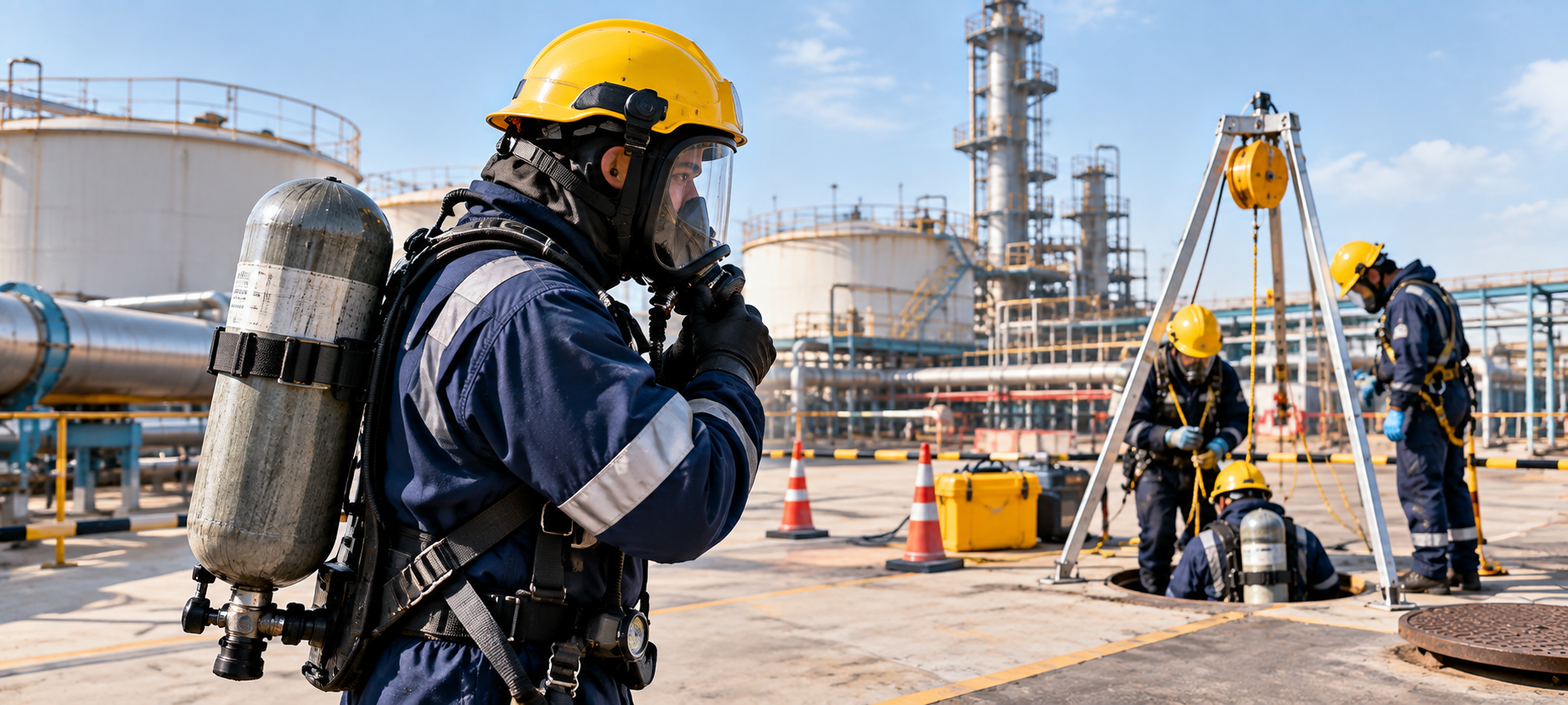
Nathan Safety Training (NIMS) built this Breathing Apparatus and SCBA course around the operational reality: a BA wearer in a confined space, a refinery emergency, or a live chemical release needs to know their equipment, their physiological limits, their team signals, and their exit procedure before they enter — not during. We train to that standard, aligned to NEBOSH, IOSH, and UAE Civil Defence requirements, with onsite delivery across all seven emirates.
The Regulatory and Standards Framework
UAE Civil Defence requirements establish the baseline for BA use in emergency response and hazardous environment scenarios across the UAE’s seven emirates. In the oil and gas sector, ADNOC HSE standards and offshore operator management system requirements create additional layers of obligation — typically requiring specific entry-level and advanced BA competency, periodic requalification, and records of each wearer’s training history. Free zone authorities including JAFZA and KIZAD impose their own competency documentation requirements on contractors operating within their boundaries.
NEBOSH Unit IGC3 and IOSH occupational safety standards both expect BA wearers in IDLH environments to hold demonstrated competency, not just a safety induction record. An incident investigation that asks “what was this person’s BA training?” and finds an induction tick-box is a very different conversation from one that finds a competency assessment with a date, an assessor, and a pass record.
For teams pursuing ISO 45001 occupational health and safety management certification, Nathan ISO Consulting — part of the same group as NIMS — can align BA competency records directly with what an OHSMS auditor expects to see in a documented safe system of work.
IDLH Environments in the UAE Context
Immediately Dangerous to Life and Health environments in the UAE’s industrial sectors have specific characteristics that shape what BA training needs to cover:
- Oil and gas processing — H₂S in concentrations that incapacitate before a wearer can register the odour, alongside hydrocarbon vapour releases in confined and semi-confined spaces
- Chemical manufacturing and storage — chlorine, ammonia refrigerant, and industrial solvent atmospheres in tank farms, process areas, and cold storage plant rooms
- Confined spaces — tanks, vessels, sewers, and ducts where oxygen deficiency from displacement or consumption creates an IDLH atmosphere with no visible warning
- Firefighting and industrial emergencies — structural fire, warehouse fire with unknown contents, and refinery or petrochemical incident response where BA is a mandatory condition of entry
- Marine and port operations — cargo hold entries, pump room atmospheres, and tanker confined spaces where both oxygen deficiency and toxic atmospheres are active risks simultaneously
BA and SCBA Equipment Types Covered
Equipment Type | Application | Key Competency Areas |
Open-circuit SCBA (compressed air) | Primary choice for firefighting, industrial emergency, IDLH confined space entry | Pre-use checks, donning sequence, duration management, distress signal, emergency procedures |
Closed-circuit / rebreather BA | Extended duration operations in mining, tunnel, and deep industrial scenarios | Circuit management, CO₂ absorbent checks, extended operation procedures |
Escape / EEBD (Emergency Escape Breathing Device) | Personal escape device — not entry equipment; used for self-rescue from an unexpected IDLH atmosphere | Activation sequence, limitations, donning under stress, integration with muster procedures |
Airline / supplied air BA | Extended duration confined space entry and surface supply diving support | Airline management, manifold operation, bailout cylinder, communication procedures |
Combination SCBA/airline sets | Operations requiring flexibility between self-contained and supplied-air modes | Mode-switching procedure, bailout management, supply pressure monitoring |
Who This Course Is For
- Oil, gas, and petrochemical workers entering process areas, tanks, and vessels under hot-work or confined space permit systems
- Industrial fire brigade members and emergency response teams at UAE refineries, LNG terminals, and chemical facilities
- Confined space entry teams across water treatment, construction, and utilities sectors
- HSE officers responsible for maintaining and auditing BA competency records
- Fire safety officers and ERT members at commercial, industrial, and hospitality sites under UAE Civil Defence requirements
- Marine crew members with responsibility for enclosed space entry procedures
- Facilities maintenance teams at sites where refrigerant, chemical storage, or confined access creates IDLH exposure
Where We Deliver BA Training, Emirate by Emirate
- Abu Dhabi — ADNOC’s onshore and offshore processing facilities, LNG terminals at Das Island, and the KEZAD industrial cluster create concentrated demand for oil-and-gas-calibrated BA competency; our instructors train to ADNOC HSE standards by default
- Dubai — JAFZA’s chemical storage and cold chain facilities, the Palm’s utility corridors, and Trakhees-regulated industrial sites each carry specific IDLH risk profiles; we deliver to contractor teams operating across all three
- Sharjah — the Industrial Areas’ manufacturing and chemical distribution sites create steady BA training demand from maintenance and emergency response teams not tied to the large hydrocarbon operators
- Ras Al Khaimah — RAK Ceramics’ production plant, cement and quarrying facilities, and the growing pharmaceutical manufacturing base each carry distinct BA training requirements our instructors cover from site experience, not classroom assumption
- Fujairah — FOIZ’s oil terminal infrastructure and the port’s bulk liquid cargo operations put BA competency at the intersection of marine, hydrocarbon, and confined space requirements simultaneously
- Ajman and Umm Al Quwain — light industrial and manufacturing sites where BA use is less frequent but, for that reason, where competency maintenance is typically weaker and incident exposure highest per use
The Physiological Dimension BA Training Can't Skip
A BA wearer’s physical condition matters as much as their equipment knowledge. Working in full BA kit in UAE ambient temperatures places cardiovascular and respiratory demand on the wearer that no amount of classroom training adequately replicates — which is why our practical exercises are conducted in the conditions your team will actually work in, not a temperature-controlled training room.
We cover heat stress management, work-rest cycles for BA operations in high-ambient-temperature environments, buddy-check and team communication procedures, and the physiological warning signs that should trigger immediate withdrawal — because a BA wearer who recognises they are approaching their physiological limit and communicates it is worth more than one who doesn’t.
What Sets Our BA Training Apart
- Instructors with active oil-and-gas, industrial fire brigade, and confined space entry backgrounds — not training professionals who have only ever delivered this course in a classroom
- Practical donning, doffing, and emergency procedure drills conducted in your actual operational environment against your specific equipment inventory
- Duration management training built around real-world work rates — not cylinder duration figures calculated for a person at rest
- ADNOC, JAFZA, and UAE Civil Defence competency record formats built in — your team leaves with documentation that meets their specific authority’s requirements
- Refresher and requalification programmes structured around your annual maintenance schedule rather than a generic calendar
Courses Offered
- First Aid Course - CPR and AED
- Confined Space
- Fire Safety Awareness
- Scaffolding Inspection
- Scaffolding Erection & Dismantling
- Flagman Safety
- Chemical Safety and Handling Training
- Hazard and Risk Assessment
- Rigging and Slinging Training
- Traffic Safety
- Hand and Power Tools Operator
- Electrical Safety
- Lock Out and Tag Out (LOTO)
- Accident Incident Investigation
- Lifeguard Training
- Advanced Risk Assessment & Compliance Service
- Behavior-Based Safety Workplace Safety Consulting
- Construction Site Safety Induction Training
- Emergency Response Team Training
- Excavator Operator Training
- Forklift Operator Training
- H2S Awareness & Breathing Apparatus Training
- Hot Work Safety Training
- Incident Reporting & Root Cause Analysis Service
- MEWP Operator Training
- Mobile Crane Operator Training
- Permit to Work System Training
- Rope Access Training
- Working at Height & Fall Protection Safety Training
- Oil & Gas Safety Training
- Fire Warden Training
- Manual Handling Training
- Banksman Safety Training
- Gas Tester Training
- Defensive Driving Training
- HAZMAT Awareness Training
- Machine Safety and Machine Guarding Training
- Spill Response and Spill Control Training
- Welding Safety Training
Need expert advice? Speak to our team today
FAQ
What's the difference between BA and SCBA?
Breathing Apparatus is the general term for any device that supplies clean air to a wearer in an atmosphere that is contaminated or oxygen-deficient. Self-Contained Breathing Apparatus (SCBA) is one type — it carries its own compressed air supply in a cylinder, making the wearer independent of any external supply. Other BA types include airline-fed systems connected to a remote clean-air supply, and EEBD emergency escape devices. Most high-risk UAE industrial settings require SCBA competency for entry; airline systems are typically used for extended-duration operations where cylinder capacity would be a limiting factor.
How long does BA competency certification last?
Most UAE operators and free zone authorities expect refresher training on an annual basis, with full requalification — including practical assessment — every one to two years. The specific period varies by operator management system and the applicable authority. We structure our requalification programmes around your maintenance cycle so competency never lapses without a scheduled refresher in place.
Does this course cover EEBD training as well?
Yes. Emergency Escape Breathing Devices are covered as a distinct module — including their limitations, activation sequence, donning under stress, and integration with your site’s muster and evacuation procedures. An EEBD is not entry equipment and should never be used as a substitute for SCBA in an IDLH environment, which is a distinction the course makes clearly.
Can SCBA training be delivered to offshore crew?
Yes. We deliver offshore-applicable BA training to marine and offshore crews, covering enclosed space entry, pump room procedures, and cargo hold atmosphere management. For offshore facilities operating under ADNOC or specific operator management system requirements, we align the training to the applicable procedure set.
What does a BA pre-use check actually involve?
A pre-use check covers cylinder pressure and air remaining, harness and buckle integrity, face seal condition and fit test, demand valve function, whistle operation (low-pressure warning), and positive-pressure check. The donning sequence matters because steps done out of order or rushed are the most common source of the seal leak a wearer doesn’t detect until they’re inside. Our training drills the pre-use check and donning sequence under time pressure and in discomfort — which is when it needs to work.
Is this training available for teams working in confined spaces specifically?
Yes — BA use in confined space entry is covered as a specific application module, including integration with the permit-to-work system, standby person responsibilities, communication procedures, and emergency retrieval when a BA-wearing entrant needs to be recovered from a space. We can deliver this alongside our Confined Space Entry training for teams that need both competencies together.
What are the heat stress risks for BA wearers working in UAE temperatures?
Working in SCBA at 40°C+ ambient temperature raises the metabolic and cardiovascular load on the wearer significantly. Cylinder duration calculated for a rest-state breathing rate doesn’t reflect what a wearer working hard in full kit will actually consume. We train teams on heat stress warning signs, work-rest cycle management for BA operations, buddy monitoring, and the procedures for withdrawing a wearer who is approaching physiological limits before the situation becomes an emergency.
Do you issue BA competency certificates?
Yes. Each participant who completes practical assessment receives a competency record with the date, assessor details, equipment type, and pass outcome. The format is compatible with ADNOC, JAFZA, and UAE Civil Defence documentation requirements so records can be produced directly at a site access check or regulatory inspection.
Can you run BA training for emergency response teams alongside our regular maintenance shutdown?
Yes — we regularly align training delivery to shutdown windows when the team is available and site access is manageable. Tell us your shutdown dates and we’ll scope a training programme that fits within your window, rather than requiring a separate mobilisation.
What's the minimum group size for onsite BA training?
We can deliver to groups from 6 upward, with practical equipment ratios maintained regardless of group size. For very small teams, we can schedule you into an upcoming open course. Tell us your numbers and location and we’ll give you the most efficient option.
Certify Your BA and SCBA Team
Whether you need first-time BA competency for a new confined space entry team or annual requalification for an established emergency response team, tell us your site type, equipment inventory, and authority requirements, and we’ll scope a course that trains your people against the exact conditions they’ll face.
Nathan Safety Training (NIMS) — Breathing Apparatus and SCBA training across Dubai, Abu Dhabi, Sharjah, Ajman, Ras Al Khaimah, Fujairah and Umm Al Quwain.