
Home / Lifeguard Training
Lifeguard Training
Lifeguard Training & Certification Across the UAE
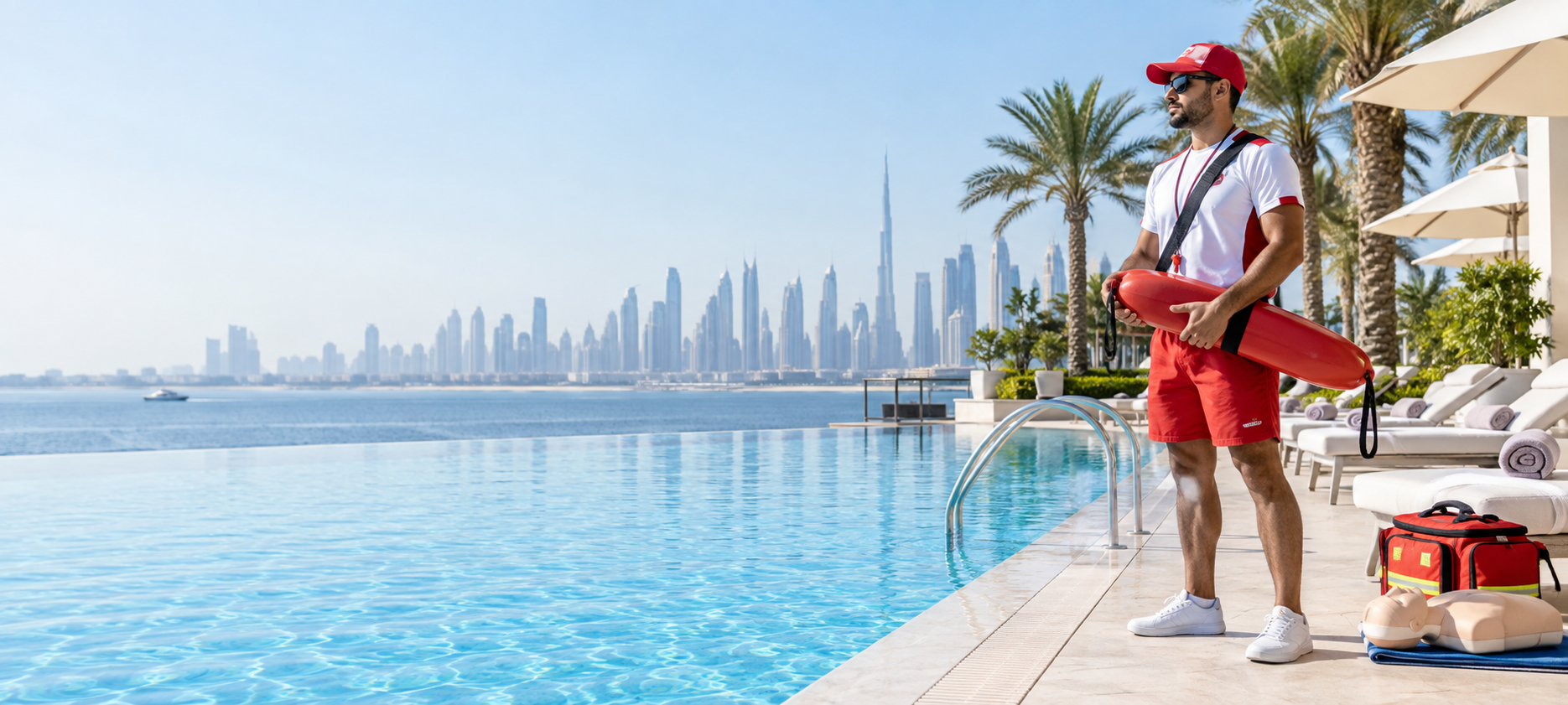
A drowning is silent. There’s no splashing, no shouting for help — a person in genuine trouble in water is usually too busy trying to breathe to call attention to themselves, which is exactly why untrained bystanders so often miss it happening a few metres away. A lifeguard’s actual job isn’t reacting to a visible emergency. It’s recognising the quiet ten seconds before one, from a scan pattern trained to catch what an untrained eye reads as normal swimming.
Nathan Safety Training (NIMS) certifies pool and beach lifeguards across the UAE to Dubai Municipality Health and Safety Department standards, with the water rescue, CPR/AED and risk-assessment-based staffing knowledge that hotels, waterparks and residential communities are audited against.
The Standard This Certification Is Built Against
Dubai Municipality’s Health and Safety Department sets lifeguard staffing and competency expectations through its Public Swimming Pools Safety Guidelines, which base the number of lifeguards required on a documented risk assessment of pool shape, visibility and expected occupancy rather than a single fixed ratio — an irregular waterpark leisure pool needs a different staffing calculation from a standard rectangular lap pool of the same surface area. Higher-acuity resuscitation elements of the course are aligned with curricula recognised by the Dubai Corporation for Ambulance Services (DCAS).
Beach lifeguarding is treated as a separate, more demanding qualification than pool lifeguarding, requiring greater open-water competency and physical fitness — the two are not interchangeable certifications, and a pool-qualified lifeguard is not automatically qualified to cover a beach.
Insurance cover for UAE hotel pools and beaches increasingly specifies minimum certified lifeguard coverage as a policy condition, not only a Dubai Municipality expectation — which means a staffing gap is now a potential coverage gap as well as a safety one.
The Ten Seconds Before It Becomes an Emergency
A drowning in progress looks almost nothing like the panicked splashing most people expect — it’s quiet, and it’s often mistaken for ordinary swimming by anyone who hasn’t been specifically trained to recognise it. That gap between what people expect an emergency to look like and what it actually looks like is the entire reason dedicated lifeguard training exists, rather than simply posting an attentive staff member poolside.
The business exposure is direct and immediate: a drowning incident at a hotel, waterpark or residential facility is not just a human tragedy but a licensing and insurance event that can affect the facility’s ability to operate its water features at all while the investigation runs its course.
Who This Course Is For
Anyone responsible for supervising a pool, beach or water attraction in the UAE.
- Hotel and resort pool and beach staff
- Waterpark and theme park attraction operators
- Residential community and HOA-managed pool facilities
- Public and semi-public beach operators
- Individuals seeking independent lifeguard certification for employment across the sector
Different Coastline, Different Emirate
Water type and visitor profile shift enormously by emirate. We deliver onsite across all seven:
- Dubai — JBR and Kite Beach’s Blue Flag-certified public beaches sit alongside the highest concentration of hotel and waterpark pools in the country, covering both our pool and beach qualification tracks in volume
- Abu Dhabi — Yas Island’s Yas Waterworld and the Corniche and Saadiyat beaches both fall under this course, with the waterpark side leaning toward irregular-pool staffing calculations
- Sharjah — Al Majaz waterfront and family-oriented pool facilities favour our pool qualification track over open-water beach certification
- Ajman — Ajman Beach and a growing base of hotel pools are bringing more first-time lifeguard certification demand as the emirate’s hospitality sector expands
- Ras Al Khaimah — Al Marjan Island’s beach resort development is driving fast-growing demand for beach-qualified lifeguards in an emirate that historically needed far fewer
- Fujairah — Gulf of Oman-facing beaches carry a genuinely different current and wave profile than the calmer Gulf-facing coastline everywhere else in the UAE, which changes the open-water rescue training emphasis
- Umm Al Quwain — Dreamland Aqua Park is one of the UAE’s longest-running waterparks, and UAQ’s quieter beaches still require the same Dubai Municipality-aligned staffing discipline as anywhere else
Pool vs Beach Lifeguard Qualification
Requirement | Pool Lifeguard | Beach Lifeguard |
Swim assessment | 100m continuous swim | 200m continuous swim, open water |
Rescue environment | Controlled, clear-visibility water | Open water — currents, waves, variable visibility |
Recommended for | Hotel pools, waterparks, residential pools | Public and hotel beaches |
Certificate renewal | Every 2 years | Every 2 years, with annual CPR/first aid recertification |
It’s Rarely About Individual Lifeguard Skill
Most gaps we find aren’t about individual lifeguard skill — they’re about staffing decisions made without reassessing the actual water they’re covering.
- Staffing ratios carried over from a standard pool design applied unchanged to an irregular waterpark configuration
- Lifeguard positioning that puts sun glare directly in their scanning sightline during peak hours
- Certifications lapsed without a tracking system catching it before the shift is worked uncovered
- Pool-qualified lifeguards rostered onto beach duty without the separate, more demanding beach qualification
- CPR/AED refresher skipped because the two-year certificate is technically still valid, even though resuscitation skill decays faster than that
Pool and Beach, Taught as Genuinely Separate Skills
We built the pool and beach tracks as genuinely separate certifications, because treating them as interchangeable is one of the more common and riskier shortcuts we see across UAE hospitality operators.
Properties needing additional certified lifeguards for a seasonal peak or an ongoing shortfall can draw on hsemanpower.ae directly, rather than running a separate recruitment cycle on top of the certification itself.
- Pool and beach qualification tracks taught as genuinely separate courses, not one certificate stretched to cover both
- Water rescue drills conducted in real pool and, where relevant, open-water conditions
- CPR, AED and first aid integrated directly into the certification, not bolted on separately
- Staffing ratio guidance based on an actual risk assessment of your specific pool or beach, not a generic number
- Certificate tracking so renewal dates are flagged well before a shift risks going uncovered
Courses Offered
- First Aid Course - CPR and AED
- Confined Space
- Fire Safety Awareness
- Scaffolding Inspection
- Scaffolding Erection & Dismantling
- Flagman Safety
- Chemical Safety and Handling Training
- Hazard and Risk Assessment
- Rigging and Slinging Training
- Traffic Safety
- Hand and Power Tools Operator
- Electrical Safety
- Lock Out and Tag Out (LOTO)
- Accident Incident Investigation
- Lifeguard Training
- Advanced Risk Assessment & Compliance Service
- Behavior-Based Safety Workplace Safety Consulting
- Construction Site Safety Induction Training
- Emergency Response Team Training
- Excavator Operator Training
- Forklift Operator Training
- H2S Awareness & Breathing Apparatus Training
- Hot Work Safety Training
- Incident Reporting & Root Cause Analysis Service
- MEWP Operator Training
- Mobile Crane Operator Training
- Permit to Work System Training
- Rope Access Training
- Working at Height & Fall Protection Safety Training
- Oil & Gas Safety Training
- Fire Warden Training
- Manual Handling Training
- Banksman Safety Training
- Gas Tester Training
- Defensive Driving Training
- HAZMAT Awareness Training
- Machine Safety and Machine Guarding Training
- Spill Response and Spill Control Training
- Welding Safety Training
Need expert advice? Speak to our team today
FAQ
How many lifeguards does a pool need in the UAE?
Dubai Municipality’s guidance bases this on a documented risk assessment of the pool’s shape, visibility and expected occupancy rather than a single fixed ratio — an irregular leisure or waterpark pool typically needs more coverage than a standard rectangular pool of the same area.
Is pool lifeguard certification the same as beach lifeguard certification?
No. Beach lifeguarding is a separate, more demanding qualification requiring greater open-water swim competency and physical fitness. A pool-qualified lifeguard is not automatically certified to cover a beach, and operators need to check which qualification their staff actually hold.
How long is lifeguard certification valid?
Certification is typically valid for two years, with CPR and first aid components recommended for annual recertification given how quickly resuscitation skills decay without regular practice, independent of the underlying lifeguard qualification’s validity.
Is CPR and AED training included in the lifeguard course, or separate?
Included — CPR, AED use and first aid are integrated directly into our lifeguard certification, since water rescue and resuscitation are inseparable skills in an actual drowning response, not sequential steps taught in isolation.
What's the physical fitness requirement to become a lifeguard?
Pool lifeguard assessment typically includes a 100 metre continuous swim; beach lifeguard assessment steps up to 200 metres in open water conditions, alongside treading water and rescue simulation components appropriate to each environment.
Do waterparks need different staffing calculations than standard pools?
Yes — irregular pool shapes, multiple water features and variable visibility across a waterpark configuration change the risk assessment substantially compared to a single rectangular pool, and staffing should be calculated against the actual layout, not a generic per-square-metre figure.
Are your lifeguard courses recognised by Dubai Municipality?
Our course content and documentation are built to align with Dubai Municipality Health and Safety Department expectations for pool and beach lifeguard competency, including the CPR/AED and first aid components auditors look for.
Can hotels train their own existing staff as lifeguards, or does it need to be a dedicated hire?
Either approach works, provided the individual passes the swim assessment and completes the full certification — we’ve trained both dedicated lifeguard hires and existing hospitality staff being cross-trained into a lifeguard role.
Do you offer female lifeguard training for ladies-only facilities?
Yes, we can arrange female-instructor-led courses and certify female lifeguards for ladies-only pool areas, residential facilities and private family venues, which is a specific and growing requirement across UAE hospitality and residential operators.
What happens if a lifeguard's certification lapses without anyone noticing?
That shift is technically running without qualified coverage, which is both a safety and liability exposure. We provide certificate tracking as part of our service specifically to flag renewals before they lapse, rather than leaving it to individual memory.
Does open-water rescue training differ between the Gulf coast and Fujairah's Gulf of Oman coast?
Yes — Fujairah’s east coast has a noticeably different current and wave profile from the calmer Gulf-facing beaches in Dubai, Abu Dhabi and RAK, and our beach lifeguard training adjusts the open-water rescue scenarios accordingly.
How long does lifeguard certification take?
Pool lifeguard certification typically runs three to four days including the swim assessment and water rescue practice; beach lifeguard certification runs five to six days given the added open-water competency requirement.
Do lifeguards need to renew their swim assessment every time they recertify, or only the classroom content?
The swim and rescue assessment is repeated at every certification renewal, not only at initial qualification — physical rescue competency is treated as perishable in the same way CPR skills are, not a one-time bar to clear.
Is a pool lifeguard certificate the same as an RLSS or international lifeguard qualification?
Our certification is built to Dubai Municipality Health and Safety Department standards specifically, which is what UAE employers are actually audited against. If a client separately requires an internationally-badged qualification such as RLSS, tell us in advance and we’ll advise on the closest alignment or additional steps needed.
- First Aid Course - CPR and AED
- Confined Space
- Fire Safety Awareness
- Scaffolding Inspection
- Scaffolding Erection & Dismantling
- Flagman Safety
- Chemical Safety and Handling Training
- Hazard and Risk Assessment
- Rigging and Slinging Training
- Traffic Safety
- Hand and Power Tools Operator
- Electrical Safety
- Lock Out and Tag Out (LOTO)
- Accident Incident Investigation
- Lifeguard Training
- Advanced Risk Assessment & Compliance Service
- Behavior-Based Safety Workplace Safety Consulting
- Construction Site Safety Induction Training
- Emergency Response Team Training
- Excavator Operator Training
- Forklift Operator Training
- H2S Awareness & Breathing Apparatus Training
- Hot Work Safety Training
- Incident Reporting & Root Cause Analysis Service
- MEWP Operator Training
- Mobile Crane Operator Training
- Permit to Work System Training
- Rope Access Training
- Working at Height & Fall Protection Safety Training


Lifeguard Training & Certification Across the UAE
A drowning is silent. There’s no splashing, no shouting for help — a person in genuine trouble in water is usually too busy trying to breathe to call attention to themselves, which is exactly why untrained bystanders so often miss it happening a few metres away. A lifeguard’s actual job isn’t reacting to a visible emergency. It’s recognising the quiet ten seconds before one, from a scan pattern trained to catch what an untrained eye reads as normal swimming.
Nathan Safety Training (NIMS) certifies pool and beach lifeguards across the UAE to Dubai Municipality Health and Safety Department standards, with the water rescue, CPR/AED and risk-assessment-based staffing knowledge that hotels, waterparks and residential communities are audited against.
The Standard This Certification Is Built Against
Dubai Municipality’s Health and Safety Department sets lifeguard staffing and competency expectations through its Public Swimming Pools Safety Guidelines, which base the number of lifeguards required on a documented risk assessment of pool shape, visibility and expected occupancy rather than a single fixed ratio — an irregular waterpark leisure pool needs a different staffing calculation from a standard rectangular lap pool of the same surface area. Higher-acuity resuscitation elements of the course are aligned with curricula recognised by the Dubai Corporation for Ambulance Services (DCAS).
Beach lifeguarding is treated as a separate, more demanding qualification than pool lifeguarding, requiring greater open-water competency and physical fitness — the two are not interchangeable certifications, and a pool-qualified lifeguard is not automatically qualified to cover a beach.
Insurance cover for UAE hotel pools and beaches increasingly specifies minimum certified lifeguard coverage as a policy condition, not only a Dubai Municipality expectation — which means a staffing gap is now a potential coverage gap as well as a safety one.
The Ten Seconds Before It Becomes an Emergency
A drowning in progress looks almost nothing like the panicked splashing most people expect — it’s quiet, and it’s often mistaken for ordinary swimming by anyone who hasn’t been specifically trained to recognise it. That gap between what people expect an emergency to look like and what it actually looks like is the entire reason dedicated lifeguard training exists, rather than simply posting an attentive staff member poolside.
The business exposure is direct and immediate: a drowning incident at a hotel, waterpark or residential facility is not just a human tragedy but a licensing and insurance event that can affect the facility’s ability to operate its water features at all while the investigation runs its course.
Who This Course Is For
Anyone responsible for supervising a pool, beach or water attraction in the UAE.
- Hotel and resort pool and beach staff
- Waterpark and theme park attraction operators
- Residential community and HOA-managed pool facilities
- Public and semi-public beach operators
- Individuals seeking independent lifeguard certification for employment across the sector
Different Coastline, Different Emirate
Water type and visitor profile shift enormously by emirate. We deliver onsite across all seven:
- Dubai — JBR and Kite Beach’s Blue Flag-certified public beaches sit alongside the highest concentration of hotel and waterpark pools in the country, covering both our pool and beach qualification tracks in volume
- Abu Dhabi — Yas Island’s Yas Waterworld and the Corniche and Saadiyat beaches both fall under this course, with the waterpark side leaning toward irregular-pool staffing calculations
- Sharjah — Al Majaz waterfront and family-oriented pool facilities favour our pool qualification track over open-water beach certification
- Ajman — Ajman Beach and a growing base of hotel pools are bringing more first-time lifeguard certification demand as the emirate’s hospitality sector expands
- Ras Al Khaimah — Al Marjan Island’s beach resort development is driving fast-growing demand for beach-qualified lifeguards in an emirate that historically needed far fewer
- Fujairah — Gulf of Oman-facing beaches carry a genuinely different current and wave profile than the calmer Gulf-facing coastline everywhere else in the UAE, which changes the open-water rescue training emphasis
- Umm Al Quwain — Dreamland Aqua Park is one of the UAE’s longest-running waterparks, and UAQ’s quieter beaches still require the same Dubai Municipality-aligned staffing discipline as anywhere else
Pool vs Beach Lifeguard Qualification
Requirement | Pool Lifeguard | Beach Lifeguard |
Swim assessment | 100m continuous swim | 200m continuous swim, open water |
Rescue environment | Controlled, clear-visibility water | Open water — currents, waves, variable visibility |
Recommended for | Hotel pools, waterparks, residential pools | Public and hotel beaches |
Certificate renewal | Every 2 years | Every 2 years, with annual CPR/first aid recertification |
It’s Rarely About Individual Lifeguard Skill
Most gaps we find aren’t about individual lifeguard skill — they’re about staffing decisions made without reassessing the actual water they’re covering.
- Staffing ratios carried over from a standard pool design applied unchanged to an irregular waterpark configuration
- Lifeguard positioning that puts sun glare directly in their scanning sightline during peak hours
- Certifications lapsed without a tracking system catching it before the shift is worked uncovered
- Pool-qualified lifeguards rostered onto beach duty without the separate, more demanding beach qualification
- CPR/AED refresher skipped because the two-year certificate is technically still valid, even though resuscitation skill decays faster than that
Pool and Beach, Taught as Genuinely Separate Skills
We built the pool and beach tracks as genuinely separate certifications, because treating them as interchangeable is one of the more common and riskier shortcuts we see across UAE hospitality operators.
Properties needing additional certified lifeguards for a seasonal peak or an ongoing shortfall can draw on hsemanpower.ae directly, rather than running a separate recruitment cycle on top of the certification itself.
- Pool and beach qualification tracks taught as genuinely separate courses, not one certificate stretched to cover both
- Water rescue drills conducted in real pool and, where relevant, open-water conditions
- CPR, AED and first aid integrated directly into the certification, not bolted on separately
- Staffing ratio guidance based on an actual risk assessment of your specific pool or beach, not a generic number
- Certificate tracking so renewal dates are flagged well before a shift risks going uncovered
FAQ
How many lifeguards does a pool need in the UAE?
Dubai Municipality’s guidance bases this on a documented risk assessment of the pool’s shape, visibility and expected occupancy rather than a single fixed ratio — an irregular leisure or waterpark pool typically needs more coverage than a standard rectangular pool of the same area.
Is pool lifeguard certification the same as beach lifeguard certification?
No. Beach lifeguarding is a separate, more demanding qualification requiring greater open-water swim competency and physical fitness. A pool-qualified lifeguard is not automatically certified to cover a beach, and operators need to check which qualification their staff actually hold.
How long is lifeguard certification valid?
Certification is typically valid for two years, with CPR and first aid components recommended for annual recertification given how quickly resuscitation skills decay without regular practice, independent of the underlying lifeguard qualification’s validity.
Is CPR and AED training included in the lifeguard course, or separate?
Included — CPR, AED use and first aid are integrated directly into our lifeguard certification, since water rescue and resuscitation are inseparable skills in an actual drowning response, not sequential steps taught in isolation.
What's the physical fitness requirement to become a lifeguard?
Pool lifeguard assessment typically includes a 100 metre continuous swim; beach lifeguard assessment steps up to 200 metres in open water conditions, alongside treading water and rescue simulation components appropriate to each environment.
Do waterparks need different staffing calculations than standard pools?
Yes — irregular pool shapes, multiple water features and variable visibility across a waterpark configuration change the risk assessment substantially compared to a single rectangular pool, and staffing should be calculated against the actual layout, not a generic per-square-metre figure.
Are your lifeguard courses recognised by Dubai Municipality?
Our course content and documentation are built to align with Dubai Municipality Health and Safety Department expectations for pool and beach lifeguard competency, including the CPR/AED and first aid components auditors look for.
Can hotels train their own existing staff as lifeguards, or does it need to be a dedicated hire?
Either approach works, provided the individual passes the swim assessment and completes the full certification — we’ve trained both dedicated lifeguard hires and existing hospitality staff being cross-trained into a lifeguard role.
Do you offer female lifeguard training for ladies-only facilities?
Yes, we can arrange female-instructor-led courses and certify female lifeguards for ladies-only pool areas, residential facilities and private family venues, which is a specific and growing requirement across UAE hospitality and residential operators.
What happens if a lifeguard's certification lapses without anyone noticing?
That shift is technically running without qualified coverage, which is both a safety and liability exposure. We provide certificate tracking as part of our service specifically to flag renewals before they lapse, rather than leaving it to individual memory.
Does open-water rescue training differ between the Gulf coast and Fujairah's Gulf of Oman coast?
Yes — Fujairah’s east coast has a noticeably different current and wave profile from the calmer Gulf-facing beaches in Dubai, Abu Dhabi and RAK, and our beach lifeguard training adjusts the open-water rescue scenarios accordingly.
How long does lifeguard certification take?
Pool lifeguard certification typically runs three to four days including the swim assessment and water rescue practice; beach lifeguard certification runs five to six days given the added open-water competency requirement.
Do lifeguards need to renew their swim assessment every time they recertify, or only the classroom content?
The swim and rescue assessment is repeated at every certification renewal, not only at initial qualification — physical rescue competency is treated as perishable in the same way CPR skills are, not a one-time bar to clear.
Is a pool lifeguard certificate the same as an RLSS or international lifeguard qualification?
Our certification is built to Dubai Municipality Health and Safety Department standards specifically, which is what UAE employers are actually audited against. If a client separately requires an internationally-badged qualification such as RLSS, tell us in advance and we’ll advise on the closest alignment or additional steps needed.
Certify or Renew Your Lifeguards
Whether you need pool certification, beach certification, or both, tell us your pool or beach configuration and expected occupancy, and we’ll recommend the right staffing level alongside certification for your team.
Nathan Safety Training (NIMS) — Pool and beach lifeguard training across Dubai, Abu Dhabi, Sharjah, Ajman, Ras Al Khaimah, Fujairah and Umm Al Quwain.