

Home / Accident Incident Investigation
Accident Incident Investigation
Accident and Incident Investigation Training UAE — Root Cause Analysis Beyond 'Human Error'
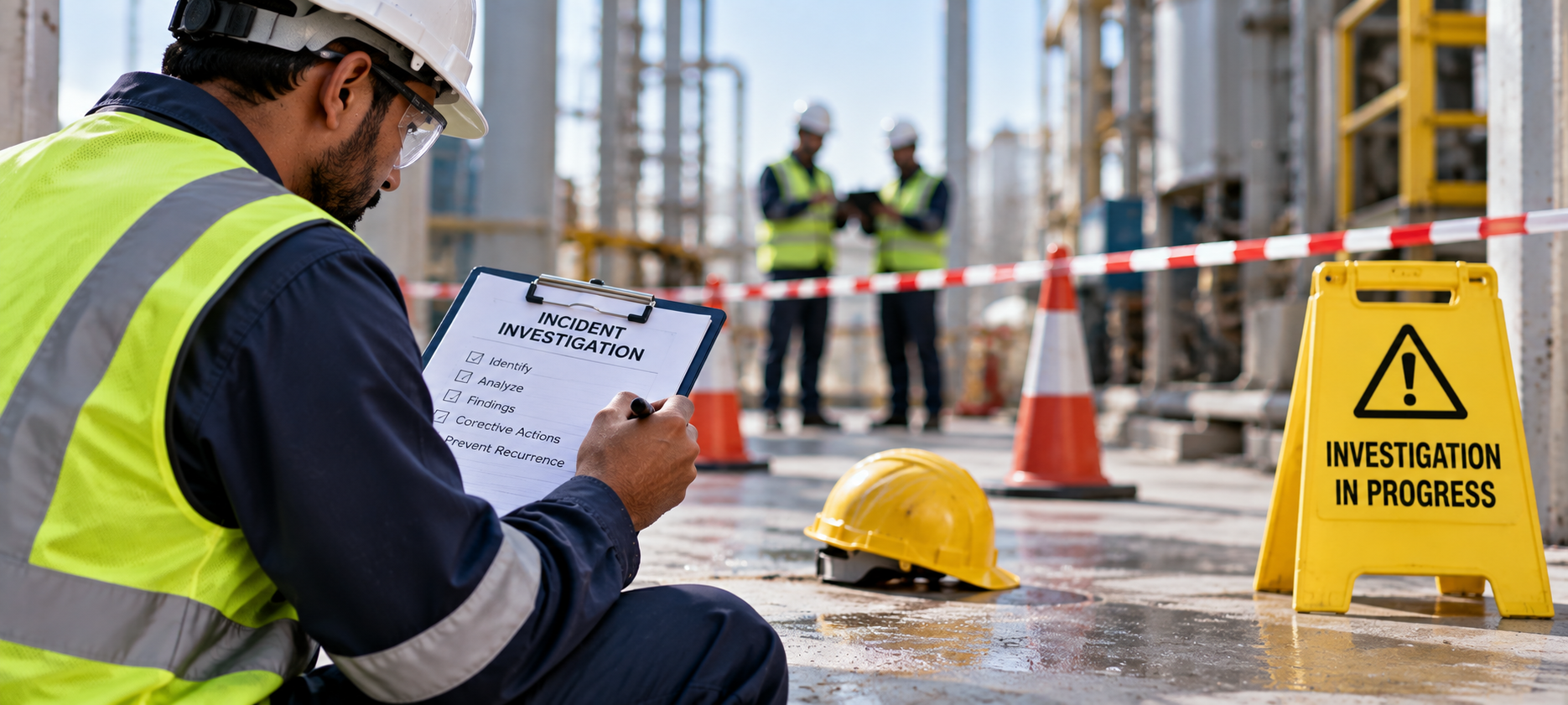
“Human error” is where most incident investigations stop, and it’s almost never where the real answer is. The worker who bypassed a guard did so because the guard made the job take twice as long and nobody had redesigned the process. The investigation that writes “employee failed to follow procedure” and closes the file will see the same incident again within the year, because the actual cause — the procedure nobody could realistically follow — was never touched.
Nathan Safety Training (NIMS) trains HSE officers and supervisors across the UAE to investigate incidents properly — evidence preservation, structured root cause analysis, and corrective actions that get tracked to genuine completion, not just logged and forgotten.
Why Investigation Quality Is a Regulatory Concern, Not Just an Internal One
Workplace incidents in the UAE carry defined reporting obligations to MOHRE and, depending on severity and location, to Dubai Municipality or ADOSH-SF as the relevant emirate authority — timelines and classification thresholds (near-miss, first aid, lost time, major) determine what has to be reported and how quickly. Beyond the reporting obligation itself, both frameworks increasingly expect to see evidence that the investigation behind a report actually identified a root cause and produced a tracked corrective action, not simply a classification and a closed file.
This matters commercially too: an investigation record that shows genuine root cause analysis is what a client or main contractor’s prequalification review actually wants to see — a pattern of incidents closed as ‘human error’ repeatedly is a red flag, not a reassurance.
Client and main contractor prequalification questionnaires across the UAE increasingly ask not just how many incidents a company has recorded, but to see an example investigation report — which means investigation documentation quality is now effectively a sales document as much as a compliance one.
The Incident That Happens Twice
An incident that gets investigated poorly doesn’t actually end when the report is filed — it just goes quiet until the same root cause produces a second, often worse, version of itself. ‘Human error’ as a closing statement doesn’t prevent a repeat; it just delays it, sometimes for years, until conditions line up the same way again.
The commercial stakes compound with each repeat. A pattern of similar incidents closed with shallow investigations is exactly what a prequalification reviewer is trained to notice, and it reads very differently from a company that can show a genuine root cause was found and fixed the first time.
Who Should Take This Course
This is a role-based course for anyone who might lead or contribute to an investigation, across any sector.
- HSE officers and managers with formal investigation responsibility
- Site and shift supervisors who are first on scene after an incident
- Safety committee members reviewing investigation findings
- Project managers signing off corrective action closure
- Anyone stepping into an HSE role who hasn’t formally investigated an incident before
Federal Rules Are Constant. Local Review Isn’t.
MOHRE’s federal reporting obligation is constant nationwide; which local authority also expects to see the investigation file changes by emirate. We deliver onsite across all seven:
- Dubai — Dubai Municipality’s HSEMS framework increasingly expects a digital, RCA-documented investigation trail, not just an incident classification
- Abu Dhabi — ADOSH-SF and, for ADNOC-facing operators, the group company’s own incident review process both sit on top of the federal MOHRE obligation
- Sharjah — Sharjah Municipality reviews investigation records for standard sites, with Hamriyah and SAIF Zone applying their own additional reporting conditions for tenants
- Ajman — Ajman Municipality’s expectations are lighter-touch than Dubai or Abu Dhabi, but a poor investigation record still shows up badly in client prequalification reviews
- Ras Al Khaimah — RAK Municipality and RAK FTZ both increasingly ask for evidence of root cause analysis behind quarrying and industrial incidents specifically
- Fujairah — Fujairah Municipality and the FOIZ authority both expect prompt investigation given the concentration of high-consequence bunkering and terminal activity
- Umm Al Quwain — UAQ Municipality’s review process is the lightest-touch of the seven, but the federal MOHRE reporting obligation applies exactly the same regardless of emirate
Incident Classification and Typical Reporting Urgency
Classification | Example | Typical Reporting Urgency |
Near miss | Dropped tool with no injury or contact | Internal log, trend review |
First aid case | Minor cut treated onsite | Internal log, may require notification |
Lost time injury | Injury preventing return to normal duty | Formal notification within defined timeframe |
Major / fatality | Serious injury, fatality, major property damage | Immediate notification to relevant authority |
The Pattern in Every Closed File We Review
We review a lot of closed investigation files before we ever run a course, and the pattern is remarkably consistent.
- Investigations that stop at “human error” without asking why the error was possible or likely in the first place
- Corrective actions logged in a register but never actually verified as completed
- Near-misses never reported at all, because staff assume nothing happened so nothing needs logging
- Evidence — photos, witness statements, physical conditions — gathered days later once the scene has already changed
- The same root cause appearing across multiple unrelated-looking incidents because nobody ever looked for the pattern
How We Teach Investigation Differently
We built this course around interview technique and root cause discipline specifically, because most investigators already know the classification system — the skill gap is almost always in the analysis, not the paperwork.
Findings from an investigation run through this training feed cleanly into the corrective action framework Nathan ISO Consulting builds for ISO 45001 clients, since both functions sit inside the same group rather than existing as separate, disconnected processes.
- Structured root cause methodology — 5 Whys and fishbone/Ishikawa analysis — taught with real case studies, not theory alone
- Evidence preservation and witness interview technique covered as practical skills, not a checklist
- Corrective action tracking systems that verify closure, not just log an intention
- Instructors with direct incident investigation experience across construction and industrial sites
- Report-writing training aimed at documentation that holds up to client and authority scrutiny
Courses Offered
- First Aid Course - CPR and AED
- Confined Space
- Fire Safety Awareness
- Scaffolding Inspection
- Scaffolding Erection & Dismantling
- Flagman Safety
- Chemical Safety and Handling Training
- Hazard and Risk Assessment
- Rigging and Slinging Training
- Traffic Safety
- Hand and Power Tools Operator
- Electrical Safety
- Lock Out and Tag Out (LOTO)
- Accident Incident Investigation
- Lifeguard Training
- Advanced Risk Assessment & Compliance Service
- Behavior-Based Safety Workplace Safety Consulting
- Construction Site Safety Induction Training
- Emergency Response Team Training
- Excavator Operator Training
- Forklift Operator Training
- H2S Awareness & Breathing Apparatus Training
- Hot Work Safety Training
- Incident Reporting & Root Cause Analysis Service
- MEWP Operator Training
- Mobile Crane Operator Training
- Permit to Work System Training
- Rope Access Training
- Working at Height & Fall Protection Safety Training
- Oil & Gas Safety Training
- Fire Warden Training
- Manual Handling Training
- Banksman Safety Training
- Gas Tester Training
- Defensive Driving Training
- HAZMAT Awareness Training
- Machine Safety and Machine Guarding Training
- Spill Response and Spill Control Training
- Welding Safety Training
Need expert advice? Speak to our team today
FAQ
Is incident investigation training required by UAE law?
Employers carry defined incident reporting obligations to MOHRE and the relevant emirate authority depending on severity, and increasingly authorities expect to see genuine root cause analysis behind those reports rather than a bare classification — which in practice makes trained investigators a compliance necessity, not an optional skill.
What's the difference between a near-miss and a reportable incident?
A near-miss is an event that could have caused injury or damage but didn’t. Whether it needs formal external reporting depends on your framework, but internally, near-misses are some of the most valuable data you have — they show you the failure before it costs anyone anything.
What is root cause analysis, and why isn't 'human error' enough?
Root cause analysis pushes past the immediate action to the underlying condition that made the action likely — a badly designed process, missing training, or a guard that slowed the job down. ‘Human error’ describes what happened, not why it kept being possible, which means it can’t actually prevent a repeat.
Do you teach a specific investigation methodology?
Yes — primarily the 5 Whys technique for straightforward incidents and fishbone (Ishikawa) diagramming for more complex, multi-factor incidents, both taught through real case studies rather than abstract theory.
How quickly does an investigation need to start after an incident?
As soon as practically possible — evidence, physical conditions and witness recall all degrade quickly. We teach evidence preservation as an immediate first step, before formal investigation even begins, specifically because delay is one of the most common causes of a weak investigation.
What does the course cover on witness interviews?
Structured, non-leading interview technique that gets an accurate account rather than the account a witness thinks the investigator wants to hear — including why interviewing separately, promptly and without blame framing matters.
How do you make sure corrective actions actually get completed, not just logged?
Through a tracked corrective action system with owners, deadlines and a verification step — someone confirming the action was genuinely implemented, not just marked closed by the person who was supposed to do it.
Is this course only for HSE officers, or also relevant for supervisors?
Very relevant for supervisors — they’re usually first on scene and make decisions in the first few minutes that determine how good the eventual investigation can be, even if a dedicated HSE officer leads the formal process afterwards.
Does this course help with client or main contractor prequalification reviews?
Yes — a documented history of investigations that identify genuine root causes and track corrective actions to completion is exactly what a prequalification reviewer is looking for, and a pattern of ‘human error’ closures is treated as a warning sign, not a clean record.
How often should investigation skills be refreshed?
We recommend every two to three years for practising HSE officers, and immediate training for anyone newly stepping into a role with investigation responsibility, given how much the quality of an investigation depends on interview and analysis technique rather than just knowing the classification system.
Does the reporting process differ if our incident happens in a free zone like JAFZA, Hamriyah or RAK FTZ?
Free zones generally layer their own notification requirement on top of the federal MOHRE obligation, in addition to whichever emirate authority applies. We cover how to identify which bodies need notifying for your specific site as part of the course.
How long does investigation training take?
Our core course runs two days, combining root cause methodology with practical case studies; a condensed one-day version focused on evidence preservation and initial response is available for supervisors who won’t lead full investigations themselves.
Can you review a past investigation report and give feedback rather than starting from theory?
Yes, and it’s often the most useful way to run this course — reviewing one or two of your own closed investigation files together surfaces gaps far faster than a hypothetical case study.
Is 'root cause analysis' a separate certification from incident investigation?
We teach it as one integrated course rather than two separate ones — root cause analysis (5 Whys, fishbone/Ishikawa) is the core method used inside a proper investigation, not a standalone add-on. Learning to investigate without root cause technique just produces a faster, equally shallow report.
- First Aid Course - CPR and AED
- Confined Space
- Fire Safety Awareness
- Scaffolding Inspection
- Scaffolding Erection & Dismantling
- Flagman Safety
- Chemical Safety and Handling Training
- Hazard and Risk Assessment
- Rigging and Slinging Training
- Traffic Safety
- Hand and Power Tools Operator
- Electrical Safety
- Lock Out and Tag Out (LOTO)
- Accident Incident Investigation
- Lifeguard Training
- Advanced Risk Assessment & Compliance Service
- Behavior-Based Safety Workplace Safety Consulting
- Construction Site Safety Induction Training
- Emergency Response Team Training
- Excavator Operator Training
- Forklift Operator Training
- H2S Awareness & Breathing Apparatus Training
- Hot Work Safety Training
- Incident Reporting & Root Cause Analysis Service
- MEWP Operator Training
- Mobile Crane Operator Training
- Permit to Work System Training
- Rope Access Training
- Working at Height & Fall Protection Safety Training


Accident and Incident Investigation Training UAE — Root Cause Analysis Beyond 'Human Error'
“Human error” is where most incident investigations stop, and it’s almost never where the real answer is. The worker who bypassed a guard did so because the guard made the job take twice as long and nobody had redesigned the process. The investigation that writes “employee failed to follow procedure” and closes the file will see the same incident again within the year, because the actual cause — the procedure nobody could realistically follow — was never touched.
Nathan Safety Training (NIMS) trains HSE officers and supervisors across the UAE to investigate incidents properly — evidence preservation, structured root cause analysis, and corrective actions that get tracked to genuine completion, not just logged and forgotten.
Why Investigation Quality Is a Regulatory Concern, Not Just an Internal One
Workplace incidents in the UAE carry defined reporting obligations to MOHRE and, depending on severity and location, to Dubai Municipality or ADOSH-SF as the relevant emirate authority — timelines and classification thresholds (near-miss, first aid, lost time, major) determine what has to be reported and how quickly. Beyond the reporting obligation itself, both frameworks increasingly expect to see evidence that the investigation behind a report actually identified a root cause and produced a tracked corrective action, not simply a classification and a closed file.
This matters commercially too: an investigation record that shows genuine root cause analysis is what a client or main contractor’s prequalification review actually wants to see — a pattern of incidents closed as ‘human error’ repeatedly is a red flag, not a reassurance.
Client and main contractor prequalification questionnaires across the UAE increasingly ask not just how many incidents a company has recorded, but to see an example investigation report — which means investigation documentation quality is now effectively a sales document as much as a compliance one.
The Incident That Happens Twice
An incident that gets investigated poorly doesn’t actually end when the report is filed — it just goes quiet until the same root cause produces a second, often worse, version of itself. ‘Human error’ as a closing statement doesn’t prevent a repeat; it just delays it, sometimes for years, until conditions line up the same way again.
The commercial stakes compound with each repeat. A pattern of similar incidents closed with shallow investigations is exactly what a prequalification reviewer is trained to notice, and it reads very differently from a company that can show a genuine root cause was found and fixed the first time.
Who Should Take This Course
This is a role-based course for anyone who might lead or contribute to an investigation, across any sector.
- HSE officers and managers with formal investigation responsibility
- Site and shift supervisors who are first on scene after an incident
- Safety committee members reviewing investigation findings
- Project managers signing off corrective action closure
- Anyone stepping into an HSE role who hasn’t formally investigated an incident before
Federal Rules Are Constant. Local Review Isn’t.
MOHRE’s federal reporting obligation is constant nationwide; which local authority also expects to see the investigation file changes by emirate. We deliver onsite across all seven:
- Dubai — Dubai Municipality’s HSEMS framework increasingly expects a digital, RCA-documented investigation trail, not just an incident classification
- Abu Dhabi — ADOSH-SF and, for ADNOC-facing operators, the group company’s own incident review process both sit on top of the federal MOHRE obligation
- Sharjah — Sharjah Municipality reviews investigation records for standard sites, with Hamriyah and SAIF Zone applying their own additional reporting conditions for tenants
- Ajman — Ajman Municipality’s expectations are lighter-touch than Dubai or Abu Dhabi, but a poor investigation record still shows up badly in client prequalification reviews
- Ras Al Khaimah — RAK Municipality and RAK FTZ both increasingly ask for evidence of root cause analysis behind quarrying and industrial incidents specifically
- Fujairah — Fujairah Municipality and the FOIZ authority both expect prompt investigation given the concentration of high-consequence bunkering and terminal activity
- Umm Al Quwain — UAQ Municipality’s review process is the lightest-touch of the seven, but the federal MOHRE reporting obligation applies exactly the same regardless of emirate
Incident Classification and Typical Reporting Urgency
Classification | Example | Typical Reporting Urgency |
Near miss | Dropped tool with no injury or contact | Internal log, trend review |
First aid case | Minor cut treated onsite | Internal log, may require notification |
Lost time injury | Injury preventing return to normal duty | Formal notification within defined timeframe |
Major / fatality | Serious injury, fatality, major property damage | Immediate notification to relevant authority |
The Pattern in Every Closed File We Review
We review a lot of closed investigation files before we ever run a course, and the pattern is remarkably consistent.
- Investigations that stop at “human error” without asking why the error was possible or likely in the first place
- Corrective actions logged in a register but never actually verified as completed
- Near-misses never reported at all, because staff assume nothing happened so nothing needs logging
- Evidence — photos, witness statements, physical conditions — gathered days later once the scene has already changed
- The same root cause appearing across multiple unrelated-looking incidents because nobody ever looked for the pattern
How We Teach Investigation Differently
We built this course around interview technique and root cause discipline specifically, because most investigators already know the classification system — the skill gap is almost always in the analysis, not the paperwork.
Findings from an investigation run through this training feed cleanly into the corrective action framework Nathan ISO Consulting builds for ISO 45001 clients, since both functions sit inside the same group rather than existing as separate, disconnected processes.
- Structured root cause methodology — 5 Whys and fishbone/Ishikawa analysis — taught with real case studies, not theory alone
- Evidence preservation and witness interview technique covered as practical skills, not a checklist
- Corrective action tracking systems that verify closure, not just log an intention
- Instructors with direct incident investigation experience across construction and industrial sites
- Report-writing training aimed at documentation that holds up to client and authority scrutiny
FAQ
Is incident investigation training required by UAE law?
Employers carry defined incident reporting obligations to MOHRE and the relevant emirate authority depending on severity, and increasingly authorities expect to see genuine root cause analysis behind those reports rather than a bare classification — which in practice makes trained investigators a compliance necessity, not an optional skill.
What's the difference between a near-miss and a reportable incident?
A near-miss is an event that could have caused injury or damage but didn’t. Whether it needs formal external reporting depends on your framework, but internally, near-misses are some of the most valuable data you have — they show you the failure before it costs anyone anything.
What is root cause analysis, and why isn't 'human error' enough?
Root cause analysis pushes past the immediate action to the underlying condition that made the action likely — a badly designed process, missing training, or a guard that slowed the job down. ‘Human error’ describes what happened, not why it kept being possible, which means it can’t actually prevent a repeat.
Do you teach a specific investigation methodology?
Yes — primarily the 5 Whys technique for straightforward incidents and fishbone (Ishikawa) diagramming for more complex, multi-factor incidents, both taught through real case studies rather than abstract theory.
How quickly does an investigation need to start after an incident?
As soon as practically possible — evidence, physical conditions and witness recall all degrade quickly. We teach evidence preservation as an immediate first step, before formal investigation even begins, specifically because delay is one of the most common causes of a weak investigation.
What does the course cover on witness interviews?
Structured, non-leading interview technique that gets an accurate account rather than the account a witness thinks the investigator wants to hear — including why interviewing separately, promptly and without blame framing matters.
How do you make sure corrective actions actually get completed, not just logged?
Through a tracked corrective action system with owners, deadlines and a verification step — someone confirming the action was genuinely implemented, not just marked closed by the person who was supposed to do it.
Is this course only for HSE officers, or also relevant for supervisors?
Very relevant for supervisors — they’re usually first on scene and make decisions in the first few minutes that determine how good the eventual investigation can be, even if a dedicated HSE officer leads the formal process afterwards.
Does this course help with client or main contractor prequalification reviews?
Yes — a documented history of investigations that identify genuine root causes and track corrective actions to completion is exactly what a prequalification reviewer is looking for, and a pattern of ‘human error’ closures is treated as a warning sign, not a clean record.
How often should investigation skills be refreshed?
We recommend every two to three years for practising HSE officers, and immediate training for anyone newly stepping into a role with investigation responsibility, given how much the quality of an investigation depends on interview and analysis technique rather than just knowing the classification system.
Does the reporting process differ if our incident happens in a free zone like JAFZA, Hamriyah or RAK FTZ?
Free zones generally layer their own notification requirement on top of the federal MOHRE obligation, in addition to whichever emirate authority applies. We cover how to identify which bodies need notifying for your specific site as part of the course.
How long does investigation training take?
Our core course runs two days, combining root cause methodology with practical case studies; a condensed one-day version focused on evidence preservation and initial response is available for supervisors who won’t lead full investigations themselves.
Can you review a past investigation report and give feedback rather than starting from theory?
Yes, and it’s often the most useful way to run this course — reviewing one or two of your own closed investigation files together surfaces gaps far faster than a hypothetical case study.
Is 'root cause analysis' a separate certification from incident investigation?
We teach it as one integrated course rather than two separate ones — root cause analysis (5 Whys, fishbone/Ishikawa) is the core method used inside a proper investigation, not a standalone add-on. Learning to investigate without root cause technique just produces a faster, equally shallow report.
Build a Stronger Investigation Process
Whether you need full root cause investigation training or a condensed evidence-preservation session for supervisors, tell us your current investigation process, and we’ll show you where root cause analysis and corrective action tracking are likely to close the biggest gaps.
Nathan Safety Training (NIMS) — Accident and incident investigation training across Dubai, Abu Dhabi, Sharjah, Ajman, Ras Al Khaimah, Fujairah and Umm Al Quwain.