
Home / Telecom Tower Safety Training UAE
A climber hanging in a harness after a fall has minutes, not hours.
Suspension trauma develops when an immobile person hangs in a harness and the leg straps restrict venous return, causing blood to pool in the lower limbs. Loss of consciousness can follow within a short period, and the condition can be fatal even though the fall arrest system worked exactly as designed and the worker was never injured by the fall itself. The harness saved them from the ground and then became the thing that threatened them.
Nathan Safety Training Services (NIMS) delivers heavy engineering safety training UAE programmes for fabrication yards, structural steel and modular contractors, pressure vessel and tank manufacturers, machine shops and heavy workshops, EPC fabrication facilities, and the plant and equipment providers who support them.
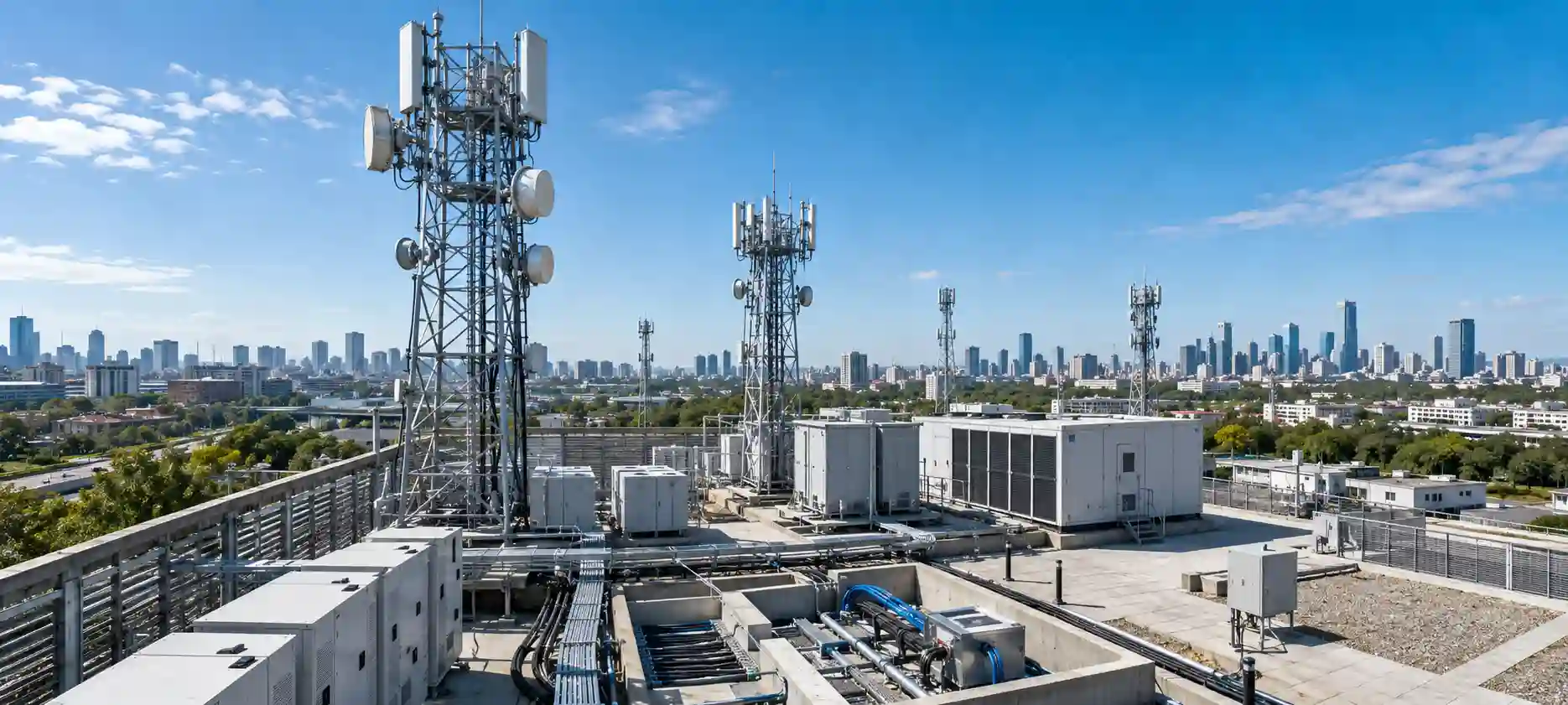
Nathan Safety Training Services (NIMS) delivers telecom safety training UAE programmes for tower construction and maintenance contractors, network rollout and upgrade teams, antenna and microwave installers, rooftop and in-building coverage installers, fibre and transmission crews, and the managed service providers who maintain the national network.
We deliver across Dubai, Abu Dhabi, Sharjah, Ajman, Umm Al Quwain, Ras Al Khaimah and Fujairah, covering rooftop sites in Business Bay, Dubai Marina and JLT, desert macro sites in Al Dhafra and the Western Region, mountain sites across the Hajar range and Jebel Jais, and greenfield rollout along the Etihad Rail and highway corridors.
Book Tower Safety Training → · Request a Rescue Capability Review → · Request HSE Manpower →
Rescue at Height Training — The Clock That Governs Everything
Most telecom contractors in the region hold working at height certificates for their climbing crews. Considerably fewer can demonstrate that a rescue could actually be performed on a given site, by the people who were present that day, within the time available.
The gap between those two positions is where the fatalities sit.
Why External Tower Rescue Is Rarely the Answer
Civil Defence and ambulance services in the UAE are capable and responsive, but a tower rescue is a specialist technical operation. The responding crew has to reach the site, which on a desert or mountain macro site may involve a considerable journey over unmade track. They then have to assess a structure they have not seen, deploy technical rescue capability, and reach a casualty who may be forty metres up a lattice tower. Set against the timeline of suspension trauma, that sequence rarely closes fast enough.
The practical conclusion is that rescue capability has to be present on site, in the climbing team, on every climb. Not on call. Not at the depot.
What Rescue at Height Competency Actually Involves
- Casualty assessment from a position of safety, without the rescuer creating a second casualty.
- Suspended casualty release and controlled descent using pick-off, counterbalance or descent-device techniques appropriate to the structure and the casualty position.
- Recovery of an unconscious casualty, which is materially harder than recovery of a conscious one and is the scenario most training programmes skip.
- Post-rescue casualty handling, including the positioning considerations following prolonged suspension and the handover to medical services.
- Equipment held at the work front, not in a vehicle at the compound gate — and checked before each climb rather than at monthly inspection.
- Rehearsal frequency high enough that the skill is current. Rescue technique degrades faster than almost any other safety competency, which is why annual refresh is a reasonable minimum for teams that climb regularly.
Before Anyone Climbs — A Pre-Climb Assurance Checklist
The following is the sequence we work through with telecom clients when reviewing their competency arrangements. Each point maps to a training requirement, and any one of them answered with an assumption rather than a fact is a gap worth closing.
1. Is the structure fit to be climbed?
Structural condition, corrosion, previous modification, current antenna and equipment loading against design, guy tension where applicable, and the ladder or climbing facility condition. Loading is the item most often overlooked — towers accumulate equipment across successive network generations and are frequently carrying far more than they were designed for.
2. Is the climber medically and physically fit today?
Tower climbing is physically demanding work in extreme heat. Fitness to climb is not a one-off assessment at recruitment; it is a daily consideration affected by heat, hydration, fatigue, illness, shift pattern and recent injury.
3. Is the fall protection system continuous from ground to work position?
The gaps are what matter. Transitions between fall arrest systems, moving around obstructions, passing antenna mounts, and the moment of arrival at the work position are where climbers most often become unattached. Twin lanyard discipline exists precisely to close these gaps and is only effective if it has been trained as a habit.
4. Has the RF been managed?
Antenna power-down or sector shutdown arranged with the network operations centre, confirmed rather than assumed, with a written record. Working in front of a live panel antenna at close range is not a theoretical hazard.
5. Can a rescue be performed by the people present?
Named rescuer, equipment on site, technique appropriate to the structure, and current competency. If the honest answer is that the plan is to call for help, the climb should not proceed.
6. Is the dropped object risk controlled?
Tool tethering, exclusion beneath the climb, and control of the ground area — which on a rooftop site may include a public street and on a greenfield site may include the crew’s own vehicles and colleagues.
7. Is there a heat and hydration plan for the climb duration?
Shade at the base, water carried aloft, climb duration limits, and a work-rest pattern appropriate to the conditions rather than to the schedule.
8. Is communication established and tested?
Between climber and ground, and between the site team and the operations centre. On remote macro sites mobile coverage is not guaranteed, which is a genuine problem on a site whose purpose is to provide coverage.
Talk to an HSE Advisor → · Request a Pre-Climb Assurance Review →
Telecom Safety Training by Workforce – Climbing and Non-Climbing Crews
Telecom contractors consistently under-serve one of these groups and over-serve the other. The climbing population receives most of the training budget while the far larger non-climbing population is treated as low risk despite spending its working life on the same sites.
Path A – Tower Climbing Safety Training for Riggers & Installers
Tower riggers, antenna installers, microwave and transmission engineers, structural maintenance crews and anyone who leaves the ground.
Core training path
- Working at Height & Fall Protection – fall hazard recognition, anchor selection on lattice and monopole structures, harness inspection and fit, twin lanyard technique, transition discipline, and the principles of restraint, work positioning and fall arrest.
- Rescue at Height – casualty assessment, suspended casualty release, controlled descent, unconscious casualty recovery, post-suspension handling. Delivered practically rather than theoretically.
- Rope Access Training – where structures require positioning that ladder and lanyard systems cannot achieve, including monopoles, chimneys and façade-mounted installations.
- Electrical Safety – site power, generators, rectifiers, battery strings, earthing and lightning protection systems.
- RF Exposure Awareness — covered in detail below.
- First Aid, CPR & AED – with specific content on post-suspension casualty management, heat illness and traumatic injury.
- Rigging & Slinging – for hoisting antennas, dishes and equipment up the structure using gin poles and hoist arrangements.
- Heat Stress Awareness — the climbing population is the most heat-exposed group in the sector.
Path B – Ground Crew Training for Fibre, Power & Equipment Room Teams
Fibre and cable crews, civil and foundation teams, generator and power technicians, equipment room and BTS engineers, site acquisition and survey staff, security and cleaning personnel, and drivers.
Core training path
- Site Safety Induction – including dropped object exclusion, RF zone awareness and site access rules.
- Electrical Safety and LOTO – rectifiers, battery strings, generators and distribution. Battery rooms at telecom sites carry the same DC and hydrogen hazards found in data centres, at smaller scale and usually with less oversight.
- Confined Space Entry – cable chambers, manholes, ducts and underground vaults on fibre and transmission routes.
- Excavation Safety and Traffic Safety – fibre trenching and duct installation, frequently in live carriageway.
- Manual Handling — battery blocks, cable drums, generator components and equipment cabinets.
- Fire Safety – equipment rooms, battery installations, generator and fuel storage.
- First Aid — particularly for crews working remote sites alone or in pairs.
Talk to an HSE Advisor → · Check On-Site Availability →
RF Exposure Awareness Training for Telecom Workers
Radiofrequency exposure is the hazard telecom workers ask about most and receive the least clear information on, which produces two opposite failures. Some crews treat every antenna as harmless because they cannot feel anything. Others refuse work on the basis of exaggerated fears about long-term effects.
The training position we take is factual. The established hazard from RF at the power levels involved is thermal — tissue heating from close-range exposure to a transmitting antenna, particularly in front of a panel or dish at short distance. It is a real and manageable hazard with defined exclusion distances, and it is entirely controlled by power-down procedures, exclusion zones, signage and personal RF monitors where the operator requires them.
Content covers antenna types and their radiation patterns, the difference between front, side and rear exposure, exclusion distances, power-down and sector shutdown procedures with the network operations centre, permit and confirmation records, signage interpretation, personal monitor use, and what to do if a sector is energised unexpectedly during work.
Telecom Site Types — Tower, Rooftop, Monopole & Fibre Route Training
Site Type | What Changes | Additional Training Emphasis |
Greenfield lattice tower | Remote access, long climb, full RF and heat exposure | Rescue at Height, First Aid, Heat Stress |
Monopole | Limited climbing facility, restricted work positioning | Rope Access, Work Positioning, Rescue at Height |
Rooftop macro site | Public below, roof edge and fragile surface, access via building | Working at Height, Dropped Objects, Site Induction |
Guyed mast | Guy tension and anchor condition, greater height | Structural Awareness, Rescue at Height, Rigging |
In-building and DAS | Ceiling voids, riser access, occupied premises, electrical | Confined Space, Electrical Safety, Manual Handling |
Fibre and duct routes | Live traffic, excavation, confined chambers | Traffic Safety, Excavation, Confined Space Entry |
Exchange and equipment rooms | Battery strings, rectifiers, suppression systems, HV supply | Electrical Safety, LOTO, Fire Safety |
Mountain and desert sites | Extreme heat, remoteness, delayed medical response, lone working | First Aid, Heat Stress, Lone Working, Emergency Response |
TDRA, Operator & OSHAD Requirements for Telecom Contractors
- TDRA — sector regulation covering telecommunications infrastructure, licensing and network requirements in the UAE.
- Network operator HSE specifications — e& and du each impose contractor HSE conditions, competency requirements and site access rules on rollout and maintenance vendors. In practice these are the binding documents for most telecom contractors, and they typically specify working at height and rescue competency explicitly.
- Managed service provider requirements — where network maintenance is outsourced, the MSP imposes its own competency and certification standards on subcontractors, frequently referencing international height and rescue standards.
- OSHAD-SF — the Abu Dhabi framework, with Codes of Practice applicable to working at height, electrical safety, confined spaces, heat stress and emergency management.
- Dubai Municipality, Dubai Civil Defence and Trakhees — requirements for rooftop installations, equipment rooms, battery installations and works within their respective jurisdictions.
- MOHRE — federal occupational safety obligations including the midday break rule, which affects tower work substantially given the exposure at height.
- Municipality and roads authorities — permits for fibre trenching, duct installation and works affecting the carriageway, including RTA in Dubai.
Training can be structured to support alignment with these frameworks and with operator competency requirements. Certificates evidence completion and assessment of a defined programme rather than operator approval or vendor accreditation.
Request a Role-Based Training Matrix → · Download Course Catalog →
HSE Manpower Supply for Telecom Rollout & Maintenance
Network rollout campaigns create short bursts of intense activity across many dispersed sites at once, which is a difficult shape for a fixed HSE headcount to cover.
Nathan Safety Training Services supplies HSE Officers, HSE Engineers, Safety Supervisors, Safety Inspectors, First Aiders and Confined Space Attendants on project, campaign and long-term assignment. Personnel with prior telecom, tower and rope access experience can be requested.
Courses Offered
- First Aid Course - CPR and AED
- Confined Space
- Fire Safety Awareness
- Scaffolding Inspection
- Scaffolding Erection & Dismantling
- Flagman Safety
- Chemical Safety and Handling Training
- Hazard and Risk Assessment
- Rigging and Slinging Training
- Traffic Safety
- Hand and Power Tools Operator
- Electrical Safety
- Lock Out and Tag Out (LOTO)
- Accident Incident Investigation
- Lifeguard Training
- Advanced Risk Assessment & Compliance Service
- Behavior-Based Safety Workplace Safety Consulting
- Construction Site Safety Induction Training
- Emergency Response Team Training
- Excavator Operator Training
- Forklift Operator Training
- H2S Awareness & Breathing Apparatus Training
- Hot Work Safety Training
- Incident Reporting & Root Cause Analysis Service
- MEWP Operator Training
- Mobile Crane Operator Training
- Permit to Work System Training
- Rope Access Training
- Working at Height & Fall Protection Safety Training
- Fire Warden Training
- Manual Handling Training
- Banksman Safety Training
- Gas Tester Training
- Defensive Driving Training
- HAZMAT Awareness Training
- Machine Safety and Machine Guarding Training
- Spill Response and Spill Control Training
- Welding Safety Training
Need expert advice? Speak to our team today
FAQ
1. What is suspension trauma and why does it govern telecom rescue planning?
It occurs when a person hangs immobile in a harness after a fall arrest. The leg straps restrict venous return, blood pools in the lower limbs, and reduced circulation to the brain can cause loss of consciousness within a short period. It can be fatal even when the fall arrest system worked perfectly and the worker sustained no injury from the fall. Because the timeline is short, rescue capability must be present on site with the climbing team rather than summoned from elsewhere.
2. Is it enough to plan on calling emergency services for a tower rescue?
For most telecom sites, no. Civil Defence and ambulance services are capable and responsive, but a tower rescue is a specialist technical operation requiring travel to what may be a remote site, assessment of an unfamiliar structure, and deployment of technical rescue capability to reach a casualty at height. Measured against the suspension trauma timeline, that sequence rarely completes quickly enough. Rescue competency should sit within the climbing team on every climb.
3. How often should rescue at height training be refreshed?
More often than most other safety competencies. Rescue technique is a perishable practical skill that degrades noticeably within months if unused, and it has to be performed correctly under acute stress by someone whose colleague is hanging above them. Annual refresh is a reasonable minimum for teams climbing regularly, and many operators and managed service providers specify exactly that. Between formal refreshers, periodic practical rehearsal at the depot is worth building into the routine.
4. What is the actual RF risk to telecom workers?
The established hazard at the power levels involved is thermal — tissue heating from close-range exposure to a transmitting antenna, most significantly directly in front of a panel antenna or dish at short distance. It is real, well characterised and entirely manageable through defined exclusion distances, power-down and sector shutdown procedures arranged with the network operations centre, signage, and personal RF monitors where the operator requires them. Training should give workers accurate information, since both complacency and exaggerated fear cause problems on site.
5. Why is tower loading a safety issue rather than just an engineering one?
Because towers accumulate equipment across successive network generations. Antennas, dishes, remote radio units, cabling and mounts are added over the years, frequently without the structure being reassessed against its original design loading. A tower that is overloaded is a structural risk to everyone who climbs it, and the climbing crew is rarely in a position to know. Structural verification before climb is a genuine pre-climb assurance item, not a formality.
6. What is twin lanyard discipline and why does it matter so much?
It means always having one lanyard attached while moving the other, so the climber is never unattached during transitions. It matters because the moments of transition — passing an obstruction, moving around antenna mounts, changing systems, arriving at the work position — are precisely when climbers most often become detached, and they are the moments where a fall is most likely. It is a habit rather than a piece of knowledge, which means it has to be trained practically and reinforced through observation.
7. Do non-climbing telecom workers need safety training?
Yes, and this group is consistently under-served. Fibre and cable crews face confined space and excavation hazards and work in live carriageway. Power technicians work on rectifiers, generators and battery strings carrying DC and hydrogen hazards similar to a data centre battery room but with less oversight. Equipment room engineers work with suppression systems and HV supplies. The climbing population gets most of the training budget while a larger non-climbing population spends its working life on the same sites.
8. Do you deliver rope access training for telecom structures?
Yes. Rope access is used on monopoles, where climbing facilities are limited and work positioning is restricted, and on façade and chimney-mounted installations. Training covers equipment inspection, anchor selection, positioning technique, transitions and rescue. Rescue capability is treated as integral rather than as an advanced add-on, since a suspended rope access casualty faces the same clock as any other.
9. How do you handle training for remote desert and mountain sites?
By building the programme around delayed emergency response rather than assuming it. That means stronger on-site first aid capability including AED provision, heat illness recognition and immediate cooling, lone working procedures and check-in protocols, casualty location and extraction planning with coordinates that responders can navigate to, and communication arrangements that work where mobile coverage is poor — which is a genuine issue on sites whose purpose is providing coverage.
10. Is telecom safety training mandatory in the UAE?
The obligation to ensure worker competence is mandatory under MOHRE occupational safety duties and the applicable emirate framework such as OSHAD-SF in Abu Dhabi. In practice the binding requirement for most contractors comes from the network operator or managed service provider, whose HSE specifications typically name working at height and rescue competency explicitly as a condition of site access and vendor qualification.
11. Can training be delivered at our depot or on a training tower?
Yes, and where a training structure exists we prefer it — it allows unlimited practical repetition without site access constraints. Where no training tower exists we deliver on operational sites, and we would recommend that rescue training in particular is performed on the structure type the crew actually climbs, because technique differs substantially between lattice towers, monopoles and rooftop masts.
12. What certificates do participants receive?
A certificate of completion for each course showing participant name, course title, delivery date and validity guidance where applicable. These support operator and managed service provider vendor qualification, contractor pre-qualification, site access approvals and audit requirements. Specific formats can usually be accommodated with advance notice.
13. How long do the courses take?
Working at height typically runs one to two days with practical assessment. Rescue at height runs one to two days and is heavily practical. Rope access runs longer depending on the level of certification required. Electrical safety, confined space and LOTO run one to two days each. RF awareness and heat stress awareness run half a day. First aid runs one to two days depending on level.
14. Can you train a multilingual telecom workforce?
Yes. English is standard, with bilingual delivery and interpreted sessions available. Telecom field crews in the UAE are typically multilingual, and practical components including harness fitting, rescue technique and equipment inspection translate particularly well because they are demonstrated and assessed rather than described.
15. Do you supply HSE manpower for telecom projects?
Yes. Through hsemanpower.ae, Nathan Safety Training Services supplies HSE Officers, HSE Engineers, Safety Supervisors, Safety Inspectors, First Aiders and Confined Space Attendants for rollout campaigns, upgrade programmes and maintenance contracts. Rollout work is dispersed across many sites simultaneously, so coverage can be structured around a campaign footprint rather than a single location.
Book Telecom Safety Training with Nathan Safety Training
Nathan Safety Training Services works with tower contractors, rollout vendors and managed service providers across the Emirates. If you are preparing for vendor qualification, expanding a climbing team, or checking whether your rescue arrangement would actually work on the sites you climb, the pre-climb checklist above is a practical place to start the conversation.
Book Corporate HSE Training → · Request HSE Manpower Support → · Talk to an HSE Advisor →