
Home / Heavy Engineering & Fabrication Safety Training
Heavy engineering & Fabrication Safety Training
Heavy Engineering & Fabrication Safety Training UAE
Ask an experienced yard manager what keeps them awake and the answer is almost never a hazard. It is a specific load, on a specific day, that has to go somewhere difficult.
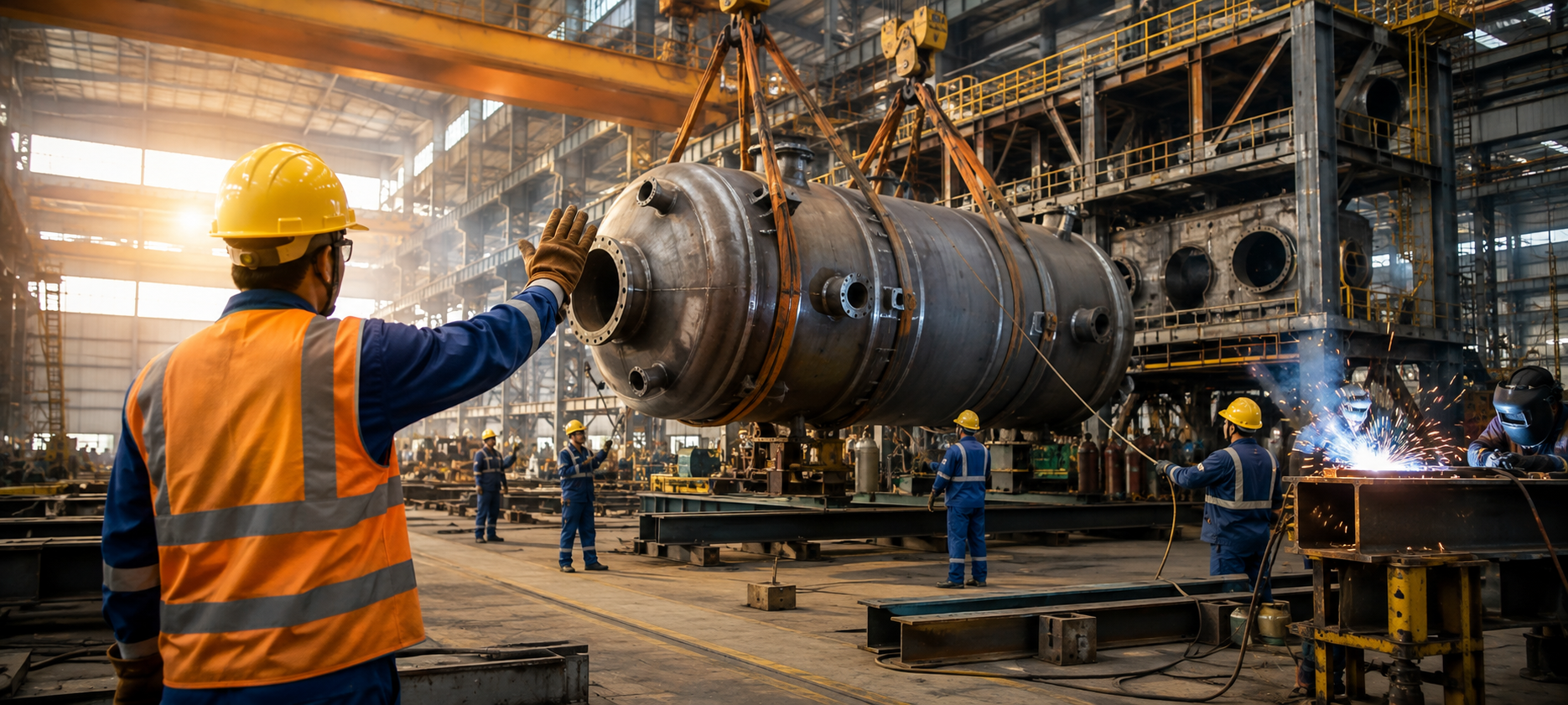
Heavy engineering is defined by the problem of moving mass. Pressure vessels, structural modules, skids, girders, tanks, spools and machined components that weigh tens or hundreds of tonnes have to be turned, upended, transported, positioned and installed inside workshops with limited headroom, across yards with variable ground, and onto transport with fixed constraints. Everything else in the yard — welding, machining, painting, assembly — is comparatively routine industrial work. The lifting is what makes the sector distinct, and it is where the fatalities occur.
Nathan Safety Training Services (NIMS) delivers heavy engineering safety training UAE programmes for fabrication yards, structural steel and modular contractors, pressure vessel and tank manufacturers, machine shops and heavy workshops, EPC fabrication facilities, and the plant and equipment providers who support them.
We deliver on site across Mussafah and ICAD, Khalifa Economic Zone and the Abu Dhabi industrial corridor, Jebel Ali and Dubai Investments Park, Hamriyah and Sharjah Industrial Areas, Ajman, Ras Al Khaimah and Fujairah.
Book Lifting & Fabrication Training → · Request a Lifting Competency Matrix → · Request HSE Manpower →
Lifting Operations Training — Routine, Complicated & Complex Lifts
The most useful structure Nathan Safety Training brings to heavy engineering clients is the distinction between lift categories. Most yards apply one procedure to every lift, which means routine lifts are over-administered and the genuinely difficult ones receive no more scrutiny than a pallet move.
Routine Lifts — Rigging, Slinging & Banksman Competence
Repetitive, well understood, within comfortable margins of equipment capacity, using standard rigging arrangements on known loads. A workshop crane moving a plate to a machining bed. These need competent operators and slingers, sound gear inspection, and a generic lifting procedure. They do not need a bespoke lift plan each time, and insisting they do tends to devalue the paperwork for the lifts that actually need it.
Competency Required for Routine Lifts
Rigging & Slinging Training, crane or forklift operator certification, Banksman and signalling competence.
Complicated Lifts — Lift Plans & Lifting Supervisor Competence
Standard equipment used near the limits of its capacity, or a non-standard load, or restricted access, or a lift over an area that cannot be fully cleared. The margin for error narrows, and the assumptions that hold on a routine lift stop holding. These require a documented lift plan, a named lifting supervisor, verified load weight and centre of gravity, and a specific rigging arrangement rather than a habitual one.
Competency Required for Complicated Lifts
As above, plus Lifting Supervisor competence, Risk Assessment Training and Permit to Work.
Complex Lifts — Tandem, Upending & Load-Out Operations
Tandem and multi-crane lifts, upending and turning operations, loads with uncertain or shifting centre of gravity, lifts requiring engineered lifting beams or spreader arrangements, load-out onto transport or barge, and any lift where failure would be catastrophic. Upending a vessel is the classic example — the load path changes continuously through the operation and the rigging sees forces that a static calculation does not reveal.
These need engineered lift studies, appointed persons, rehearsed communication, exclusion zones enforced by someone with authority to stop, and a workforce that understands why the sequence matters. Rigging and slinging training UAE at this level is as much about recognising when to stop as about how to proceed.
Competency Required for Complex Lifts
All of the above, plus engineered lift plan review, Emergency Response arrangements, and — in our experience the most valuable single element — a genuine stop-work culture reinforced through Behaviour-Based Safety.
Fabrication Yard Hazards by Work Area
Lifting dominates the severe injury statistics. The frequent injuries come from everywhere else, and a training plan that only addresses cranes will leave most of the injury rate untouched.
Yard Area | Principal Hazards | Relevant Training |
Material receipt and storage | Load stability, mobile plant, manual handling, stack collapse | Forklift Operator, Traffic Safety, Rigging & Slinging |
Cutting and profiling | Hot work, fume, noise, sparks, gas cylinders | Hot Work Safety, Hand & Power Tools, Fire Safety |
Fit-up and assembly | Crush and trap points, temporary supports, height, dropped objects | Working at Height, Rigging & Slinging, Risk Assessment |
Welding bays | Arc radiation, metal fume, fire, electrical, confined welding | Hot Work Safety, Electrical Safety, Confined Space Entry |
Machining and workshops | Entanglement, ejected material, coolant exposure, noise | LOTO, Hand & Power Tools, Chemical Safety |
Blasting and painting | Silica and abrasive dust, solvent vapour, confined booths, fire | Confined Space Entry, Chemical Safety, Fire Safety |
Pressure and hydro testing | Stored pressure energy, joint failure, pneumatic test risk | Permit to Work, Risk Assessment, Emergency Response |
Vessel and tank internals | Confined entry, fume, oxygen deficiency, restricted rescue | Confined Space Entry, Gas Testing, ERT Training |
Yard transport and load-out | SPMT and trailer movement, ground conditions, tie-down failure | Traffic Safety, Flagman Safety, Rigging & Slinging |
Maintenance of plant and cranes | Multi-source isolation, working at height, stored energy | LOTO, Working at Height, Permit to Work |
Scaffolding and access | Erection and dismantling, incomplete platforms, dropped items | Scaffolding Erection & Dismantling, Scaffolding Inspection |
Site-wide | Heat stress, noise exposure, hand-arm vibration, housekeeping | First Aid, Behaviour-Based Safety, Incident Investigation |
Dropped Object Prevention Training for Fabrication Yards
Yards focus attention on the load under the hook, which is correct. The injuries that occur between lifts come from something smaller falling from somewhere higher.
A shackle pin, a hand tool, a grinding disc, a scaffold fitting, a welding rod stub or a section of temporary bracing dropped from a fit-up platform carries enough energy to kill. On a fabrication yard the exposure is continuous, because work happens at multiple levels on the same structure simultaneously and the area below is rarely empty.
The controls are unglamorous and effective: tool tethering, toe boards and containment netting on elevated platforms, exclusion beneath simultaneous overhead work, drop zone barriers that people actually respect, secured temporary steelwork, and a housekeeping standard on platforms that treats loose items as a hazard rather than as untidiness. This content sits within our working at height and site induction programmes, and it deserves more attention than it usually gets.
Talk to an HSE Advisor → · Check On-Site Availability →
Heavy Engineering & Fabrication HSE Training Courses We Deliver
Rigging & Slinging Training
The core programme for this sector. Sling and accessory selection, load estimation, centre of gravity determination, sling angle and its effect on tension, lifting point assessment, accessory inspection and rejection criteria, tandem lifting principles, and communication protocols. Delivered with practical assessment using the yard’s own gear.
Mobile Crane Operator Training
Load charts and their limitations, outrigger and ground bearing pressure, quadrant working, wind limits, tandem operation, exclusion zones, and emergency procedures for a load that cannot be safely landed. Overhead and gantry crane content is covered where the yard operates them.
Banksman and Signalling
Delivered within our rigging, crane and traffic safety programmes. Standard hand signals, radio discipline, positioning for visibility, the authority to stop a lift, and the specific difficulties of signalling for blind lifts and multi-crane operations.
Hot Work Safety Training
Hot work safety training UAE for welding, cutting, gouging and grinding across fabrication bays and inside vessels. Work area preparation, combustible control, gas cylinder handling and storage, fire watch responsibilities including the post-work watch period, and the permit interface. Confined space hot work is treated as a distinct scenario.
Confined Space Entry Training
Vessel and tank internals, spool sections, blast and paint booths, ducting and pits. Atmospheric testing, welding fume and inerting hazards, ventilation, entry permits, attendant duties and rescue planning. Vessel internals are among the most difficult rescue environments in industry, and rescue arrangements are treated accordingly.
Working at Height & Fall Protection
Fit-up platforms, structural steel, vessel exteriors, crane runways and access towers. Anchor selection on structures that are themselves under construction, harness inspection and fit, restraint versus arrest, dropped object control and rescue planning.
Scaffolding Erection, Dismantling and Inspection
Fabrication yards build and strike scaffold continuously around changing structures. Covers erection and dismantling sequence, tie and bracing requirements, loading limits, handover and tagging, and competent inspection.
Lock Out Tag Out (LOTO) Training
Machine tools, presses, rolls, conveyors, cranes, compressors and hydraulic systems. Multi-source isolation, stored hydraulic and pneumatic energy, gravitational energy in suspended components, and group lockout across trades.
Permit to Work System Training
Work authorisation, hot work permits, confined space entry permits, isolation certificates, pressure testing permits, and the coordination of simultaneous operations across a busy yard.
Hand & Power Tools Safety
Grinders, cutting equipment, drills, impact wrenches and chipping tools. Guard integrity, disc selection and storage, kickback, tool inspection, and hand-arm vibration exposure — which in a fabrication yard is a genuine occupational health issue rather than a theoretical one.
Chemical Safety & Handling Training
Paints, solvents, thinners, degreasers, blasting media, penetrant testing consumables, cutting fluids and hydraulic oils. Data sheets, storage segregation, ventilation requirements in booths, spill response and respiratory protection selection.
Fire Safety Training
Fabrication yards carry a substantial fire load from gas cylinders, paint stores, solvent, timber packing and accumulated combustibles. Extinguisher selection, gas cylinder emergency handling, alarm and evacuation, and fire warden duties.
Emergency Response Team (ERT) Training
Scenario-based training covering casualty extraction from vessel internals and elevated structures, crush and entrapment response, gas cylinder incidents, and coordination with Civil Defence.
Forklift and Mobile Plant Operator Training
Load stability, long and awkward loads, restricted visibility, ground conditions across a yard, and pedestrian segregation.
Risk Assessment, Incident Investigation and Behaviour-Based Safety
Task-based risk assessment for supervisors, incident investigation with root cause analysis, and observation-based programmes. In lifting-intensive environments, behaviour-based safety earns its place because the difference between a safe and an unsafe lift is frequently a decision made by one person under schedule pressure.
ADNOC, EPC Client, OSHAD & Trakhees Requirements for Fabrication Yards
- Client and EPC contractor specifications. Most heavy engineering work in the UAE is performed against a client HSE specification — ADNOC and its operating companies, international EPC contractors, and end clients each impose competency requirements for lifting personnel that are usually stricter than the regulatory baseline. Lifting supervisor, banksman and rigger competency is frequently named explicitly.
- OSHAD-SF — the Abu Dhabi framework, with Codes of Practice directly applicable to lifting operations, hot work, confined spaces, working at height and energy isolation. Governs the Mussafah and ICAD fabrication concentration.
- Dubai Municipality and Dubai Civil Defence — workplace, fire and life safety requirements for facilities within Dubai.
- Trakhees – EHS — applies within Ports, Customs and Free Zone Corporation jurisdiction, including the Jebel Ali fabrication cluster, with its own contractor HSE and lifting requirements.
- Free zone authorities — Hamriyah Free Zone, Khalifa Economic Zone, Fujairah Free Zone and Sharjah authorities each maintain EHS conditions for industrial tenants.
- MOHRE — federal occupational safety obligations, including the midday break rule, which affects open yard fabrication and load-out work substantially through the summer.
- Third-party inspection and certification bodies — lifting equipment thorough examination and certification requirements imposed through contract and insurance.
Training can be structured to support alignment with these frameworks. Certificates evidence completion and assessment of a defined programme rather than statutory appointment, which remains the employer’s responsibility.
Heavy Engineering Safety Training by Job Role
- Riggers and slingers — rigging and slinging, banksman and signalling, working at height, manual handling, hand and power tools.
- Crane operators — mobile crane operation, load chart competence, ground conditions, tandem lifting, emergency procedures.
- Lifting supervisors and appointed persons — lift planning, risk assessment, permit to work, engineered lift review, emergency arrangements, stop-work authority.
- Welders and fabricators — hot work, confined space entry, electrical safety, metal fume awareness, hand and power tools, working at height.
- Machinists and workshop operators — LOTO, machine guarding awareness, hand and power tools, chemical safety, noise and vibration awareness.
- Blasting and painting crews — confined space entry, chemical safety, respiratory protection, fire safety, working at height.
- Scaffolders — scaffolding erection and dismantling, scaffolding inspection, working at height, rigging and slinging.
- Maintenance teams — LOTO, permit to work, confined space, working at height, hot work.
- Supervisors and HSE officers — risk assessment, incident investigation and root cause analysis, permit auditing, behaviour-based safety observation, ERT leadership.
- Drivers and yard transport operators — forklift and mobile plant operation, traffic safety, flagman duties, load securing.
Request a Role-Based Training Matrix → · Download Course Catalog →
Fabrication Yard Safety Training Across Mussafah, Jebel Ali & Hamriyah
- Abu Dhabi — Mussafah and ICAD, which together form the largest fabrication and heavy engineering cluster in the country, plus Khalifa Economic Zone, Al Taweelah and the Ruwais supply chain. HSE training Mussafah and safety training Abu Dhabi are core delivery routes for our trainers.
- Dubai — Jebel Ali Free Zone, Dubai Investments Park, Dubai Industrial City, Al Quoz and Ras Al Khor. Safety training Jebel Ali is regular delivery.
- Sharjah — Hamriyah Free Zone, Sajaa, Al Sajaa Industrial and the Sharjah Industrial Areas, with a substantial concentration of fabrication and oilfield service workshops.
- Fujairah — port-linked fabrication, tank farm construction and marine support workshops. Industrial safety training Fujairah is delivered on site.
- Ras Al Khaimah and Ajman — Al Ghail, Al Jazeera and the Ajman industrial areas.
Delivery is on site by default, since rigging and crane assessment has to use the yard’s own equipment and loads. For contractors mobilising to remote project sites — Ruwais, offshore support bases, or Fujairah tank farm projects — we deliver at the yard before mobilisation and at the project location afterwards.
HSE Manpower Supply — Riggers, Banksmen & Lifting Supervisors
Load-out weeks, major lifts and inspection campaigns create demand for supervision that no yard carries year-round — lifting supervisors for a specific complex lift, fire watch for extended hot work, confined space attendants for a vessel campaign.
Nathan Safety Training Services supplies HSE Officers, HSE Engineers, Safety Supervisors, Safety Inspectors, Lifting Supervisors, Riggers, Banksmen, Fire Watchers and Confined Space Attendants on project, campaign and long-term assignment. Personnel with CICPA clearance and ADNOC experience can be deployed where the project or client access regime requires it.
Courses Offered
- First Aid Course - CPR and AED
- Confined Space
- Fire Safety Awareness
- Scaffolding Inspection
- Scaffolding Erection & Dismantling
- Flagman Safety
- Chemical Safety and Handling Training
- Hazard and Risk Assessment
- Rigging and Slinging Training
- Traffic Safety
- Hand and Power Tools Operator
- Electrical Safety
- Lock Out and Tag Out (LOTO)
- Accident Incident Investigation
- Lifeguard Training
- Advanced Risk Assessment & Compliance Service
- Behavior-Based Safety Workplace Safety Consulting
- Construction Site Safety Induction Training
- Emergency Response Team Training
- Excavator Operator Training
- Forklift Operator Training
- H2S Awareness & Breathing Apparatus Training
- Hot Work Safety Training
- Incident Reporting & Root Cause Analysis Service
- MEWP Operator Training
- Mobile Crane Operator Training
- Permit to Work System Training
- Rope Access Training
- Working at Height & Fall Protection Safety Training
- Oil & Gas Safety Training
- Fire Warden Training
- Manual Handling Training
- Banksman Safety Training
- Gas Tester Training
- Defensive Driving Training
- HAZMAT Awareness Training
- Machine Safety and Machine Guarding Training
- Spill Response and Spill Control Training
- Welding Safety Training
Need expert advice? Speak to our team today
FAQ
1. What is the difference between a routine, complicated and complex lift?
Routine lifts are repetitive and well within equipment capacity using standard rigging on known loads – they need competent people and a generic procedure. Complicated lifts approach equipment limits, involve non-standard loads or restricted access, and need a documented lift plan and a named lifting supervisor. Complex lifts include tandem and multi-crane operations, upending, uncertain centre of gravity, engineered lifting beams and load-out – they need engineered lift studies, appointed persons and rehearsed communication. Applying one procedure to all three is the most common structural weakness we see in yard lifting management.
2. Why is upending a vessel treated as a complex lift?
Because the load path changes continuously through the operation. Sling angles, tension distribution and centre of gravity all shift as the vessel rotates, so forces that a static calculation shows as acceptable can peak well beyond that at intermediate positions. Upending also frequently involves two cranes working in coordination, or a crane and a tailing device, which introduces the possibility of one machine loading the other. It requires an engineered study rather than an experienced judgement.
3. Do you provide lifting supervisor and banksman training?
Yes. Banksman and signalling competence is delivered within our rigging, crane and traffic safety programmes, covering standard signals, radio discipline, positioning for visibility, blind lift technique and the authority to stop. Lifting supervisor content covers lift planning, load and centre of gravity verification, rigging arrangement selection, exclusion zone control and emergency arrangements. Both are frequently named explicitly in EPC and ADNOC contractor requirements.
4. How should lifting gear be inspected in a fabrication yard?
More frequently than a general industrial setting, and with attention to the specific degradation mechanisms of the environment. Synthetic slings suffer from cutting on sharp fabricated edges, abrasion, UV exposure and heat near welding and cutting. Chains and shackles suffer from impact damage and mechanical wear. Pre-use inspection by the user, periodic inspection by a competent person, and third-party thorough examination on the required interval should all be in place, with clear rejection criteria that operatives are trained to apply.
5. Why do you highlight dropped objects specifically?
Because on a fabrication yard the exposure is continuous. Work happens at several levels on the same structure at once, and the area below is rarely empty. A shackle pin, hand tool, grinding disc or scaffold fitting falling from a fit-up platform carries enough energy to cause a fatal injury. The controls are simple — tool tethering, toe boards and containment netting, exclusion beneath simultaneous overhead work, secured temporary steelwork, and platform housekeeping treated as a safety control rather than tidiness.
6. What makes confined space entry in vessel internals particularly difficult?
The rescue problem. Vessel and tank internals are typically entered through a manway that limits the size of any rescue package, with internal baffles, trays or structure that obstruct extraction, and often at height. Add welding fume, coating vapour, possible inerting and residual blast media, and the entry can be straightforward while the rescue is close to impossible without prior planning. Rescue arrangements have to be worked out and rehearsed before the first entry.
7. Is safety training mandatory for fabrication yards in the UAE?
The obligation to ensure worker competence is mandatory, arising from MOHRE occupational safety duties and the applicable emirate framework — OSHAD-SF in Abu Dhabi, Dubai Municipality and Civil Defence requirements in Dubai, Trakhees within free zone jurisdiction. Beyond that, the practical driver is the client specification. ADNOC, international EPC contractors and end clients each impose competency requirements for lifting and high-risk activity that are generally stricter than the regulatory minimum, and pre-qualification usually depends on demonstrating them.
8. Can training be delivered before mobilisation to a project site?
Yes, and for fabrication contractors this is usually the better arrangement. We deliver at the yard before crews mobilise to Ruwais, offshore support bases, Fujairah tank farms or other project locations, then follow up with site-specific content at the project once the team is in place. It avoids losing productive time on site and means the workforce arrives already qualified for pre-qualification purposes.
9. Do you deliver practical assessment using our own equipment?
Yes, and we prefer to. Rigging assessment on the yard’s own gear, crane familiarisation on the machines the operators actually use, and confined space practical work on representative vessels are all more effective than generic demonstration equipment. It also surfaces equipment and procedural issues that a classroom session would never reveal.
10. What certificates do participants receive?
A certificate of completion for each course showing participant name, course title, delivery date and validity guidance where applicable. These support client pre-qualification, contractor competency files, gate pass and CICPA applications, and third-party audit requirements. Specific formats or client branding can usually be accommodated with advance notice.
11. How long do the courses take?
Awareness programmes such as fire safety or dropped object awareness generally run half a day. Rigging and slinging typically runs one to two days with practical assessment. Confined space entry runs one to two days, longer where rescue competency is required. Crane and forklift operator training runs one to three days depending on prior experience and machine type. Incident investigation for supervisors runs two days.
12. How often should lifting training be refreshed?
Rigging, slinging and crane operation are commonly refreshed every one to two years, and many EPC clients specify two years as a maximum for lifting personnel. Banksman competence is often refreshed annually where signalling is a primary duty. Confined space, hot work and working at height follow similar intervals. The governing requirement is usually the client HSE specification, and we align the recommendation to it.
13. Can you train a multilingual workforce?
Yes. English is standard, with bilingual delivery and interpreted sessions available. Fabrication yards typically have highly multilingual workforces and we deliver accordingly. Practical assessment components translate particularly well in this sector because rigging, signalling and equipment inspection are demonstrated rather than described.
14. Do you provide technical safety and risk services beyond training?
Yes. HAZID and HAZOP facilitation, fire and explosion risk assessment, bow tie analysis, emergency evacuation, escape and rescue assessments, safety critical elements work and reliability studies. For heavy engineering clients the most frequent requests are yard-wide risk assessment, lifting operation risk studies for complex campaigns, and emergency response planning for load-out operations.
15. Do you supply riggers, banksmen and lifting supervisors as well as HSE staff?
Yes. Through hsemanpower.ae we supply HSE Officers, HSE Engineers, Safety Supervisors, Safety Inspectors, Lifting Supervisors, Riggers, Banksmen, Fire Watchers and Confined Space Attendants. Demand in this sector is typically campaign-shaped — a load-out week, a major lift, a vessel inspection programme — so we can mobilise for defined windows rather than requiring long minimum engagements. CICPA-cleared and ADNOC-experienced personnel are available where the project requires it.
Book Heavy Engineering Safety Training with Nathan Safety Training
Nathan Safety Training Services delivers on site at fabrication yards and heavy workshops across the Emirates. If you are planning a load-out, preparing for a client pre-qualification, or reviewing a lifting management system that applies the same procedure to a pallet and a vessel, the productive starting point is the lift classification and the competency sitting behind each tier.
Book Corporate HSE Training → · Request HSE Manpower Support → · Talk to an HSE Advisor →