
Home / Event & Exhibition Safety Training UAE
Event & Exhibition Safety Training UAE
Event & Exhibition Safety Training UAE
An exhibition hall becomes a construction site on a Sunday, hosts forty thousand members of the public on a Wednesday, and is an empty shell again by Friday night.
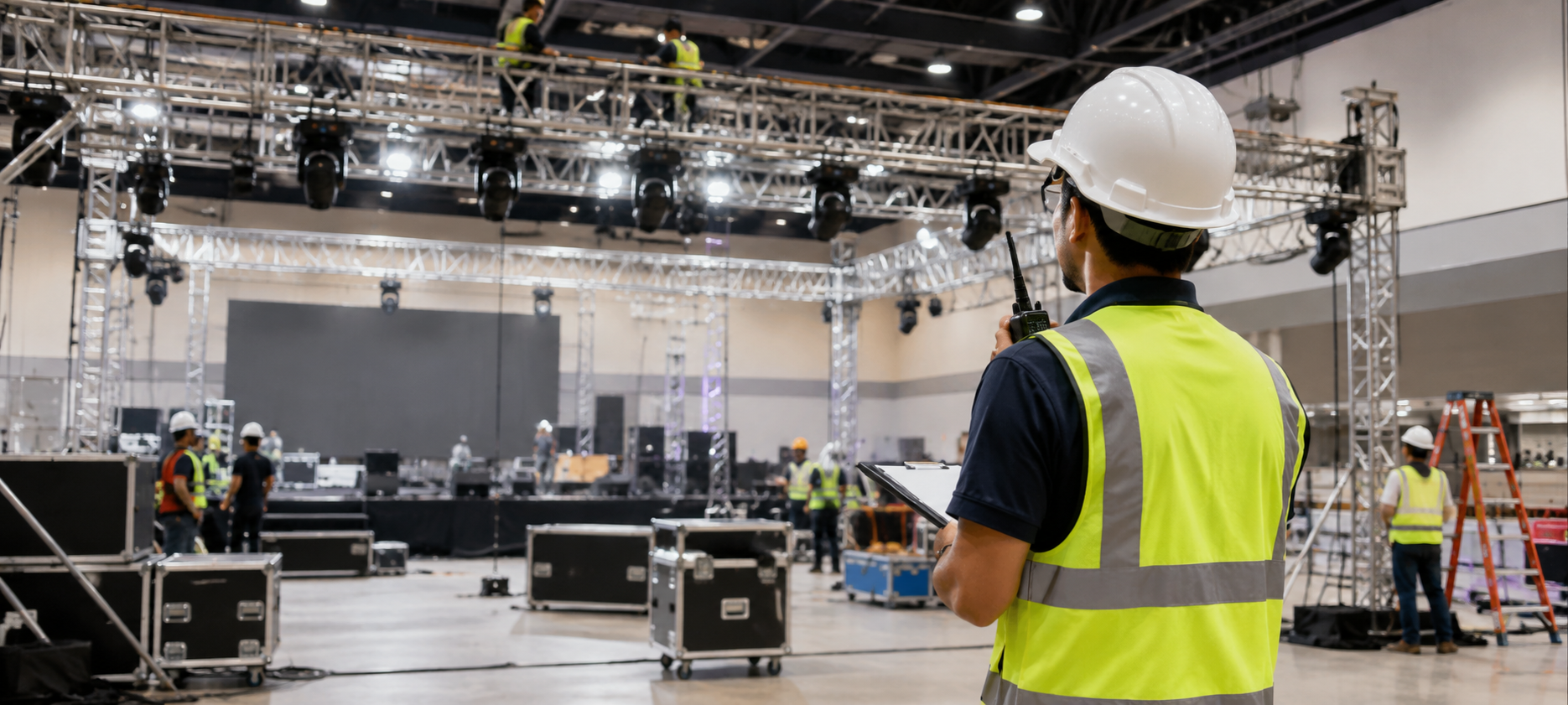
No other industry compresses that much change into that little time. During build-up the hall contains forklifts, scissor lifts, overhead rigging, power distribution being installed live, carpenters, welders and several hundred contractors from companies that have never worked together and will not work together again. Ten days later the same space holds a crowd whose safety depends entirely on decisions made during that build.
And the injuries do not happen during the show. They happen during build-up and breakdown, when the pressure is highest, the supervision is thinnest, and the people on site are the least likely to have been inducted by anyone.
Nathan Safety Training Services (NIMS) delivers event safety training UAE programmes for exhibition organisers and venue operators, stand builders and fit-out contractors, production and staging companies, rigging and AV specialists, temporary structure and marquee providers, event security and crowd management teams, and the agencies that deliver festivals, concerts, conferences and sporting events.
We deliver across Dubai World Trade Centre, Expo City Dubai, Dubai Exhibition Centre, Coca-Cola Arena and Dubai Festival City, ADNEC and Etihad Arena on Yas Island, the Abu Dhabi Corniche event grounds, Expo Centre Sharjah, and outdoor event sites across Ras Al Khaimah and Fujairah.
Book Event Safety Training → · Request a Build-Up Phase Safety Review → · Request HSE Manpower →
The Three-Phase Clock — Build-Up, Show Open, Breakdown
Event safety runs on a clock rather than a calendar, and each phase has a completely different risk profile, workforce and control regime. Training bought as a single package for the whole event misses this entirely.
Phase 1 — Build-Up: A Construction Site With a Fixed Deadline
This is where most event injuries occur. The hall is full of vehicles and pedestrians sharing the same floor with no segregation, work happening at height above people working below, temporary power being installed and energised progressively, and a deadline that cannot move because the doors open at a published time.
The workforce is the complicating factor. Stand builders arrive from dozens of separate companies, frequently including overseas contractors working in the UAE for a single event, with varying training backgrounds and no shared safety culture. Many will be on site for three days and will never return.
Training that matters in build-up
Site Safety Induction delivered at the door rather than in advance, Working at Height & Fall Protection, MEWP Operator Training, Forklift Operator Training, Rigging & Slinging, Traffic Safety and Flagman Safety, Hand & Power Tools Safety, Electrical Safety, Hot Work Safety where welding or cutting occurs, Manual Handling.
Phase 2 — Show Open: The Public Arrives
The hazard set inverts. Construction risk largely disappears and is replaced by a crowd of untrained members of the public occupying a space they do not know, with exits they have not located, in a building whose layout was completed forty-eight hours earlier.
Show-open risk is concentrated in crowd movement, emergency evacuation, medical response, and the ongoing operational hazards that remain live — catering, temporary electrics, moving exhibits, demonstrations and forklift movement in service corridors.
Training that matters during show open
Crowd Safety and Crowd Management, Fire Safety and Fire Warden duties, Evacuation Management, First Aid with CPR and AED, Incident Reporting, Emergency Response Team capability, Heat Stress Awareness for outdoor events.
Phase 3 — Breakdown: The Most Dangerous Hours of the Event
Breakdown is build-up with three additional problems: everyone is tired, everyone wants to leave, and the structures being dismantled were not designed to be taken apart in the order people will take them apart.
Dismantling sequence is a genuine engineering issue. A stand or structure erected in a planned order becomes unstable if removed in a different one, and the crew removing it is frequently not the crew that built it. Add forklifts moving in a hall that still contains members of the public in some cases, and the fatigue of a team that has worked the full event, and breakdown consistently produces the most serious incidents of the whole cycle.
Training that matters in breakdown
The full build-up set, plus specific content on dismantling sequence, structural stability during removal, fatigue awareness, and traffic management as vehicle density peaks.
Temporary Structures & Rigging — The Load Path Nobody Signed For
Permanent buildings have drawings, calculations, an engineer of record and a sign-off. Temporary structures at events frequently have none of those, and the load they carry is decided on site by people improvising against a deadline.
Where temporary structures fail
- Overhead rigging point loading. Trusses, lighting bars, speaker arrays, banners and screens hung from venue rigging points or ground-support towers. The failure mode is cumulative — each addition seems small, and nobody is tracking the total against the point capacity.
- Ground support and goalpost systems. Used where venue rigging points are unavailable or insufficient. Stability depends on correct ballast, bracing and base condition, and all three are routinely compromised for space or appearance.
- Stage and platform structures. Decking, ramps, barriers and access. Edge protection, loading limits and crowd surge loading on barriers.
- Marquees, tents and shade structures. Wind loading is the governing case, and the UAE produces enough sudden wind events to make anchoring and a documented wind management plan essential rather than precautionary.
- Double-decker and complex stands. Frequently the largest structures on an exhibition floor, requiring engineering approval and load-limited occupancy that is rarely enforced during the show.
- LED walls and hanging screens. Heavy, wind-affected outdoors, and often added late in the build after the rigging plan was finalised.
What the training addresses
Rigging and slinging training for event applications covers load calculation and point loading, sling angles and their effect on tension, equipment inspection and rejection, hanging over occupied areas, bridle arrangements, and the discipline of recording what has actually been hung rather than what was planned. Working at height covers access to rigging positions, harness use on truss and tower, and rescue planning.
The wind management element deserves separate mention for outdoor events. A structure that is stable in still air may not be at forty knots, and the decision to strike, lower or evacuate has to be made against a documented trigger rather than a judgement call made by whoever is standing there.
Talk to an HSE Advisor → · Request Rigging & Temporary Structures Training →
Crowd Safety & Crowd Management Training for Events
Crowd incidents are rarely caused by panic. They are caused by density, geometry and information — too many people, in a space that funnels or pinches, who do not know what is happening or where to go.
The factors that actually matter
Factor | Why It Causes Problems | What Training Addresses |
Density | Above a threshold, individuals lose the ability to control their own movement | Density recognition, counting, flow rate monitoring |
Pinch points | Doorways, corridors, escalators and turnstiles concentrate flow | Layout review, staffing of pinch points, dynamic control |
Counterflow | People moving against the main direction create turbulence | One-way routing, signage, stewarding position |
Information vacuum | Crowds fill uncertainty with movement toward or away from rumour | Public address discipline, staff briefing, consistent messaging |
Arrival and egress surges | Doors opening, headline act finishing, session breaks | Surge planning, staggered release, holding areas |
Mixed mobility | Wheelchair users, children, elderly attendees within a moving crowd | Assisted evacuation planning, refuge provision |
Heat and queueing outdoors | Collapse in queues is a common UAE event medical presentation | Shade and water provision, queue monitoring, medical positioning |
Alcohol and fatigue | Reduced compliance and slower response to instruction | Stewarding technique, escalation to licensed security |
Training covers crowd dynamics and density, capacity calculation and monitoring, ingress and egress planning, stewarding positioning and technique, communication and public address, incident escalation, and evacuation of an unfamiliar crowd. It sits alongside — not instead of — the licensed security function, which in Dubai runs through SIRA and in Abu Dhabi through the Private Security Business Department.
Event & Exhibition HSE Training Courses We Deliver
- Site Safety Induction for Events — short, delivered at the door, designed for a transient multinational contractor workforce that may be on site for seventy-two hours.
- Working at Height & Fall Protection — rigging positions, truss access, stand structures, ladder and tower discipline, rescue planning.
- MEWP Operator Training — scissor and boom lifts, the default access method on an exhibition floor, with crush-against-structure as the main injury mechanism.
- Forklift Operator Training — hall floor operation with pedestrians present, long and awkward loads, restricted visibility.
- Rigging & Slinging Training — overhead rigging, point loading, ground support, hanging over occupied areas.
- Traffic Safety and Flagman Safety — loading bay and hall floor vehicle movement, marshalling during build and breakdown.
- Electrical Safety Training — temporary distribution, generators, cable management, progressive energisation during build.
- Fire Safety and Fire Warden Training — fire loading from stand materials and packaging, extinguisher provision, evacuation of a public crowd.
- First Aid, CPR & AED — crowd medical response, heat illness, cardiac events, and coordination with event medical provision.
- Crowd Safety and Crowd Management — as described above.
- Hot Work Safety — where welding, cutting or grinding occurs during stand construction, under permit.
- Hand & Power Tools Safety and Manual Handling — the two courses that address the highest-frequency injuries during build and breakdown.
- Hazard Identification & Risk Assessment — for organisers and contractors preparing event safety documentation.
- Accident & Incident Investigation — for organisers and venue teams, including incidents involving members of the public.
DWTC, Expo City, ADNEC, Civil Defence & DET Requirements for Event Organisers
- Venue operator requirements — Dubai World Trade Centre, Expo City Dubai, ADNEC, Etihad Arena, Coca-Cola Arena and Expo Centre Sharjah each publish their own technical and health and safety regulations covering stand construction, rigging, electrical work, materials, working at height and contractor conduct. In practice these are the binding documents for most exhibitors and stand builders.
- Civil Defence — fire and life safety approval for event layouts, temporary structures, fire loading of stand materials, means of escape, occupancy limits, extinguisher provision and evacuation arrangements.
- Dubai Department of Economy and Tourism — event permits and licensing for public events within the emirate, including the safety and crowd arrangements assessed as part of the permit.
- Abu Dhabi Department of Culture and Tourism — equivalent event permitting and approvals within the emirate.
- Dubai Municipality and Abu Dhabi Municipality — temporary structure approvals, food safety for event catering outlets, and public health requirements.
- SIRA in Dubai and the Private Security Business Department in Abu Dhabi — licensing of security personnel deployed at events, which is a separate requirement from crowd safety training.
- RTA and roads authorities — traffic management, road closures, parking and transport plans for events affecting the public highway.
- MOHRE — federal occupational safety obligations, including the midday break rule affecting outdoor build-up, breakdown and event operation through the summer.
Training can be structured to support alignment with venue regulations and authority requirements. Certificates evidence completion and assessment of a defined programme rather than venue accreditation or security licensing.
Event Safety Training by Role
- Event organisers and operations managers — risk assessment, crowd safety and management, emergency and evacuation planning, incident investigation, contractor control.
- Venue operations teams — crowd management, fire warden duties, evacuation, first aid, traffic safety, incident reporting.
- Stand builders and fit-out crews — site induction, working at height, MEWP, hand and power tools, manual handling, electrical safety, hot work where applicable.
- Riggers and production crew — rigging and slinging, working at height, rescue planning, electrical safety, load management.
- AV, lighting and staging teams — working at height, rigging, electrical safety, manual handling, MEWP.
- Stewards and crowd staff — crowd safety, fire warden and evacuation duties, first aid, incident escalation, communication discipline.
- Event security personnel — crowd management alongside their licensed security training, first aid, evacuation leadership.
- Catering and hospitality staff at events — food hygiene, fire safety, manual handling, evacuation awareness.
- Forklift and plant operators — forklift and MEWP operation, traffic safety, pedestrian interaction during build and breakdown.
Request a Role-Based Training Matrix → · Download Course Catalog →Contact
Event Safety Training Across Dubai, Abu Dhabi & the UAE
- Dubai — Dubai World Trade Centre, Expo City Dubai and the Dubai Exhibition Centre, Coca-Cola Arena, Dubai Festival City, Madinat Jumeirah, Dubai Marina and JBR event sites, Meydan, and outdoor festival grounds across the emirate.
- Abu Dhabi — ADNEC, Etihad Arena and the Yas Island event cluster including the marina and circuit, the Corniche event grounds, Saadiyat cultural venues and Al Ain event sites. HSE training Abu Dhabi for event contractors is delivered on site.
- Sharjah — Expo Centre Sharjah and municipal event venues.
- Ras Al Khaimah and Fujairah — outdoor festival, sporting and beach event sites, including the New Year events that draw very large crowds to constrained waterfront locations.
Delivery is timed to the event cycle. Induction and refresher training is commonly delivered on site in the days immediately before build-up begins, in short modules that a transient contractor workforce can actually complete. For organisers and venue teams we deliver in the quieter periods between event seasons.
HSE Manpower Supply for Events & Exhibitions
The event manpower curve is the sharpest of any sector we supply. A venue may need twenty HSE personnel for a ten-day build and show cycle, and two the week afterwards.
Nathan Safety Training Services supplies HSE Officers, HSE Engineers, Safety Supervisors, Safety Inspectors, Fire Watchers, First Aiders and Crowd Safety Stewards on event, seasonal and long-term assignment. Personnel with prior exhibition, live event and venue experience can be requested, and because event demand is measured in days rather than months, we mobilise for defined event windows rather than requiring minimum engagement periods.
Courses Offered
- First Aid Course - CPR and AED
- Confined Space
- Fire Safety Awareness
- Scaffolding Inspection
- Scaffolding Erection & Dismantling
- Flagman Safety
- Chemical Safety and Handling Training
- Hazard and Risk Assessment
- Rigging and Slinging Training
- Traffic Safety
- Hand and Power Tools Operator
- Electrical Safety
- Lock Out and Tag Out (LOTO)
- Accident Incident Investigation
- Lifeguard Training
- Advanced Risk Assessment & Compliance Service
- Behavior-Based Safety Workplace Safety Consulting
- Construction Site Safety Induction Training
- Emergency Response Team Training
- Excavator Operator Training
- Forklift Operator Training
- H2S Awareness & Breathing Apparatus Training
- Hot Work Safety Training
- Incident Reporting & Root Cause Analysis Service
- MEWP Operator Training
- Mobile Crane Operator Training
- Permit to Work System Training
- Rope Access Training
- Working at Height & Fall Protection Safety Training
- Oil & Gas Safety Training
- Fire Warden Training
- Manual Handling Training
- Banksman Safety Training
- Gas Tester Training
- Defensive Driving Training
- HAZMAT Awareness Training
- Machine Safety and Machine Guarding Training
- Spill Response and Spill Control Training
- Welding Safety Training
Need expert advice? Speak to our team today
FAQ
When do most event injuries actually happen?
During build-up and breakdown, not during the show. Build-up combines vehicles and pedestrians sharing an unsegregated floor, overhead work above people working below, progressive energisation of temporary power, and a deadline that cannot move. Breakdown adds fatigue, the desire to leave, and dismantling sequences that were never planned. The show itself, by comparison, is a comparatively controlled period — which is why training concentrated only on show operations misses where the risk sits.
Why is breakdown considered more dangerous than build-up?
Three reasons compound. The workforce has been on site for the full event and is tired. Everyone wants to finish and leave, which compresses the schedule further. And structures erected in a planned sequence are frequently dismantled in a different order by a crew that did not build them, which can make a stable structure unstable partway through removal. Vehicle density also peaks as everything leaves at once.
What makes temporary structures riskier than permanent ones?What makes temporary structures riskier than permanent ones?
Permanent buildings have drawings, calculations, an engineer of record and a sign-off. Temporary structures frequently have none of those, and the load they end up carrying is decided on site by people improvising against a deadline. Overhead rigging is the clearest example — each additional item hung from a point seems small, nobody tracks the cumulative total against the point capacity, and the failure is sudden.
How should wind be managed for outdoor events?
Against documented trigger points rather than judgement in the moment. A marquee, shade structure, LED wall or banner that is stable in still air may not be at higher wind speeds, and the UAE produces enough sudden wind events to make this a live concern rather than a precaution. The plan should define wind speeds at which specific actions occur — stop rigging, lower screens, strike structures, evacuate — with a named person authorised to call it and a means of measuring wind on site.
What actually causes crowd incidents?
Density, geometry and information rather than panic. When density exceeds a threshold, individuals lose the ability to control their own movement and the crowd behaves as a fluid. Pinch points at doorways, corridors and escalators concentrate that density. Counterflow creates turbulence. And crowds fill an information vacuum with movement, which is why public address discipline and consistent staff messaging are safety controls rather than customer service ones.
Is crowd safety training the same as security training?
No, and both are needed. Security personnel in Dubai are licensed through SIRA and in Abu Dhabi through the Private Security Business Department, covering their security function. Crowd safety training addresses a different competency — crowd dynamics and density, capacity monitoring, ingress and egress planning, stewarding position, communication and evacuation of an unfamiliar public crowd. Stewards who are not licensed security personnel still need crowd safety competency, and licensed security staff benefit from it alongside their licensing.
How do you train a contractor workforce that is only on site for three days?
By making the induction short, practical and delivered at the door rather than in advance. Exhibition build-up brings contractors from dozens of separate companies, frequently including overseas crews working in the UAE for a single event, with varying training backgrounds and no shared safety culture. A twenty-minute induction that is actually delivered to everyone beats a comprehensive programme that half the workforce never attends.
Do venue regulations matter more than the general legal requirements?
In practice, usually yes. Dubai World Trade Centre, Expo City, ADNEC, Etihad Arena, Coca-Cola Arena and Expo Centre Sharjah each publish technical and health and safety regulations covering stand construction, rigging, electrical work, materials and contractor conduct. These are enforced directly through venue access and stand approval, which makes them the operative document for most exhibitors and stand builders — alongside Civil Defence approval and the relevant event permit.
What training do riggers at events need?
Rigging and slinging with event-specific content — load calculation and point loading, sling angles and tension, equipment inspection and rejection criteria, bridle arrangements, hanging over occupied areas, and the discipline of recording what has actually been hung rather than what the plan showed. Alongside that, working at height for truss and tower access, including rescue planning, since a rigger suspended in a harness at height faces the same clock as any other suspended casualty.
How is heat managed at outdoor events in the UAE?
It affects three groups differently. Build and breakdown crews are covered by MOHRE midday break requirements and need hydration, shade and work-rest planning. Event staff working outdoor positions need rotation and monitoring. And attendees queueing outdoors are a genuine medical risk — collapse in queues is one of the most common medical presentations at UAE outdoor events, which makes shade, water provision, queue monitoring and medical positioning at queue locations part of the safety plan rather than the hospitality plan.
Can training be delivered around an event schedule?
Yes, and it has to be. Induction and refresher content is commonly delivered on site in the days immediately before build-up, in short modules a transient workforce can complete without losing build time. For organisers and permanent venue teams we deliver in the quieter periods between event seasons, when the operations team is actually available.
What certificates do participants receive?
A certificate of completion for each course showing participant name, course title, delivery date and validity guidance where applicable. These support venue contractor approval, exhibitor and stand builder registration, event permit documentation, organiser due diligence files and insurer requirements. Specific formats can usually be accommodated with advance notice.
How long do the courses take?
Event site induction runs from twenty minutes to half a day depending on depth. Working at height, MEWP, forklift and rigging typically run one to two days with practical assessment. Crowd safety and crowd management run one to two days. Fire warden and first aid run half a day to two days depending on level. Manual handling and hand and power tools run half a day each.
How often should event safety training be refreshed?
Practical competencies such as working at height, MEWP, forklift and rigging are commonly refreshed every one to two years. Crowd safety is usefully refreshed annually, ideally before the main event season. Site induction is repeated for every event rather than annually, since the venue, layout and hazards change each time — an induction from the last exhibition does not describe this one.
Do you supply HSE manpower for individual events?
Yes, and this sector is where short-window supply matters most. Through hsemanpower.ae, Nathan Safety Training Services supplies HSE Officers, HSE Engineers, Safety Supervisors, Safety Inspectors, Fire Watchers, First Aiders and Crowd Safety Stewards for build-up, show and breakdown. Because event demand is measured in days, we mobilise for defined event windows rather than requiring minimum engagement periods.
Book Event Safety Training with Nathan Safety Training
Nathan Safety Training Services works with organisers, venue operators, stand builders, production companies and event agencies across the Emirates. If you are preparing for an exhibition season, mobilising a build crew, or reviewing why the incident log fills up during breakdown rather than during the show, the three-phase clock is the right frame for the conversation.