
Home / Marine & Shipyard Safety Training
MArine & Shipyard Safety Training UAE
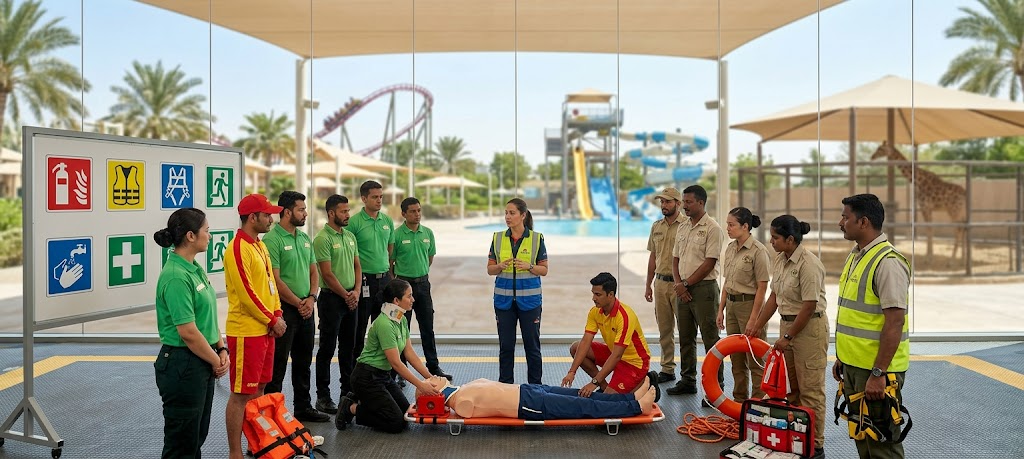
Theme Park, Waterpark & Zoo Safety Training UAE
In almost every industry, the people inside the hazard zone are employees. They have been inducted, trained, assessed and issued PPE, and they can be instructed.
An attraction operator has none of that. The people closest to the moving machinery, the deep water and the animals are members of the public who arrived an hour ago, received no training, are frequently on holiday and in an unfamiliar country, may not read the language of the signage, include small children and elderly visitors, and are actively looking for excitement rather than avoiding risk.
The guest cannot be trained. So everything has to be absorbed by the operator — by ride and attraction design, by operating procedure, and above all by the competence of frontline staff who are typically young, seasonal and only months into the role. That is the defining safety problem of the attractions sector, and it is why training in this industry is weighted toward frontline operators rather than toward engineers.
Nathan Safety Training Services (NIMS) delivers theme park safety training UAE programmes for theme and amusement parks, waterparks and aquatic attractions, zoos, aquariums and wildlife attractions, indoor entertainment and family entertainment centres, adventure and edutainment venues, and the operators, maintenance teams and concessionaires who run them.
We deliver across Dubai Parks and Resorts at Jebel Ali, IMG Worlds and Global Village, Atlantis and Palm Jumeirah attractions, Dubai Marina and City Walk venues, Yas Island in Abu Dhabi, Saadiyat and the Corniche, Al Ain, Sharjah, Ras Al Khaimah and Fujairah.
The Guest as an Uncontrolled Variable
Every control in an attraction has to work on people who will not follow instructions reliably. Designing and training on any other assumption produces procedures that fail on a busy Saturday.
- Guests will not read signage. Height restrictions, health warnings, swimming ability requirements and behavioural rules are posted and largely ignored. Enforcement has to be physical and staffed — a measuring stick at the queue, a gate, a staff member — rather than informational.
- Guests will conceal disqualifying conditions. Height, pregnancy, heart conditions, back and neck problems and non-swimming ability are all under-declared, because the guest wants the experience and has queued for it.
- Guests will misjudge their own capability. Particularly in water. Adults consistently overestimate swimming ability, and parents consistently overestimate their capacity to supervise multiple children in a busy pool.
- Guests will behave differently in groups. Peer pressure, showing off and horseplay increase in groups of teenagers and in family groups, and increase again when the queue has been long.
- Guests do not know the emergency procedure. In an evacuation they will move toward the entrance they arrived through, not the nearest exit, and they will attempt to retrieve belongings and locate family members first.
- Language is not a reliable channel. UAE attractions serve a highly international visitor base. Instructions that depend on spoken English will not reach everyone, which makes demonstration, physical restraint checks and visual signals the operative controls.
Frontline operator training is therefore built around observation, physical verification and intervention rather than around instruction. The operator does not tell the guest what to do and assume compliance; the operator checks.
Ride Operations & Attraction Engineering
Ride safety divides cleanly into two populations with almost nothing in common: the engineers who maintain the machine, and the operators who run it in front of guests. Both fail in different ways.
The operator side
Ride operators are typically the youngest and least experienced staff in the park, performing a highly repetitive dispatch cycle several hundred times a day. The failure mode is not ignorance but automaticity — the restraint check that becomes a glance, the dispatch that happens before the cycle is complete, the height check that gets waved through because the queue is long and the child is nearly tall enough.
Training addresses restraint verification as a physical action performed every time regardless of familiarity, height and health restriction enforcement, dispatch discipline and the authority to hold, guest loading and unloading including guests with disabilities, ride stoppage and evacuation procedure, and the specific competency of recognising when a guest is in distress mid-cycle.
The engineering side
Maintenance teams face a conventional industrial hazard set inside an entertainment venue: lock out tag out on hydraulic, pneumatic, electrical and gravitational energy, working at height on structures and lift hills, confined space entry into machinery pits, tunnels and show scenes, electrical safety on drive and control systems, and rigging and slinging for component replacement.
The distinctive risk is the overnight maintenance window. Work happens at night on machinery that must be back in service by opening, which produces the same time compression seen on the sanitation shift in food manufacturing — with the added complication that a ride released to service without a completed check carries the consequence into the guest population.
Waterpark Operations & Lifeguard Training
Drowning is silent, fast and almost never looks like the popular image of it. A person in difficulty in water rarely shouts or waves, because the respiratory system is occupied with breathing. They remain upright, make no forward progress, and go under within a short period. In a busy wave pool it can happen a few metres from a hundred people who notice nothing.
That is why waterpark lifeguarding is a scanning discipline rather than a rescue discipline. The rescue is the easy part; seeing it is the hard part.
What attraction lifeguarding demands
- Zone scanning with defined coverage and time targets. Each guard has a defined zone, a defined scanning pattern, and a target time within which the whole zone is covered. Overlapping zones so no water is unwatched by anyone.
- Rotation to counter vigilance decay. Sustained scanning degrades measurably after a relatively short period. Rotation schedules exist to counter this and are a safety control rather than a break entitlement.
- Recognition of the passive and active drowning presentations, and of the distressed swimmer who can still be reached before either develops.
- Bather load management. Wave pools, activity pools and lazy rivers have capacity limits that exist for surveillance reasons, not comfort.
- Slide dispatch control. Interval discipline between riders, weight and height restrictions, rider position enforcement, and communication between top and bottom of the slide — collisions in flumes are a leading waterpark injury.
- Zero-depth and children’s areas. Very shallow water where small children drown, and where parental supervision is assumed by everyone and provided by nobody.
- Spinal injury management in water. Shallow water diving and slide impact injuries require in-water immobilisation and extraction technique.
- Rapid response and resuscitation including oxygen and AED use, and a plan for extracting a casualty from a wave pool or lazy river with a crowd present.
Alongside surveillance, waterparks run a significant chemical operation — chlorine or hypochlorite, acid for pH correction, and the mixing scenario that generates chlorine gas. Plant room work involves confined space entry, and dosing systems require the same discipline as any industrial chemical installation.
Zoo, Aquarium & Animal Attraction Safety Training
Animal attractions add two hazard classes that exist nowhere else in the leisure sector, and both are frequently managed informally by staff whose primary expertise is animal welfare rather than occupational safety.
Animal handling and containment
The controlling principle in modern animal collections is barrier management rather than animal behaviour prediction. Dangerous animals are handled through protected contact and separation protocols, not through familiarity, and the incidents that occur are almost always containment or procedural failures rather than unprovoked animal behaviour.
- Enclosure entry protocols — lock and key control, double-gate systems, physical verification that the animal is secured in a separate space, and a second-person check before entry. This is functionally a lock out tag out discipline applied to a living hazard.
- Categorisation of species by risk and the corresponding contact protocol — free contact, protected contact or no contact.
- Escape and containment breach response, including recall procedures, guest evacuation or shelter, and the chain of authority for a lethal response decision.
- Capture, restraint and veterinary procedure support, including chemical immobilisation, where the risk extends to the drugs themselves — potent immobilising agents are hazardous to humans in very small quantities and require specific handling and antidote arrangements.
- Guest-animal contact areas — petting zoos, walkthrough aviaries, touch pools and feeding experiences, where the public is deliberately placed in proximity to animals.
- Aquarium-specific work — dive operations in exhibits, life support system plant, confined space entry into filtration and tank spaces, and electrical work around water.
Zoonoses and biological exposure
Diseases transmissible from animals to humans are an occupational health hazard for keepers, veterinary staff, cleaners and guests in contact areas. The routes are contact, aerosol, ingestion, bites and scratches, and vector-borne transmission.
Training covers transmission routes and the specific risks associated with different taxa, hand hygiene as the primary control, PPE selection including respiratory protection for high-risk enclosures, bite and scratch response and reporting, food preparation area segregation, waste and bedding handling, and the health surveillance and vaccination arrangements that should sit alongside training. Guest contact areas require the additional control of accessible, enforced hand washing at exit points — a genuine public health measure rather than a courtesy.
Attraction HSE Training Courses We Deliver
- Lifeguard Training — attraction lifeguarding with zone scanning, rotation, bather load, slide dispatch, spinal management and in-water rescue.
- First Aid, CPR & AED — the core guest safety competency across all three attraction types, including paediatric response, drowning, heat illness, cardiac events and anaphylaxis.
- Emergency Response Team (ERT) Training — ride evacuation, water rescue support, animal containment breach, fire and mass casualty scenarios.
- Fire Safety and Fire Warden Training — evacuation of a large guest population from an unfamiliar site, including guests at height on stalled rides and guests in water.
- Crowd Safety Awareness — queue management, capacity, peak-period flow and evacuation of a public crowd.
- Chemical Safety & Handling — pool and water treatment chemicals, cleaning products, and the acid-hypochlorite mixing hazard.
- Confined Space Entry — plant rooms, filtration spaces, ride pits, tunnels, show scenes and tank spaces.
- Lock Out Tag Out — ride and attraction machinery with multiple energy sources, applied under overnight time pressure.
- Working at Height & Fall Protection — ride structures, lift hills, theming, aviaries and building maintenance.
- Rope Access — where ride structures and theming cannot be reached by conventional access.
- Electrical Safety Training — ride control and drive systems, show electrics, and electrical work in wet environments.
- Rigging & Slinging — component replacement, theming installation and show equipment.
- Food Hygiene and HACCP Awareness — for the substantial F&B operation most attractions run.
- Manual Handling — across operations, retail, F&B and housekeeping.
- Hazard Identification & Risk Assessment and Incident Investigation — for supervisors and managers, including investigation of guest incidents.
DET, Municipality, Civil Defence & MOCCAE Requirements for Attractions
- Dubai Department of Economy and Tourism and Abu Dhabi DCT — licensing and operating requirements for tourist attractions, including safety arrangements assessed as part of the permit and classification process.
- Dubai Municipality and Abu Dhabi Municipality — swimming pool and aquatic facility requirements including water quality, lifeguard provision, safety equipment and signage; food safety for attraction F&B outlets; and public health requirements for guest contact areas.
- Civil Defence — fire and life safety requirements under the UAE Fire and Life Safety Code, covering means of escape, occupancy, detection and suppression, and evacuation planning for large guest populations.
- MOCCAE — wildlife and animal collection regulation, permitting for the keeping of animals, CITES-listed species controls, animal welfare requirements and environmental permitting.
- MOHAP, DHA and Department of Health Abu Dhabi — requirements relevant to on-site medical provision, first aid facilities and communicable disease reporting, including zoonotic disease notification.
- Ride certification and third-party inspection — amusement device inspection and certification is generally imposed through municipality requirements, insurer conditions and manufacturer maintenance schedules rather than through a single federal instrument.
- SIRA and the Private Security Business Department — licensing for security personnel deployed at attractions.
- MOHRE and OSHAD-SF — federal occupational safety obligations and, within Abu Dhabi, the OSHAD framework, including heat provisions affecting outdoor attraction operation.
Training can be structured to support alignment with these frameworks. Certificates evidence completion and assessment of a defined programme rather than authority licensing, ride certification or veterinary authorisation.
Attraction Safety Training by Role
- Ride and attraction operators — restraint verification, dispatch discipline, height and health restriction enforcement, ride evacuation, guest distress recognition, first aid, fire and evacuation.
- Lifeguards and aquatic staff — lifeguard training, zone scanning and rotation, spinal management, resuscitation with oxygen and AED, slide dispatch, bather load control.
- Animal keepers and veterinary staff — enclosure entry protocol, containment breach response, capture and restraint support, zoonoses and biological exposure, chemical immobilisation handling, first aid.
- Attraction maintenance and engineering — LOTO, working at height, confined space, electrical safety, rigging, hot work, permit to work.
- Water treatment and plant operators — chemical safety, confined space, LOTO, gas release response, emergency response.
- Guest services, admissions and queue staff — crowd safety, height and restriction enforcement, first aid, fire warden and evacuation duties, incident reporting.
- F&B and retail staff — food hygiene, HACCP awareness, allergen awareness, fire safety, manual handling, chemical safety.
- Housekeeping and grounds teams — chemical safety, manual handling, sharps awareness, traffic safety, heat stress.
- Security and crowd staff — crowd safety, evacuation leadership, first aid, incident escalation alongside their licensed security training.
- Duty managers and supervisors — risk assessment, incident investigation including guest incidents, emergency response command, contractor control.
Attraction Safety Training Across Dubai, Abu Dhabi & the UAE
- Dubai — Dubai Parks and Resorts at Jebel Ali, IMG Worlds, Global Village, Atlantis and Palm Jumeirah attractions, Aquaventure and Wild Wadi, Dubai Marina and City Walk venues, Dubai Mall attractions and Deep Dive Dubai. Safety training Jebel Ali is a regular delivery route for our trainers.
- Abu Dhabi — the Yas Island attraction cluster including Ferrari World, Yas Waterworld, Warner Bros World and SeaWorld Abu Dhabi, Saadiyat cultural attractions, and Corniche and city venues. HSE training Abu Dhabi for attraction operators is delivered on site.
- Al Ain — zoo, wildlife and leisure attractions, and mountain and desert attraction sites.
- Sharjah — aquarium, wildlife and family entertainment venues, and Al Montazah attractions.
- Ras Al Khaimah — Jebel Jais adventure attractions, Al Hamra and Al Marjan leisure venues.
- Fujairah — east coast marine, dive and beach attractions.
Delivery is scheduled around operating hours and season. For seasonal operations the practical pattern is intensive pre-season training for the incoming cohort, refreshers through the season, and specialist maintenance training during closure or low-season periods. Lifeguard and ride operator practical assessment is delivered at the attraction itself, on the actual pool or ride.
HSE Manpower Supply for Theme Parks, Waterparks & Attractions
Attractions run on a seasonal and peak-day curve, and safety-critical roles such as lifeguards frequently need to scale for school holidays, national holidays and the winter season.
Nathan Safety Training Services supplies HSE Officers, Safety Supervisors, Fire Safety Officers, Lifeguards, First Aiders and Environmental Officers on seasonal, project and long-term assignment. Personnel with prior attraction, aquatic and leisure operations experience can be requested.
Courses Offered
- First Aid Course - CPR and AED
- Confined Space
- Fire Safety Awareness
- Scaffolding Inspection
- Scaffolding Erection & Dismantling
- Flagman Safety
- Chemical Safety and Handling Training
- Hazard and Risk Assessment
- Rigging and Slinging Training
- Traffic Safety
- Hand and Power Tools Operator
- Electrical Safety
- Lock Out and Tag Out (LOTO)
- Accident Incident Investigation
- Lifeguard Training
- Advanced Risk Assessment & Compliance Service
- Behavior-Based Safety Workplace Safety Consulting
- Construction Site Safety Induction Training
- Emergency Response Team Training
- Excavator Operator Training
- Forklift Operator Training
- H2S Awareness & Breathing Apparatus Training
- Hot Work Safety Training
- Incident Reporting & Root Cause Analysis Service
- MEWP Operator Training
- Mobile Crane Operator Training
- Permit to Work System Training
- Rope Access Training
- Working at Height & Fall Protection Safety Training
- Oil & Gas Safety Training
- Fire Warden Training
- Manual Handling Training
- Banksman Safety Training
- Gas Tester Training
- Defensive Driving Training
- HAZMAT Awareness Training
- Machine Safety and Machine Guarding Training
- Spill Response and Spill Control Training
- Welding Safety Training
Need expert advice? Speak to our team today
FAQ
Why are theme parks, waterparks and zoos treated as one training sector?
Because they share the defining risk of the attractions industry: untrained members of the public occupying the hazard zone, with frontline staff who are typically young and seasonal absorbing the entire control burden. The specific hazards differ — ride machinery, deep water, animals — but the operator competency model, the guest emergency response requirement, the crowd and evacuation problem and the back-of-house profile are close to identical. Training designed for one transfers substantially to the others.
What does the phrase "the guest cannot be trained" mean in practice?
That every control has to work on people who will not follow instructions reliably. Guests do not read signage, under-declare disqualifying health conditions, overestimate their swimming ability, behave differently in groups, and in an evacuation move toward the entrance they arrived through rather than the nearest exit. Frontline training is therefore built around observation, physical verification and intervention rather than instruction — the operator checks rather than tells and assumes.
Why is drowning described as silent?
Because a person in genuine difficulty in water cannot shout or wave. The respiratory system is fully occupied trying to breathe, so there is no breath available for calling out, and the arms are instinctively pressing down on the water surface rather than waving. The person remains upright, makes no forward progress and submerges within a short period. It can happen a few metres from a crowded pool deck without anyone noticing, which is why lifeguarding is fundamentally a scanning discipline rather than a rescue one.
What makes waterpark lifeguarding different from pool lifeguarding?
Bather load, water movement and attraction-specific hazards. Wave pools generate turbulence that conceals a casualty and moves them unpredictably. Lazy rivers carry casualties away from the point of incident. Slide dispatch requires interval control, position enforcement and top-to-bottom communication, since in-flume collisions are a leading injury. Zero-depth areas concentrate very small children in shallow water. And bather density in attraction pools is far higher than in lap pools, which changes the scanning problem entirely.
Why does lifeguard rotation matter so much?
Because sustained visual scanning degrades measurably after a relatively short period. A guard who has been watching the same zone continuously is objectively less likely to detect a developing incident than one who has just rotated in, regardless of motivation or professionalism. Rotation schedules are therefore a surveillance control, not a break entitlement, and they should be enforced as rigorously as any other safety procedure.
What is the main failure mode for ride operators?
Automaticity rather than ignorance. A ride operator performs the same dispatch cycle several hundred times a day, and the restraint check that was a deliberate physical action in week one becomes a glance by month three. The same applies to height checks waved through when the queue is long, and to dispatch initiated before the cycle is complete. Training and supervision have to counter repetition specifically — restraint verification is trained as a physical action performed every time regardless of familiarity.
How is enclosure entry managed in a zoo?
As a lock out tag out discipline applied to a living hazard. The controlling principle is barrier management and separation rather than prediction of animal behaviour. Protocols typically involve lock and key control, double-gate systems, physical verification that the animal is secured in a separate space, and a second-person check before entry. Incidents in modern collections are almost always containment or procedural failures rather than unprovoked animal behaviour, which is why the procedure carries the safety rather than the keeper’s familiarity with the animal.
What are zoonoses and who is at risk?
Diseases transmissible from animals to humans, through contact, aerosol, ingestion, bites and scratches, and vectors. The exposed population is wider than most collections assume — keepers and veterinary staff obviously, but also cleaners, maintenance staff working in animal areas, food preparation staff handling animal diets, and guests in contact areas such as petting zoos and touch pools. Hand hygiene is the primary control, supported by PPE selection, bite and scratch reporting, waste and bedding handling, and enforced hand washing at the exit of any guest contact area.
Do chemical immobilisation drugs present a risk to staff?
Yes, and it is a significant one. Potent immobilising agents used in veterinary procedures are hazardous to humans in very small quantities, including through skin contact or accidental needlestick. Handling, storage, administration support and antidote availability all require specific procedures, and anyone assisting with capture or veterinary work should understand the risk and the emergency response before they are in the enclosure. This is frequently managed informally by teams whose expertise is animal welfare rather than occupational safety.
What water treatment training does a waterpark need?
The same discipline an industrial chemical operation requires. Waterparks hold substantial inventories of chlorine or hypochlorite and acid for pH correction, with dosing systems, plant rooms that are frequently confined spaces, and the ever-present mixing scenario where acid and hypochlorite combine to release chlorine gas. Training covers chemical safety and handling, incompatibility, dosing system maintenance, spill and release response, confined space entry and emergency response.
How do you evacuate an attraction with guests stuck at height on a ride?
Through a rehearsed ride-specific evacuation procedure rather than a general site evacuation plan. Each ride has its own access route, restraint release method and evacuation sequence, and guests may need to be brought down from height, from water or from an enclosed show scene. It requires trained personnel, equipment stored at the attraction, and rehearsal — and it has to work while the guests are frightened, may not speak English, and are being watched by everyone in the queue.
Is attraction safety training mandatory in the UAE?
Several requirements apply together. Municipality requirements govern swimming pool and aquatic facility operation including lifeguard provision. Civil Defence requirements under the fire and life safety code govern evacuation and occupancy. DET and Abu Dhabi DCT licensing covers attraction operation including safety arrangements. MOCCAE regulates animal collections. Ride certification and inspection generally arrives through municipality requirements, insurer conditions and manufacturer schedules. Underneath all of it, MOHRE occupational safety duties and, in Abu Dhabi, OSHAD-SF apply to the workforce.
When is the best time to train seasonal attraction staff?
Intensively before the season opens, with refreshers through it. The practical pattern most attractions use is a pre-season block for the incoming cohort covering the safety-critical competencies, shorter refreshers at intervals during operation to counter automaticity and vigilance decay, and specialist maintenance and engineering training during closure or low-season periods when rides can be taken out of service. Lifeguard and ride operator practical assessment should happen at the attraction itself.
What certificates do participants receive?
A certificate of completion for each course showing participant name, course title, delivery date and validity guidance where applicable. These support municipality inspections including aquatic facility requirements, Civil Defence requirements, attraction licensing, insurer conditions, brand standard audits and internal competency files. Specific formats can usually be accommodated with advance notice.
Do you supply lifeguards and HSE staff for peak season?
Yes. Through hsemanpower.ae, Nathan Safety Training Services supplies HSE Officers, Safety Supervisors, Fire Safety Officers, Lifeguards, First Aiders and Environmental Officers. Attractions run on a seasonal and peak-day curve, and safety-critical roles such as lifeguards frequently need to scale for school holidays, national holidays and the winter season, so cover can be arranged for defined periods rather than as permanent headcount.
Book Attraction Safety Training with Nathan Safety Training
Nathan Safety Training Services works with theme parks, waterparks, zoos, aquariums and family entertainment operators across the Emirates. If you are preparing an incoming seasonal cohort, reviewing lifeguard surveillance arrangements, or checking whether your ride evacuation procedures have actually been rehearsed rather than written, the frontline operator is where the conversation should start.