


Home / First Aid Course
First Aid Course
The First Three Minutes: First Aid, CPR and AED Training for UAE Workplaces
A warehouse worker collapses in cardiac arrest. The statistic that decides whether he goes home to his family isn’t how close the nearest hospital is — it’s whether someone within reach knows how to start compressions and use the AED on the wall in the first three minutes. Ambulance response in UAE cities is fast by global standards, and it is still not fast enough to be the plan.
Nathan Safety Training (NIMS) trains workplace first aiders across the UAE to a standard that holds up under Ministry of Human Resources and Emiratisation (MOHRE) inspection, Dubai Municipality and ADOSH-SF (Abu Dhabi’s occupational safety framework, formerly known as OSHAD-SF) audit, and, more importantly, under the pressure of an actual emergency. Certification is only useful if the person wearing it can still perform under stress.
Why First Aid Provision Is a Legal Obligation, Not a Nice-to-Have
This is the first question we ask a new Dubai client, and it is worth asking yourself before you buy training from anyone. The answer changes what “compliant” actually means for your business.
Where You Are | Who Governs Safety | What That Means in Practice |
Mainland Dubai (most commercial and industrial plots) | Dubai Municipality and Dubai Civil Defence | General workplace safety rules, the UAE Fire and Life Safety Code, and municipality inspection |
JAFZA, Palm Jumeirah, Dubai World Central, Nakheel developments | Trakhees – EHS, under the Ports, Customs and Free Zone Corporation | Separate EHS registration, Operational Fitness Certificate renewal, and Trakhees-specific inspection — distinct from Dubai Municipality |
DMCC, DAFZA, Dubai South Free Zone, Dubai Silicon Oasis and similar specialist zones | The individual free zone authority | Each authority sets its own EHS conditions for tenants, layered on top of federal and Civil Defence requirements |
DIFC | DIFC’s own regulatory framework | A distinct legal and regulatory jurisdiction within Dubai with its own workplace requirements |
Everywhere in Dubai, regardless of jurisdiction | MOHRE, Civil Defence fire code, and DEWA where utilities are involved | Federal labour law and the fire and life safety code apply across every jurisdiction above |
The practical effect is that two businesses doing near-identical work — one in JAFZA, one two kilometres away on Dubai Municipality land — can face different registration, documentation and inspection requirements for the same activity. We build training and compliance support around whichever regime actually governs your site, rather than issuing the same generic certificate to every Dubai client.
Based in Jebel Ali — What That Means for Response Time
Our office sits at Ibn Battuta Gate on Sheikh Zayed Road, inside the Jebel Ali corridor that anchors Dubai’s industrial and logistics economy. For clients in JAFZA, Dubai Investments Park, Dubai Industrial City and the wider southern industrial belt, that means a trainer can be on site the same day a booking is confirmed, with practical equipment brought from an office that is a short drive away rather than a same-day flight or a multi-hour crossing of the city.
For clients in Downtown, Business Bay, Dubai Marina or the eastern side of the emirate, Dubai’s road network keeps every part of the city within a manageable delivery radius — something that is simply not true for the same trainer travelling to a site in Fujairah or the RAK interior.
Dubai’s Industrial & Commercial Geography
Federal Decree-Law No. 33 of 2021 on the Regulation of Labour Relations, together with Cabinet Resolution No. 33 of 2022 concerning Occupational Health and Safety, requires employers across the UAE to provide adequate first aid provision proportionate to workforce size and risk profile. In Abu Dhabi, this sits inside the ADOSH-SF (formerly branded OSHAD-SF) Codes of Practice administered through the Abu Dhabi Public Health Centre. In Dubai, Dubai Municipality’s Health and Safety Department sets the standard most contractors and facility operators are actually audited against, and higher-acuity resuscitation elements typically follow curricula recognised by the Dubai Corporation for Ambulance Services (DCAS).
None of these frameworks publish a single fixed number of first aiders for every business. What they consistently require is a documented risk assessment that determines the ratio, and named, currently-certified individuals who match it — not a certificate from three years ago in a drawer. We recommend running that risk assessment before staffing your first aid provision, not after an inspector asks for it.
Three Minutes, Not Three Weeks
Survival from sudden cardiac arrest falls sharply with every minute that passes without CPR and defibrillation — well before an ambulance can realistically arrive, even in a city with fast response times. That single fact is the entire argument for this training: it exists to compress the gap between ‘someone collapsed’ and ‘someone competent is already acting’ down to seconds, not minutes.
The business case sits alongside the human one. A workplace with a documented, current first aid programme recovers faster from an incident in every sense — medically, operationally, and in how a client or insurer reads the aftermath. A workplace without one is, in the worst case, explaining to a family, a labour authority and its own insurer simultaneously why nobody was ready.
Who Sends Their People to This Course
This is the most universally required course on our schedule, which is exactly why it needs to be genuinely well taught rather than a box-ticking afternoon. The sectors we see most often:
- Construction and industrial sites, where trauma risk (falls, crush injuries, lacerations) dominates the case mix
- Hotels, resorts and F&B operations, where choking, burns and cardiac events are the realistic scenarios staff will face
- Event management and exhibition companies, staffing large, temporary crowds with no fixed medical infrastructure
- Theme parks, waterparks and attractions, where paediatric first aid and heat-related illness both come up constantly
- Warehousing, logistics and manufacturing, where machinery injuries and confined, sometimes remote work areas raise the stakes of response time
- Schools, nurseries and family entertainment centres, where paediatric-specific technique is not optional
- Offices and corporate facilities, still legally obligated even though the risk profile is lower
Delivered in All Seven Emirates
The right first aid mix shifts by emirate, because the workforce and the risk profile shift with it. We deliver onsite across all seven:
- Dubai — the highest concentration of hotels and F&B outlets in the UAE alongside a dense industrial base in Jebel Ali and Dubai Investment Park, so we regularly run hospitality-focused and occupational-level batches side by side, often for the same client group
- Abu Dhabi — Mussafah and ICAD’s industrial workforce needs occupational first aid depth, while Yas Island’s attraction and hospitality staff need the paediatric-aware track more than a standard industrial site would
- Sharjah — Industrial Areas 1 to 18 hold the densest concentration of small manufacturing teams in the UAE, where a lean, correctly-sized first aider ratio matters more than at a large single-site employer
- Ajman — the Free Zone’s growing furniture and wood manufacturing base carries laceration and machinery injury risk that’s easy to under-train for if a generic office-level course is used instead of occupational level
- Ras Al Khaimah — RAK Ceramics and the quarrying and cement operations around Al Hamra bring a genuinely higher trauma-risk profile than most training providers plan for outside Dubai and Abu Dhabi
- Fujairah — the Fujairah Oil Industry Zone’s remote-site distances mean ambulance response time is longer than in the denser western emirates, which raises the value of a well-staffed, well-drilled first aid team
- Umm Al Quwain — a smaller industrial footprint, but UAQ Free Trade Zone manufacturers and attractions like Dreamland Aqua Park still carry the same MOHRE first aid provision obligation as anywhere else in the country
Course Levels at a Glance
Course | Typical Duration | Certificate Validity | Best Suited To |
Emergency First Aid at Work | 1 day | 2 years | Low-risk offices, retail, small teams |
Occupational First Aid (First Aider) | 2–3 days | 2–3 years | Construction, industrial, warehousing |
CPR & AED Standalone | Half day | 1–2 years | Refresher / AED-only sites, lifeguard and hospitality teams |
Paediatric First Aid | 1 day | 2 years | Nurseries, schools, waterparks, family entertainment |
The Gaps We Find Before an Inspector Does
We’ve audited enough sites to see the same gaps recur, and almost none of them are about the training content itself.
- AED pads and batteries past their expiry date, discovered only when the unit is needed
- First aid kits stocked at induction and never restocked after the first real use
- All certified first aiders scheduled on the day shift, with nobody covering nights or weekends
- Certificates that lapsed eight months ago because renewal wasn’t tracked against an actual register
- Staff trained on adult CPR only, deployed in a family attraction with a paediatric-heavy visitor base
- A first aid room that exists on the site plan but has been repurposed as storage
What You Actually Get With Nathan Safety Training (NIMS)
This is also where the group behind NIMS earns its keep: Nathan Safety Training operates alongside Nathan ISO Consulting and hsemanpower.ae, so a client can move from certified first aiders today to a fully documented ISO 45001 occupational health programme later, without switching providers or re-explaining the site from scratch.
- Instructors with active clinical or emergency-response backgrounds, not just a training certificate
- Courses delivered in English, Arabic, Hindi and Urdu to match real UAE site workforces
- Onsite delivery across Dubai, Abu Dhabi, Sharjah and the Northern Emirates, scheduled around shift patterns
- AED units and manikins used in training are the same models common on UAE sites, not generic imports
- A certificate tracking service so you know exactly who lapses and when, instead of finding out at audit
Courses Offered
- First Aid Course - CPR and AED
- Confined Space
- Fire Safety Awareness
- Scaffolding Inspection
- Scaffolding Erection & Dismantling
- Flagman Safety
- Chemical Safety and Handling Training
- Hazard and Risk Assessment
- Rigging and Slinging Training
- Traffic Safety
- Hand and Power Tools Operator
- Electrical Safety
- Lock Out and Tag Out (LOTO)
- Accident Incident Investigation
- Lifeguard Training
- Advanced Risk Assessment & Compliance Service
- Behavior-Based Safety Workplace Safety Consulting
- Construction Site Safety Induction Training
- Emergency Response Team Training
- Excavator Operator Training
- Forklift Operator Training
- H2S Awareness & Breathing Apparatus Training
- Hot Work Safety Training
- Incident Reporting & Root Cause Analysis Service
- MEWP Operator Training
- Mobile Crane Operator Training
- Permit to Work System Training
- Rope Access Training
- Working at Height & Fall Protection Safety Training
- Oil & Gas Safety Training
- Fire Warden Training
- Manual Handling Training
- Banksman Safety Training
- Gas Tester Training
- Defensive Driving Training
- HAZMAT Awareness Training
- Machine Safety and Machine Guarding Training
- Spill Response and Spill Control Training
- Welding Safety Training
Need expert advice? Speak to our team today
FAQ
Is workplace first aid training legally required in the UAE?
Yes, in substance. Federal Decree-Law No. 33 of 2021 and Cabinet Resolution No. 33 of 2022 require employers to provide first aid provision proportionate to workforce size and risk. Neither law names an exact headcount ratio; that’s determined through a documented risk assessment, which is itself something inspectors ask to see.
How many certified first aiders do we need per employee?
There is no single fixed ratio across the UAE. Abu Dhabi’s ADOSH-SF framework and Dubai Municipality both expect the ratio to come from a documented site risk assessment reflecting headcount, shift pattern and hazard level, not a generic rule of thumb. A construction site and an office of the same size will not need the same number.
How long does a First Aid or CPR/AED certificate stay valid?
Most workplace first aid certifications in the UAE are valid for two years, with CPR/AED-only refreshers sometimes set at one year given how quickly resuscitation skills decay without practice. We track your team’s expiry dates and flag renewals before they lapse.
What's the difference between Emergency First Aid at Work and Occupational First Aid?
Emergency First Aid at Work is a one-day course covering core life-saving skills, suited to lower-risk environments like offices and retail. Occupational First Aid runs two to three days and adds trauma management, spinal awareness and extended casualty care, and is what most construction and industrial sites are expected to provide.
Do you deliver training onsite, or only in a classroom?
Both. Most industrial and hospitality clients prefer onsite delivery scheduled around shift changes, using their own AED units and first aid room so staff train on the equipment they’ll actually use. We also run scheduled open classroom sessions in Dubai and Abu Dhabi for smaller teams.
Is AED training included, or is it a separate course?
AED use is built into every first aid course we run, since UAE guidance treats defibrillation as part of core resuscitation rather than an optional add-on. We also offer a standalone half-day CPR & AED refresher for sites that already have first aid coverage but need to keep AED competency current.
Which clinical guidelines does the course follow?
Our resuscitation technique follows internationally recognised guidelines consistent with those referenced by Dubai’s ambulance and emergency medical authorities, updated whenever those bodies issue revisions. We do not teach outdated compression ratios or superseded technique just because a manikin still supports it.
Will this certificate be accepted by ADOSH-SF and Dubai Municipality auditors?
Yes. Our course structure and instructor qualifications are built against the documentation both frameworks expect to see during an OHS audit or prequalification review. We provide the supporting instructor and curriculum evidence your HSE team can hand directly to an assessor.
Do you cover paediatric first aid separately?
Yes, as its own course. Adult CPR technique and equipment sizing are meaningfully different for infants and children, which matters directly for schools, nurseries, waterparks and family entertainment venues with young visitors on site.
Can first aid training be combined with fire warden or fire safety training?
Frequently, yes, and many clients schedule them back to back since the same staff are often nominated for both roles. Combining them on one site visit also reduces total downtime versus running them as separate bookings.
What happens if a trained employee performs first aid and something goes wrong?
UAE law does not leave a certified first aider personally exposed for acting in good faith within the scope of their training during a genuine emergency. Proper documentation of the training itself — what was taught, by whom, and when — is part of what protects both the individual and the employer if the response is ever reviewed.
Do you deliver first aid training in Ajman, Ras Al Khaimah and Umm Al Quwain, or only Dubai and Abu Dhabi?
All seven emirates, onsite. Ajman, RAK, Fujairah and Umm Al Quwain get the same course depth and certification as Dubai and Abu Dhabi — we simply travel to your site rather than requiring smaller-emirate clients to bring staff to a classroom in Dubai.
Is this the same as a Basic Life Support (BLS) course?
Overlapping but not identical. BLS usually refers specifically to CPR and airway management, often aimed at healthcare-adjacent roles, while our workplace First Aid, CPR & AED course adds wound care, fractures, burns and general workplace trauma response on top of the same core resuscitation skills. Ask us which is the right fit if you’re specifically after a BLS-only certificate.
- First Aid Course - CPR and AED
- Confined Space
- Fire Safety Awareness
- Scaffolding Inspection
- Scaffolding Erection & Dismantling
- Flagman Safety
- Chemical Safety and Handling Training
- Hazard and Risk Assessment
- Rigging and Slinging Training
- Traffic Safety
- Hand and Power Tools Operator
- Electrical Safety
- Lock Out and Tag Out (LOTO)
- Accident Incident Investigation
- Lifeguard Training
- Advanced Risk Assessment & Compliance Service
- Behavior-Based Safety Workplace Safety Consulting
- Construction Site Safety Induction Training
- Emergency Response Team Training
- Excavator Operator Training
- Forklift Operator Training
- H2S Awareness & Breathing Apparatus Training
- Hot Work Safety Training
- Incident Reporting & Root Cause Analysis Service
- MEWP Operator Training
- Mobile Crane Operator Training
- Permit to Work System Training
- Rope Access Training
- Working at Height & Fall Protection Safety Training

The First Three Minutes: First Aid, CPR and AED Training for UAE Workplaces
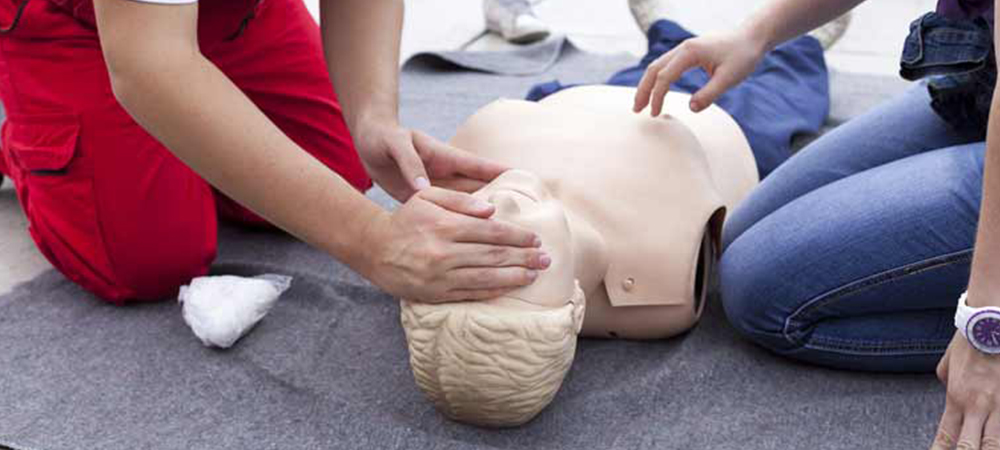
A warehouse worker collapses in cardiac arrest. The statistic that decides whether he goes home to his family isn’t how close the nearest hospital is — it’s whether someone within reach knows how to start compressions and use the AED on the wall in the first three minutes. Ambulance response in UAE cities is fast by global standards, and it is still not fast enough to be the plan.
Nathan Safety Training (NIMS) trains workplace first aiders across the UAE to a standard that holds up under Ministry of Human Resources and Emiratisation (MOHRE) inspection, Dubai Municipality and ADOSH-SF (Abu Dhabi’s occupational safety framework, formerly known as OSHAD-SF) audit, and, more importantly, under the pressure of an actual emergency. Certification is only useful if the person wearing it can still perform under stress.
Why First Aid Provision Is a Legal Obligation, Not a Nice-to-Have
Federal Decree-Law No. 33 of 2021 on the Regulation of Labour Relations, together with Cabinet Resolution No. 33 of 2022 concerning Occupational Health and Safety, requires employers across the UAE to provide adequate first aid provision proportionate to workforce size and risk profile. In Abu Dhabi, this sits inside the ADOSH-SF (formerly branded OSHAD-SF) Codes of Practice administered through the Abu Dhabi Public Health Centre. In Dubai, Dubai Municipality’s Health and Safety Department sets the standard most contractors and facility operators are actually audited against, and higher-acuity resuscitation elements typically follow curricula recognised by the Dubai Corporation for Ambulance Services (DCAS).
None of these frameworks publish a single fixed number of first aiders for every business. What they consistently require is a documented risk assessment that determines the ratio, and named, currently-certified individuals who match it — not a certificate from three years ago in a drawer. We recommend running that risk assessment before staffing your first aid provision, not after an inspector asks for it.
Three Minutes, Not Three Weeks
Survival from sudden cardiac arrest falls sharply with every minute that passes without CPR and defibrillation — well before an ambulance can realistically arrive, even in a city with fast response times. That single fact is the entire argument for this training: it exists to compress the gap between ‘someone collapsed’ and ‘someone competent is already acting’ down to seconds, not minutes.
The business case sits alongside the human one. A workplace with a documented, current first aid programme recovers faster from an incident in every sense — medically, operationally, and in how a client or insurer reads the aftermath. A workplace without one is, in the worst case, explaining to a family, a labour authority and its own insurer simultaneously why nobody was ready.
Who Sends Their People to This Course
This is the most universally required course on our schedule, which is exactly why it needs to be genuinely well taught rather than a box-ticking afternoon. The sectors we see most often:
- Construction and industrial sites, where trauma risk (falls, crush injuries, lacerations) dominates the case mix
- Hotels, resorts and F&B operations, where choking, burns and cardiac events are the realistic scenarios staff will face
- Event management and exhibition companies, staffing large, temporary crowds with no fixed medical infrastructure
- Theme parks, waterparks and attractions, where paediatric first aid and heat-related illness both come up constantly
- Warehousing, logistics and manufacturing, where machinery injuries and confined, sometimes remote work areas raise the stakes of response time
- Schools, nurseries and family entertainment centres, where paediatric-specific technique is not optional
- Offices and corporate facilities, still legally obligated even though the risk profile is lower
Delivered in All Seven Emirates
The right first aid mix shifts by emirate, because the workforce and the risk profile shift with it. We deliver onsite across all seven:
- Dubai — the highest concentration of hotels and F&B outlets in the UAE alongside a dense industrial base in Jebel Ali and Dubai Investment Park, so we regularly run hospitality-focused and occupational-level batches side by side, often for the same client group
- Abu Dhabi — Mussafah and ICAD’s industrial workforce needs occupational first aid depth, while Yas Island’s attraction and hospitality staff need the paediatric-aware track more than a standard industrial site would
- Sharjah — Industrial Areas 1 to 18 hold the densest concentration of small manufacturing teams in the UAE, where a lean, correctly-sized first aider ratio matters more than at a large single-site employer
- Ajman — the Free Zone’s growing furniture and wood manufacturing base carries laceration and machinery injury risk that’s easy to under-train for if a generic office-level course is used instead of occupational level
- Ras Al Khaimah — RAK Ceramics and the quarrying and cement operations around Al Hamra bring a genuinely higher trauma-risk profile than most training providers plan for outside Dubai and Abu Dhabi
- Fujairah — the Fujairah Oil Industry Zone’s remote-site distances mean ambulance response time is longer than in the denser western emirates, which raises the value of a well-staffed, well-drilled first aid team
- Umm Al Quwain — a smaller industrial footprint, but UAQ Free Trade Zone manufacturers and attractions like Dreamland Aqua Park still carry the same MOHRE first aid provision obligation as anywhere else in the country
Course Levels at a Glance
Course | Typical Duration | Certificate Validity | Best Suited To |
Emergency First Aid at Work | 1 day | 2 years | Low-risk offices, retail, small teams |
Occupational First Aid (First Aider) | 2–3 days | 2–3 years | Construction, industrial, warehousing |
CPR & AED Standalone | Half day | 1–2 years | Refresher / AED-only sites, lifeguard and hospitality teams |
Paediatric First Aid | 1 day | 2 years | Nurseries, schools, waterparks, family entertainment |
The Gaps We Find Before an Inspector Does
We’ve audited enough sites to see the same gaps recur, and almost none of them are about the training content itself.
- AED pads and batteries past their expiry date, discovered only when the unit is needed
- First aid kits stocked at induction and never restocked after the first real use
- All certified first aiders scheduled on the day shift, with nobody covering nights or weekends
- Certificates that lapsed eight months ago because renewal wasn’t tracked against an actual register
- Staff trained on adult CPR only, deployed in a family attraction with a paediatric-heavy visitor base
- A first aid room that exists on the site plan but has been repurposed as storage
What You Actually Get With Nathan Safety Training (NIMS)
This is also where the group behind NIMS earns its keep: Nathan Safety Training operates alongside Nathan ISO Consulting and hsemanpower.ae, so a client can move from certified first aiders today to a fully documented ISO 45001 occupational health programme later, without switching providers or re-explaining the site from scratch.
- Instructors with active clinical or emergency-response backgrounds, not just a training certificate
- Courses delivered in English, Arabic, Hindi and Urdu to match real UAE site workforces
- Onsite delivery across Dubai, Abu Dhabi, Sharjah and the Northern Emirates, scheduled around shift patterns
- AED units and manikins used in training are the same models common on UAE sites, not generic imports
- A certificate tracking service so you know exactly who lapses and when, instead of finding out at audit
FAQ
Is workplace first aid training legally required in the UAE?
Yes, in substance. Federal Decree-Law No. 33 of 2021 and Cabinet Resolution No. 33 of 2022 require employers to provide first aid provision proportionate to workforce size and risk. Neither law names an exact headcount ratio; that’s determined through a documented risk assessment, which is itself something inspectors ask to see.
How many certified first aiders do we need per employee?
There is no single fixed ratio across the UAE. Abu Dhabi’s ADOSH-SF framework and Dubai Municipality both expect the ratio to come from a documented site risk assessment reflecting headcount, shift pattern and hazard level, not a generic rule of thumb. A construction site and an office of the same size will not need the same number.
How long does a First Aid or CPR/AED certificate stay valid?
Most workplace first aid certifications in the UAE are valid for two years, with CPR/AED-only refreshers sometimes set at one year given how quickly resuscitation skills decay without practice. We track your team’s expiry dates and flag renewals before they lapse.
What's the difference between Emergency First Aid at Work and Occupational First Aid?
Emergency First Aid at Work is a one-day course covering core life-saving skills, suited to lower-risk environments like offices and retail. Occupational First Aid runs two to three days and adds trauma management, spinal awareness and extended casualty care, and is what most construction and industrial sites are expected to provide.
Do you deliver training onsite, or only in a classroom?
Both. Most industrial and hospitality clients prefer onsite delivery scheduled around shift changes, using their own AED units and first aid room so staff train on the equipment they’ll actually use. We also run scheduled open classroom sessions in Dubai and Abu Dhabi for smaller teams.
Is AED training included, or is it a separate course?
AED use is built into every first aid course we run, since UAE guidance treats defibrillation as part of core resuscitation rather than an optional add-on. We also offer a standalone half-day CPR & AED refresher for sites that already have first aid coverage but need to keep AED competency current.
Which clinical guidelines does the course follow?
Our resuscitation technique follows internationally recognised guidelines consistent with those referenced by Dubai’s ambulance and emergency medical authorities, updated whenever those bodies issue revisions. We do not teach outdated compression ratios or superseded technique just because a manikin still supports it.
Will this certificate be accepted by ADOSH-SF and Dubai Municipality auditors?
Yes. Our course structure and instructor qualifications are built against the documentation both frameworks expect to see during an OHS audit or prequalification review. We provide the supporting instructor and curriculum evidence your HSE team can hand directly to an assessor.
Do you cover paediatric first aid separately?
Yes, as its own course. Adult CPR technique and equipment sizing are meaningfully different for infants and children, which matters directly for schools, nurseries, waterparks and family entertainment venues with young visitors on site.
Can first aid training be combined with fire warden or fire safety training?
Frequently, yes, and many clients schedule them back to back since the same staff are often nominated for both roles. Combining them on one site visit also reduces total downtime versus running them as separate bookings.
What happens if a trained employee performs first aid and something goes wrong?
UAE law does not leave a certified first aider personally exposed for acting in good faith within the scope of their training during a genuine emergency. Proper documentation of the training itself — what was taught, by whom, and when — is part of what protects both the individual and the employer if the response is ever reviewed.
Do you deliver first aid training in Ajman, Ras Al Khaimah and Umm Al Quwain, or only Dubai and Abu Dhabi?
All seven emirates, onsite. Ajman, RAK, Fujairah and Umm Al Quwain get the same course depth and certification as Dubai and Abu Dhabi — we simply travel to your site rather than requiring smaller-emirate clients to bring staff to a classroom in Dubai.
Is this the same as a Basic Life Support (BLS) course?
Overlapping but not identical. BLS usually refers specifically to CPR and airway management, often aimed at healthcare-adjacent roles, while our workplace First Aid, CPR & AED course adds wound care, fractures, burns and general workplace trauma response on top of the same core resuscitation skills. Ask us which is the right fit if you’re specifically after a BLS-only certificate.
Get Your Team Certified
Whether your team needs occupational first aid, a CPR refresher, or AED-only certification, tell us your headcount, shift pattern and site type, and we’ll recommend the right mix of course levels rather than selling you a one-size course that under- or over-trains your team.
Nathan Safety Training (NIMS) — First Aid, CPR & AED training delivered across Dubai, Abu Dhabi, Sharjah, Ajman, Ras Al Khaimah, Fujairah and Umm Al Quwain.