

Home / Rope Access Training
Rope Access Training
IRATA-Aligned Rope Access Training for the UAE's Tallest Buildings
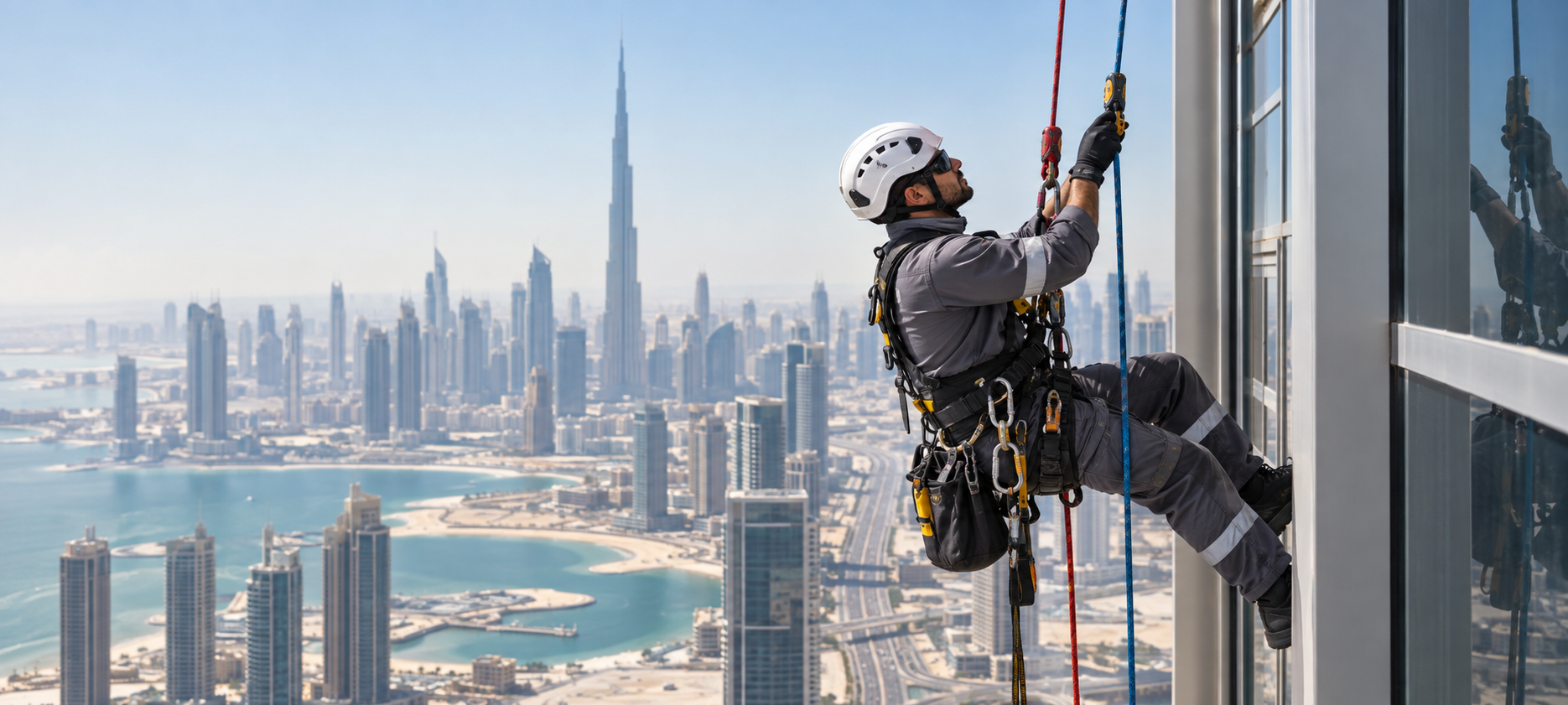
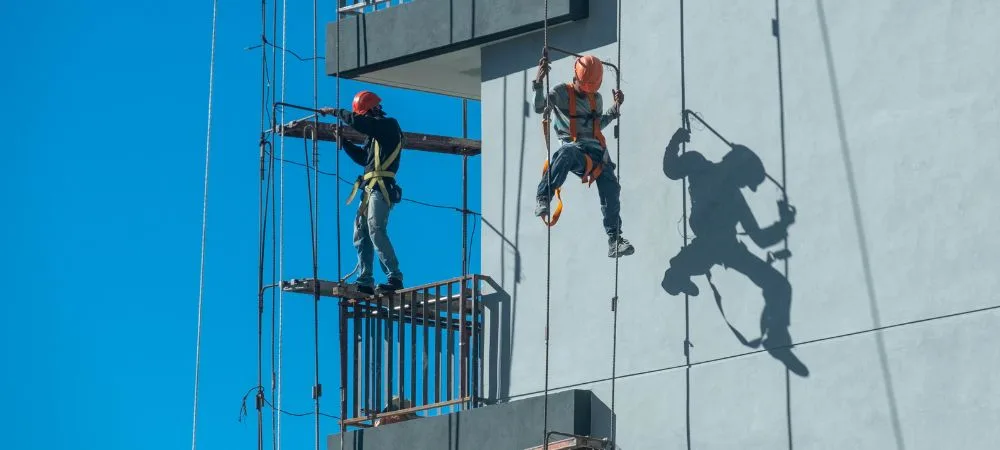
Some facades in Dubai and Abu Dhabi simply don’t have a MEWP that reaches them, and scaffolding the full height of a supertall tower for a routine glass clean or inspection isn’t realistic either. Rope access exists for exactly that gap — two independent rope systems, a technician trained to move and work suspended between them, reaching points nothing else on a UAE construction or maintenance site can reach economically.
Nathan Safety Training (NIMS) trains rope access technicians and supervisors to the industry-standard three-level competency structure used across the UAE’s high-rise and industrial access sector, building the redundancy discipline that makes two ropes genuinely safer than one — provided both are used correctly, every time.
The Standard Behind This Discipline
Rope access as a discipline is built around a globally recognised three-level competency structure — most widely known through IRATA, the international rope access trade association whose framework UAE high-rise and industrial access companies commonly reference as the industry benchmark, particularly given Dubai’s concentration of some of the tallest and most architecturally complex buildings in the world. UAE working-at-height obligations under Dubai Municipality and ADOSH-SF apply to rope access the same way they apply to scaffolding or MEWP work — documented risk assessment, rescue planning and competent supervision are not optional extras.
The core safety principle is redundancy: a working line and a separate, independently anchored backup line, so a failure in one system doesn’t leave the technician with nothing. That principle only holds if every anchor point, every connection and every technician’s understanding of it is correct — which is what separates trained rope access work from someone improvising with a harness and a rope.
If a specific client or project explicitly requires IRATA-badged certification rather than equivalent competency, tell us in advance — we’ll advise on the right pathway, since IRATA operates as a formal membership and assessment scheme with its own specific certification process.
What Makes This Different From a Fall Off a Ladder
Rope access incidents are rare relative to the sheer number of hours technicians spend suspended at height — which is exactly the record the discipline depends on to remain viable as an access method at all. A serious incident doesn’t just affect the individual; it tends to trigger a wider review of every rope access contract on a project or in an emirate, given how visible and reputationally sensitive suspended work at height is.
For clients, the commercial stake is direct: rope access is frequently the only economically viable access method for supertall facade work, and a poorly-run programme risks that access method being restricted or banned on a project entirely, forcing a far more expensive alternative like full-height scaffolding or extended MEWP hire.
Who This Course Is For
Rope access serves a narrower but highly specialised set of roles compared to our other working-at-height courses.
- Facade maintenance and glass cleaning technicians on high-rise commercial and residential towers
- Building inspection and survey teams assessing cladding, sealant or structural condition at height
- Oil & gas and offshore platform maintenance crews accessing structures a MEWP or scaffold can’t reach
- Telecom tower technicians performing installation or maintenance work
- Wind and solar asset maintenance teams accessing turbine or structural components
Where We Deliver This Training
Demand concentrates wherever tall buildings or inaccessible industrial structures exist. We deliver onsite and at partner facilities across all seven:
- Dubai — the UAE’s highest concentration of supertall and high-rise towers drives by far the largest rope access demand in the country, particularly for ongoing facade maintenance contracts
- Abu Dhabi — a mix of high-rise commercial towers and ADNOC group offshore and onshore platform access work, a genuinely different risk environment from a glass facade
- Sharjah — lower-rise building stock overall, with rope access demand concentrated more around industrial structures than commercial towers
- Ajman — a smaller but growing base of mid-rise residential towers beginning to require facade access programmes
- Ras Al Khaimah — industrial and quarrying structure access work around Al Hamra, distinct from the facade-maintenance-driven demand seen in Dubai
- Fujairah — FOIZ terminal structure access and inspection work, where rope access often reaches tank and pipeline infrastructure other methods can’t
- Umm Al Quwain — limited current demand, but growing alongside the emirate’s industrial base
Competency Levels
Level | Role | Typical Progression |
Level 1 | Rope Access Technician — works under Level 3 supervision | Entry point, minimum logged hours before Level 2 |
Level 2 | Rope Access Technician — handles more complex rigging and rescue scenarios | Requires logged Level 1 hours and reassessment |
Level 3 | Rope Access Supervisor — responsible for rigging, rescue planning and site safety | Requires extensive logged hours across both prior levels |
Where Rope Access Programmes Actually Go Wrong
The discipline’s safety record depends entirely on the redundancy principle being followed without exception — which is also exactly where shortcuts creep in on a time-pressured job.
If I had to flag one thing to check first on any site audit, it’s whether the backup line is truly independently anchored, or just clipped to the same anchor point as the working line for convenience.
- Backup line anchored to the same point as the working line, defeating the entire redundancy principle
- A Level 1 technician working without Level 3 supervision actually present on site, not just nominally assigned
- Rescue plans that exist on paper but have never been physically rehearsed by the team that would execute them
- Equipment inspection records that don’t match the equipment actually in use that day
- Weather and wind limits ignored under schedule pressure, particularly on exposed high-rise facades
What Sets Our Rope Access Training Apart
We built this course around the redundancy principle as the single non-negotiable, because everything else in rope access safety is downstream of whether that principle is actually followed under time pressure.
hsemanpower.ae, part of the same group, can supply additional certified rope access technicians for a defined facade or inspection programme where a client needs capacity as well as training.
- Instructors with direct high-rise and industrial rope access field experience, not classroom-only backgrounds
- Rescue scenario practice built into every level, not treated as a theoretical add-on
- Equipment inspection discipline taught to the standard your site auditor and insurer will actually check
- Logged-hours tracking support to help technicians progress cleanly from Level 1 through to Level 3
- Assessment conducted on representative structures, not only a training tower unrelated to real site conditions
Courses Offered
- First Aid Course - CPR and AED
- Confined Space
- Fire Safety Awareness
- Scaffolding Inspection
- Scaffolding Erection & Dismantling
- Flagman Safety
- Chemical Safety and Handling Training
- Hazard and Risk Assessment
- Rigging and Slinging Training
- Traffic Safety
- Hand and Power Tools Operator
- Electrical Safety
- Lock Out and Tag Out (LOTO)
- Accident Incident Investigation
- Lifeguard Training
- Advanced Risk Assessment & Compliance Service
- Behavior-Based Safety Workplace Safety Consulting
- Construction Site Safety Induction Training
- Emergency Response Team Training
- Excavator Operator Training
- Forklift Operator Training
- H2S Awareness & Breathing Apparatus Training
- Hot Work Safety Training
- Incident Reporting & Root Cause Analysis Service
- MEWP Operator Training
- Mobile Crane Operator Training
- Permit to Work System Training
- Rope Access Training
- Working at Height & Fall Protection Safety Training
- Oil & Gas Safety Training
- Fire Warden Training
- Manual Handling Training
- Banksman Safety Training
- Gas Tester Training
- Defensive Driving Training
- HAZMAT Awareness Training
- Machine Safety and Machine Guarding Training
- Spill Response and Spill Control Training
- Welding Safety Training
Need expert advice? Speak to our team today
FAQ
Is this the same as IRATA certification?
A structured system where trained peer observers watch for specific safe and at-risk behaviours during normal work, log what they see without assigning blame, and feed that data back as coaching conversations and trend reports — rather than relying only on procedures, PPE rules and after-the-fact incident investigation.
What's the difference between rope access and our Fall Protection course?
Fall Protection covers general working-at-height principles — harness use, anchor points, arrest systems — that apply broadly across scaffolding, MEWP and general height work. Rope access is a specific access method using suspended dual-rope systems to reach places those other methods can’t, and requires its own dedicated, more extensive certification.
How long does it take to progress from Level 1 to Level 3?
Progression requires logged working hours at each level before reassessment to the next, not just elapsed time — typically at least a year of active field hours between levels, though this varies by individual workload and project availability.
Can a Level 1 technician work unsupervised?
No — Level 1 technicians work under the direct supervision of a Level 3 supervisor, who must be genuinely present and available on site, not simply nominated on paper.
Is rope access safer than scaffolding or a MEWP for facade work?
Each method suits different structures and circumstances rather than one being universally safer. Rope access is often the only economically viable option for supertall or complex facades a MEWP can’t reach and full-height scaffolding can’t justify, provided the redundancy discipline is followed correctly.
Do you train on rescue procedures, or only ascending and descending?
Rescue scenario training is built into every level of this course, since the ability to retrieve a suspended, incapacitated technician quickly is one of the most safety-critical skills in the entire discipline, not an optional extra.
Is this course relevant to oil & gas platform work, not just building facades?
Yes — rope access is widely used on offshore and onshore platforms to reach structures that scaffolding or MEWP access can’t economically justify, and the core competency structure applies whether the structure is a tower or a platform.
How often does equipment need to be inspected?
Before every use at minimum, plus a periodic thorough inspection on a defined schedule — rope access equipment carries the same non-negotiable inspection discipline as any other life-safety system, and mismatched records between what’s inspected and what’s in use is a common audit finding.
Do you provide this training onsite, or only at a fixed facility?
We deliver both, depending on what representative structures are needed for assessment — some sessions run at partner training facilities with purpose-built rigging points, others directly on a client’s actual structure where appropriate.
Is rope access training relevant to wind turbine or solar asset maintenance?
Yes, and it’s a growing area of demand — turbine and large-scale solar structures often require access to points that conventional platforms can’t reach efficiently, and the same core rope access competencies apply.
Do you deliver this training across all seven emirates?
Yes, though demand is heavily concentrated in Dubai given its high-rise density; we also deliver for industrial and offshore-adjacent structure access work in Abu Dhabi, Fujairah and Ras Al Khaimah.
How long does Level 3 Supervisor training take?
Beyond the logged-hours progression requirement from Levels 1 and 2, the Level 3 assessment itself typically runs three to four days, covering rigging, rescue planning and site safety supervision responsibilities in depth.
- First Aid Course - CPR and AED
- Confined Space
- Fire Safety Awareness
- Scaffolding Inspection
- Scaffolding Erection & Dismantling
- Flagman Safety
- Chemical Safety and Handling Training
- Hazard and Risk Assessment
- Rigging and Slinging Training
- Traffic Safety
- Hand and Power Tools Operator
- Electrical Safety
- Lock Out and Tag Out (LOTO)
- Accident Incident Investigation
- Lifeguard Training
- Advanced Risk Assessment & Compliance Service
- Behavior-Based Safety Workplace Safety Consulting
- Construction Site Safety Induction Training
- Emergency Response Team Training
- Excavator Operator Training
- Forklift Operator Training
- H2S Awareness & Breathing Apparatus Training
- Hot Work Safety Training
- Incident Reporting & Root Cause Analysis Service
- MEWP Operator Training
- Mobile Crane Operator Training
- Permit to Work System Training
- Rope Access Training
- Working at Height & Fall Protection Safety Training
IRATA-Aligned Rope Access Training for the UAE's Tallest Buildings
Some facades in Dubai and Abu Dhabi simply don’t have a MEWP that reaches them, and scaffolding the full height of a supertall tower for a routine glass clean or inspection isn’t realistic either. Rope access exists for exactly that gap — two independent rope systems, a technician trained to move and work suspended between them, reaching points nothing else on a UAE construction or maintenance site can reach economically.
Nathan Safety Training (NIMS) trains rope access technicians and supervisors to the industry-standard three-level competency structure used across the UAE’s high-rise and industrial access sector, building the redundancy discipline that makes two ropes genuinely safer than one — provided both are used correctly, every time.
The Standard Behind This Discipline
Rope access as a discipline is built around a globally recognised three-level competency structure — most widely known through IRATA, the international rope access trade association whose framework UAE high-rise and industrial access companies commonly reference as the industry benchmark, particularly given Dubai’s concentration of some of the tallest and most architecturally complex buildings in the world. UAE working-at-height obligations under Dubai Municipality and ADOSH-SF apply to rope access the same way they apply to scaffolding or MEWP work — documented risk assessment, rescue planning and competent supervision are not optional extras.
The core safety principle is redundancy: a working line and a separate, independently anchored backup line, so a failure in one system doesn’t leave the technician with nothing. That principle only holds if every anchor point, every connection and every technician’s understanding of it is correct — which is what separates trained rope access work from someone improvising with a harness and a rope.
If a specific client or project explicitly requires IRATA-badged certification rather than equivalent competency, tell us in advance — we’ll advise on the right pathway, since IRATA operates as a formal membership and assessment scheme with its own specific certification process.
What Makes This Different From a Fall Off a Ladder
Rope access incidents are rare relative to the sheer number of hours technicians spend suspended at height — which is exactly the record the discipline depends on to remain viable as an access method at all. A serious incident doesn’t just affect the individual; it tends to trigger a wider review of every rope access contract on a project or in an emirate, given how visible and reputationally sensitive suspended work at height is.
For clients, the commercial stake is direct: rope access is frequently the only economically viable access method for supertall facade work, and a poorly-run programme risks that access method being restricted or banned on a project entirely, forcing a far more expensive alternative like full-height scaffolding or extended MEWP hire.
Who This Course Is For
Rope access serves a narrower but highly specialised set of roles compared to our other working-at-height courses.
- Facade maintenance and glass cleaning technicians on high-rise commercial and residential towers
- Building inspection and survey teams assessing cladding, sealant or structural condition at height
- Oil & gas and offshore platform maintenance crews accessing structures a MEWP or scaffold can’t reach
- Telecom tower technicians performing installation or maintenance work
- Wind and solar asset maintenance teams accessing turbine or structural components
Where We Deliver This Training
Demand concentrates wherever tall buildings or inaccessible industrial structures exist. We deliver onsite and at partner facilities across all seven:
- Dubai — the UAE’s highest concentration of supertall and high-rise towers drives by far the largest rope access demand in the country, particularly for ongoing facade maintenance contracts
- Abu Dhabi — a mix of high-rise commercial towers and ADNOC group offshore and onshore platform access work, a genuinely different risk environment from a glass facade
- Sharjah — lower-rise building stock overall, with rope access demand concentrated more around industrial structures than commercial towers
- Ajman — a smaller but growing base of mid-rise residential towers beginning to require facade access programmes
- Ras Al Khaimah — industrial and quarrying structure access work around Al Hamra, distinct from the facade-maintenance-driven demand seen in Dubai
- Fujairah — FOIZ terminal structure access and inspection work, where rope access often reaches tank and pipeline infrastructure other methods can’t
- Umm Al Quwain — limited current demand, but growing alongside the emirate’s industrial base
Competency Levels
Level | Role | Typical Progression |
Level 1 | Rope Access Technician — works under Level 3 supervision | Entry point, minimum logged hours before Level 2 |
Level 2 | Rope Access Technician — handles more complex rigging and rescue scenarios | Requires logged Level 1 hours and reassessment |
Level 3 | Rope Access Supervisor — responsible for rigging, rescue planning and site safety | Requires extensive logged hours across both prior levels |
Where Rope Access Programmes Actually Go Wrong
The discipline’s safety record depends entirely on the redundancy principle being followed without exception — which is also exactly where shortcuts creep in on a time-pressured job.
If I had to flag one thing to check first on any site audit, it’s whether the backup line is truly independently anchored, or just clipped to the same anchor point as the working line for convenience.
- Backup line anchored to the same point as the working line, defeating the entire redundancy principle
- A Level 1 technician working without Level 3 supervision actually present on site, not just nominally assigned
- Rescue plans that exist on paper but have never been physically rehearsed by the team that would execute them
- Equipment inspection records that don’t match the equipment actually in use that day
- Weather and wind limits ignored under schedule pressure, particularly on exposed high-rise facades
What Sets Our Rope Access Training Apart
We built this course around the redundancy principle as the single non-negotiable, because everything else in rope access safety is downstream of whether that principle is actually followed under time pressure.
hsemanpower.ae, part of the same group, can supply additional certified rope access technicians for a defined facade or inspection programme where a client needs capacity as well as training.
- Instructors with direct high-rise and industrial rope access field experience, not classroom-only backgrounds
- Rescue scenario practice built into every level, not treated as a theoretical add-on
- Equipment inspection discipline taught to the standard your site auditor and insurer will actually check
- Logged-hours tracking support to help technicians progress cleanly from Level 1 through to Level 3
- Assessment conducted on representative structures, not only a training tower unrelated to real site conditions
FAQ
Is this the same as IRATA certification?
A structured system where trained peer observers watch for specific safe and at-risk behaviours during normal work, log what they see without assigning blame, and feed that data back as coaching conversations and trend reports — rather than relying only on procedures, PPE rules and after-the-fact incident investigation.
What's the difference between rope access and our Fall Protection course?
Fall Protection covers general working-at-height principles — harness use, anchor points, arrest systems — that apply broadly across scaffolding, MEWP and general height work. Rope access is a specific access method using suspended dual-rope systems to reach places those other methods can’t, and requires its own dedicated, more extensive certification.
How long does it take to progress from Level 1 to Level 3?
Progression requires logged working hours at each level before reassessment to the next, not just elapsed time — typically at least a year of active field hours between levels, though this varies by individual workload and project availability.
Can a Level 1 technician work unsupervised?
No — Level 1 technicians work under the direct supervision of a Level 3 supervisor, who must be genuinely present and available on site, not simply nominated on paper.
Is rope access safer than scaffolding or a MEWP for facade work?
Each method suits different structures and circumstances rather than one being universally safer. Rope access is often the only economically viable option for supertall or complex facades a MEWP can’t reach and full-height scaffolding can’t justify, provided the redundancy discipline is followed correctly.
Do you train on rescue procedures, or only ascending and descending?
Rescue scenario training is built into every level of this course, since the ability to retrieve a suspended, incapacitated technician quickly is one of the most safety-critical skills in the entire discipline, not an optional extra.
Is this course relevant to oil & gas platform work, not just building facades?
Yes — rope access is widely used on offshore and onshore platforms to reach structures that scaffolding or MEWP access can’t economically justify, and the core competency structure applies whether the structure is a tower or a platform.
How often does equipment need to be inspected?
Before every use at minimum, plus a periodic thorough inspection on a defined schedule — rope access equipment carries the same non-negotiable inspection discipline as any other life-safety system, and mismatched records between what’s inspected and what’s in use is a common audit finding.
Do you provide this training onsite, or only at a fixed facility?
We deliver both, depending on what representative structures are needed for assessment — some sessions run at partner training facilities with purpose-built rigging points, others directly on a client’s actual structure where appropriate.
Is rope access training relevant to wind turbine or solar asset maintenance?
Yes, and it’s a growing area of demand — turbine and large-scale solar structures often require access to points that conventional platforms can’t reach efficiently, and the same core rope access competencies apply.
Do you deliver this training across all seven emirates?
Yes, though demand is heavily concentrated in Dubai given its high-rise density; we also deliver for industrial and offshore-adjacent structure access work in Abu Dhabi, Fujairah and Ras Al Khaimah.
How long does Level 3 Supervisor training take?
Beyond the logged-hours progression requirement from Levels 1 and 2, the Level 3 assessment itself typically runs three to four days, covering rigging, rescue planning and site safety supervision responsibilities in depth.
Book Rope Access Training or Assessment
Whether you need Level 1 technicians certified from scratch or a Level 3 supervisor assessed and progressed, tell us your structure type and current technician levels, and we’ll scope the right training or reassessment.
Nathan Safety Training (NIMS) — Rope access training and assessment across Dubai, Abu Dhabi, Sharjah, Ajman, Ras Al Khaimah, Fujairah and Umm Al Quwain.